


This article was written in response to the article . I disagree with most of the author's points, and in this article, I want not only to refute them but also to present my own theses, which I will defend later in the comments. I will discuss several principles that I follow when designing a local network for any enterprise.
The first principle is reliability. An unreliable network will always end up being more expensive due to maintenance costs, losses during downtime, and losses from external interference. Based on this principle, I always design the main network as wired, and if necessary, an additional wireless network (guest network or network for mobile terminals). Why is a wireless network less reliable? Any wireless network has a series of security, stability, and compatibility issues. Too many risks for a serious company.
Reliability also defines the network structure. The ‘Star’ topology is the ideal to strive for. The ‘Star’ reduces the necessary number of switches, the number of vulnerable trunk lines, and simplifies maintenance. It is much easier to troubleshoot a single switch than several scattered across offices, as suggested by the author of the aforementioned article. No wonder the phrase ‘switch zoo’ is in common use.
But in practice, it often becomes necessary to use either the ‘fractal star’ topology or a ‘mixed topology’. This is due to distance limitations from the switching equipment to the workstation. That's why I believe that optical networks will eventually completely replace twisted pair cables.
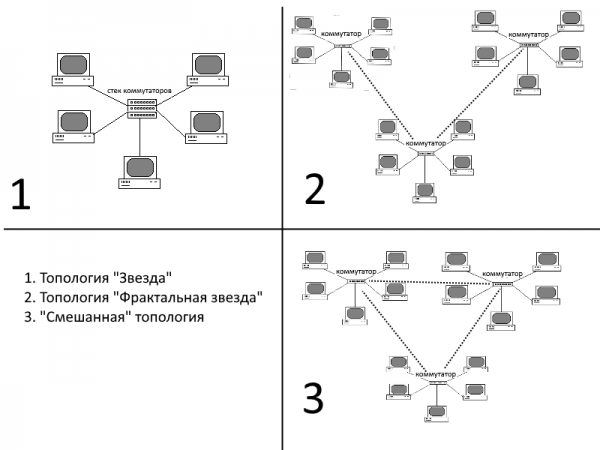
If it's not possible to place all switches in one location, then using a mixed topology is preferable, as all trunk lines will take different paths, minimizing the likelihood of multiple trunk lines being damaged simultaneously.
Speaking of trunks. Switches connected by trunk lines should always have a backup channel, so in the event of a line failure, communication between nodes will remain intact, and no connection will be lost. You can take your time to replace the damaged cable. Therefore, for trunks, even over short distances, it's possible to use a faster and thinner optical patch cord.
The second principle of structured cabling systems is rationality and practicality. It is precisely rationality that prevents the use of "modern" optics for connecting workstations and other network devices. As correctly noted by the author of the aforementioned article — everything currently operates over twisted pair. This is very practical. However, not much can still work over optical channels without additional devices. Each additional device not only brings vulnerability but also incurs extra costs. Yet, this is the future. Sooner or later, when almost every device will have a built-in optical port, optics will completely replace twisted pairs.
Rationality and practicality can also be reflected in the number of RJ45 sockets at the workplace. It's practical to use two sockets per workstation. The second line can be used, for example, to connect an analog (digital) phone or simply serve as a backup. This is how structured cabling systems are usually designed for large companies. For small and medium-sized businesses, it is more rational to use one computer socket per workstation, as IP phones generally have two ports — one for the incoming link and the second for connecting a computer. It’s always advisable to design a separate workstation for network printers, placing them conveniently for all users, for example, in hallways. Deciding what is more important — rationality or practicality — should be left to a qualified IT professional, as we all know what management usually chooses.
There is one more important point that I would relate to rationality and practicality. This is reasonable redundancy. It makes more sense to have as many workspaces in the offices as there are employees who can fit there, rather than just those who are currently working. Again, a competent employee must decide this, one who understands the company's financial capabilities and knows that in the case of new demands, the issue of insufficient spaces will need to be resolved by them.
Of course, the choice of equipment and materials can also be attributed to the principle of rationality and practicality. For example, if the company is small and cannot afford to have a qualified network administrator capable of working with L2 switches, it makes sense to use unmanaged switches; at the same time, backup trunks should still be in place, even if they aren't active. One should not save on materials. Using copper-clad instead of copper twisted pair means that in a couple of years you will inevitably face issues with bad connections. Refusing patch panels, factory patch cords, and organizers will lead to chaos in the cabinet over time, with constantly “dropping” links and oxidation of connectors. Additionally, one should not skimp on server cabinets. A larger size will not only allow more equipment to be housed but will also facilitate maintenance.
Don't skimp on patch cords. Good factory patch cords should be used both at workstations and in the server cabinet. If you calculate the time spent on crimping connectors and the material costs, buying a factory patch cord will end up being cheaper. Additionally, the cable will be stiff, the connectors may be of poor quality, they will oxidize much faster, and the crimping tool might not be reliable; there are many reasons not to use homemade patch cords.
In my opinion, if there is no need for the workstation to operate at 10G speeds, it is more rational to use category 5e twisted pair instead of 6, as it is not only cheaper but also thinner, more flexible, and thus easier to install.
And finally, the third principle is organization. The larger the network, the more important the order within it becomes. Outlets and patch panel ports must be numbered. Typically, numbering starts from the workstations, moving left to right from the entrance to the room. An approved layout plan should exist showing the locations and numbering of the outlets.
Patch panels are used for organization, not for physically separating networks. If the author of the 'previously mentioned' article assumes that there’s not much to connect in his rack, we cannot afford such a luxury.
That's it. These three fundamental principles define any of my structured cabling projects. In this article, I couldn’t cover everything, and I may have missed a lot—some of it might even be incorrect. I am always open to constructive discussion if I'm invited or if someone wants to engage in private correspondence.
Source: habr.com
