

I noticed this error (or, if you prefer, discrepancy) while reviewing the translation of the NETGEAR switches. The point is that when translating the term “trunk” , it is essential to consider the vendor's interpretation— Cisco or HP, as there is a very different technical meaning between them.
Let's break it down.
Let's look at the problem with the following examples:
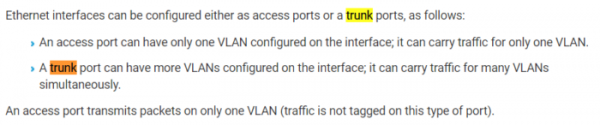
1. Cisco
2. HP
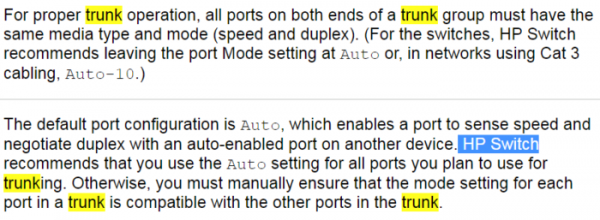
The attentive reader will notice that “trunk” in these examples it has a different meaning.
Let's delve deeper.
The Cisco
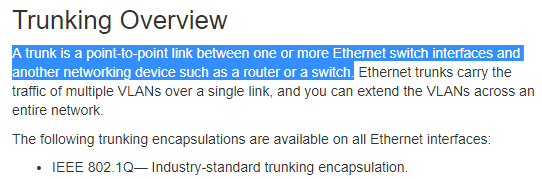
Cisco version under “trunk’ understands a point-to-point channel (a communication channel directly connecting two devices), which connects a switch and another network device, such as another switch or router. Its purpose is to carry traffic from multiple VLANs over a single channel and grant them access to the entire network. In layman's terms, it is called a “trunk”, which makes sense.
Operating principle
Let's start with what VLAN is.
VLAN stands for Virtual Local Area Network or virtual local area network. This technology allows dividing a single physical network into several logical networks that operate independently of each other. For example, within an organization, there are HR department, accounting and IT department. They have their switches, which are connected through a central switch into a single network, and it is necessary to segregate the networks of these departments from each other. This is where VLAN technology comes into play.
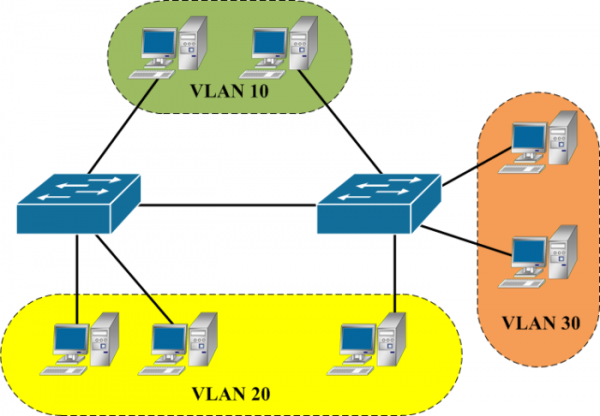
This is how a network divided into VLANs (virtual networks) looks.
Often, different colors are used to denote VLANs.
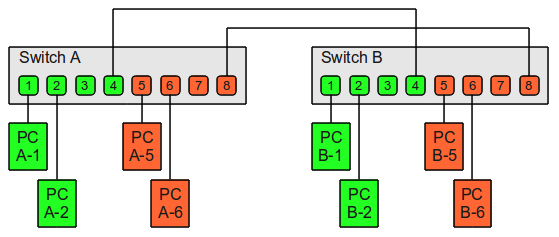
For instance, ports marked with green color belong to one VLAN, while ports marked with red color belong to another. Computers that reside in the same VLAN can interact only with each other, but cannot communicate with computers in another VLAN.
Changes in the switching table for VLANs
When creating VLANs, an additional field is added to the switching table in switches, which specifies VLAN identifiers. Simplified, it looks like this:
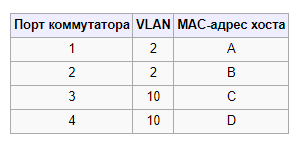
Here we see that ports 1 and 2 belong to VLAN 2, while ports 3 and 4 belong to VLAN 10.
Let's move on. At the data link layer, data is transmitted in the form of frames (frames). When transmitting frames from one switch to another, information is needed regarding which VLAN a particular frame belongs to. This information is added to the transmitted frame. Currently, an open standard is used for this purpose. IEEE 802.1Q. Step-by-step evolution of the frame in VLAN
- The computer generates and sends a regular frame (frame, also known as a data link layer packet, i.e., switch level), without adding anything. This frame looks like this:
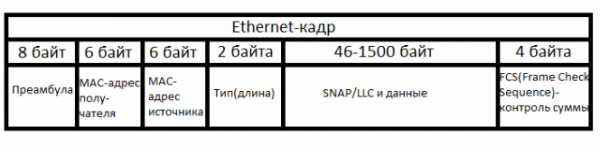
- The switch receives the frame. According to the switching table, it understands from which computer the frame arrived and to which VLAN this computer belongs. Then, the switch itself adds management information to the frame, known as the tag. The tag is a field after the sender's MAC address, which contains, broadly speaking, the VLAN number. This is how a frame with a tag looks:
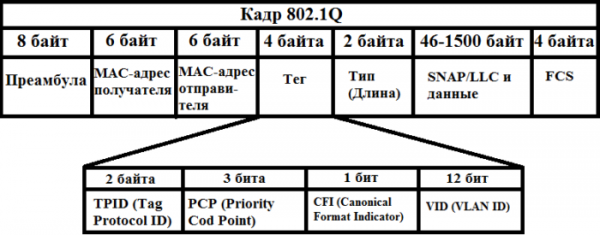
Then, the switch sends this frame to another switch.
The switch that receives the frame extracts VLAN information from it, meaning it understands to which computer this frame should be sent, removes all management information from the frame, and forwards it to the recipient computer.
The frame arrives at the recipient computer already without management information.
Now, let’s return to our “trunk’”. The ports of the switch that support VLAN can be divided into two groups:
- Tagged ports (or trunk ports at Cisco)
- Untagged ports (or access ports)
We are interested in tagged ports or trunk ports. They are precisely designed to transmit data belonging to a single port while receiving data from several VLANs on one port (we remember that usually ports from different VLANs do not see each other) In this diagram, the tagged ports are number , which connect two switches. Frames will pass through them, for example, from computer.
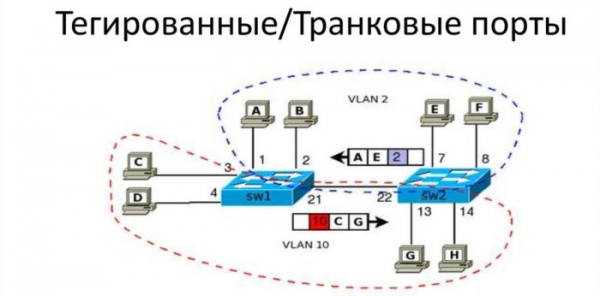
to computer 21 and 22, which are located in the same VLAN, according to the scheme described above. E So, the communication channel between these ports in Ais precisely called “
’.” Cisco How does the company interpret this term?trunkHere, in fact, there is no talk about VLAN. In the case of
Version HP
we are talking about channel aggregation technology. They have
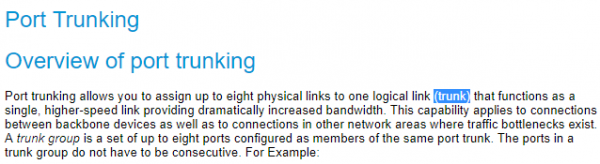
– this is HP a logical channel “trunk” , which combines multiple physical channels.that combines multiple physical channelsSuch aggregation allows for increased bandwidth and reliability of the channel. Let’s illustrate with an example. Suppose we have two switches, each with four ports connected by four wires.

If we leave everything as it is — just connections between the switches — then these connections will pass frames to one another in a loop, forming loops (and broadcast frames will be duplicated over and over again, causing the switches to enter a broadcast storm).
Such duplicate connections are considered redundant, and they need to be eliminated; for this purpose, the STP (Spanning Tree Protocol) is used. Then, out of our four connections, STP will disable three because it considers them redundant, leaving only one connection.
So, if we combine these four physical channels, there will be one logical channel between the switches with increased bandwidth (the maximum speed of data transmission over a communication channel in a unit of time). That is, all four channels are utilized, and the problem with redundant connections is resolved. This logical (aggregated) channel is referred to as HP “trunkHere, in fact, there is no talk about VLAN. In the case of

Channel aggregation can be configured between two switches or between a switch and a router. Up to eight physical channels can be combined into one logical channel. It is important that all ports included in the aggregated channel have the same parameters:
- type of transmission medium (twisted pair, fiber optic, etc.),
- speed,
- flow control mode, and duplex.
If one of the ports in the aggregated channel fails, the channel will continue to operate. The ports of the aggregated channel are perceived as a single entity, aligning with the concept of a logical channel.
To clarify further, this technology is referred to by Cisco the name EtherChannel. EtherChannel – a channel aggregation technology developed Cisco. The principle remains the same; it allows multiple physical Ethernet channels to be combined into one logical channel.

Thus, the term trunk is translated depending on the context as follows:
in documentation for switches Cisco — trunk port, tagged port, trunk port;
in documentation for switches HP — aggregated port, aggregated channel.
In case you want to delve deeper into the topic, here is a brief list of sources.
Cisco: (or like this:
HP:
VLAN:
Link aggregation:
Source: habr.com
