


The first press releases regarding the emergence of coherent CFP modules (coherent CFP optical pluggable modules) started appearing about 5-6 years ago. At that time, their use in optical multiplexing systems was a novelty and essentially represented a niche solution. Now, after six years, these modules have firmly entered the telecom world and continue to gain popularity. What types exist, how do they differ, and what solutions based on them are being offered (and of course, pictures under spoilers) — all this is below. A basic understanding of DWDM systems is required to read the article.
A Brief Excursion into the Past.
Historically, the first form factor for optical pluggable modules with a transmission speed of 100G was the CFP, which also became the first form factor for CFP-WDM solutions. At that time, there were two market solutions:
1. CFP from (now part of IPG Photonics), allowing the transmission of 4 separate channels of 28Gbps in the standard DWDM frequency grid of 50GHz using pulse modulation. It did not gain significant popularity, although it had interesting potential for building metro networks. We will not discuss such modules further in the article.
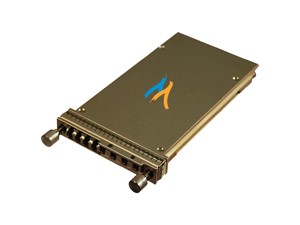
2. CFP from the pioneers – Acacia , built on the most advanced technology for coherent detection at that time using DP-QPSK modulation.
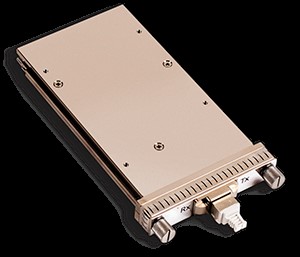
What was the breakthrough of the modules from Acacia: — it was the first industry module to offer a separate coherent channel of 50GHz 100Gbit DP-QPSK
— fully tunable in C-band
Before this, similar solutions typically looked as follows: a linear laser was an inseparable element of the board, which had only one connector for the client optical module. It looked something like this:
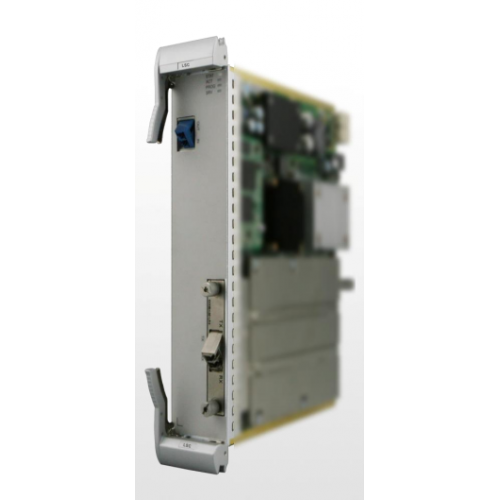
Let me remind you, that was in 2013.
Such a module replaced the classic linear DWDM interface on a traditional transponder operating in the C-band, which can be amplified, multiplexed, etc.
Now, the principles of building coherent networks have become the de facto standard in the industry, and no one is surprised by this, while the density and range of optical multiplexing systems have increased exponentially.
Module Components
The first module (Acacia) was a type of CFP-ACO. Below is a brief overview of how coherent CFP modules differ. However, first, it is necessary to take a slight off-topic and explain a bit about DSP, which is largely the heart of this technology.
A bit about the module and DSPThe module generally consists of several components
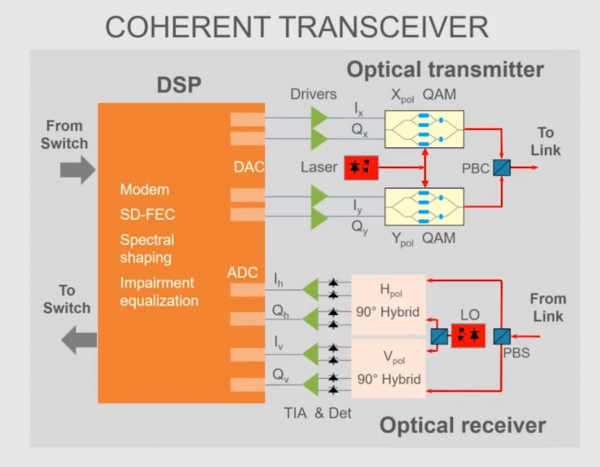
- Narrowband tunable laser
- Coherent modulator with dual polarization
- Digital to analog converter (DAC/ADC) – A DAC that converts digital signals to optical and back.
- Digital signal processor (DSP) – recovers useful information from the signal by removing the influences exerted on the useful signal during transmission. In particular:
- Compensation for chromatic dispersion (CMD). Moreover, its mathematical compensation capacity is virtually unlimited. This is remarkable because physical compensation for CMD has always caused quite a few problems, as it leads to the enhancement of nonlinear effects in fiber. You can read more about nonlinear effects online or in a
- Compensation for polarization mode dispersion (PMD). Compensation also occurs mathematically, but due to the complex nature of PMD, this is a more complicated process, and PMD is currently one of the main reasons limiting the range of optical systems (besides attenuation and nonlinear effects).
DSP operates at very high symbol rates; in the latest systems, these speeds are around 69 Gbaud.
So how do they differ?
Coherent optical modules are distinguished from each other by the placement of DSP:
- CFO-ACO – The module contains only the optical part. All the electronics are located on the equipment board (card; board) into which this module is inserted. At that time, there were simply no technologies to accommodate DSP within the optical module. Essentially, these are first-generation modules.
- CFP-DCO – In this case, the DSP is located within the optical module itself. The module is a complete 'box solution'. These are second-generation modules.
External modules have exactly the same form factor. However, they have different internals, power consumption (DCO consumes about twice as much), and heat generation. Consequently, solution manufacturers have certain flexibility — ACO provides deeper integration of solutions, while DCO allows a ready-made 'out of the box' solution, using an optical module like a Lego block to build your own solution. One separate point is that, in the overwhelming majority of cases, the operation of a pair of DSPs is only possible from the same manufacturer. This imposes certain limitations and .
Evolution of the solution
As progress does not stand still and is constantly developing new standards, the latest form factor where DSPs have been successfully placed is CFP2. In fact, I believe they are close to the next step. Here is CFP4-ACO.I accidentally stumbled upon this : But I am not aware of any commercial products using such modules yet.
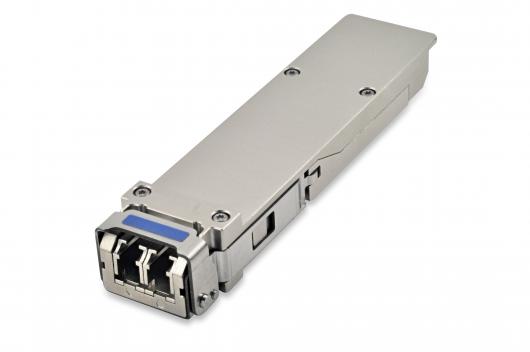
The form factor (CFP2) currently predominates in all ready-made commercial products. These connectors are what you’ve likely seen on telecom equipment, and many are confused because these connectors are much larger than the QSFP28 connectors most are accustomed to. Now you know one of the ways to use them (but it's better to additionally verify that the equipment can work with CFP2-ACO/DCO).
comparison of QSFP28 and CFP2 connectors using Juniper AXC6160 as an example.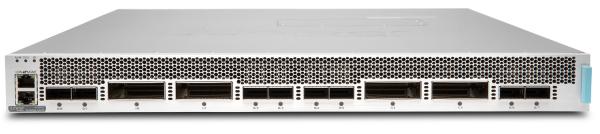
In addition to compact sizes, there are also improvements in modulation methods. All CFP2-ACO/DCO products I am aware of support not only DP-QPSK modulation but also QAM-8 / QAM-16. That's why these modules are referred to as 100G/200G. The customer can choose the modulation that suits their tasks. In the near future, modules supporting speeds up to 400G on a single optical channel should appear.
Evolution of Acacia solutions.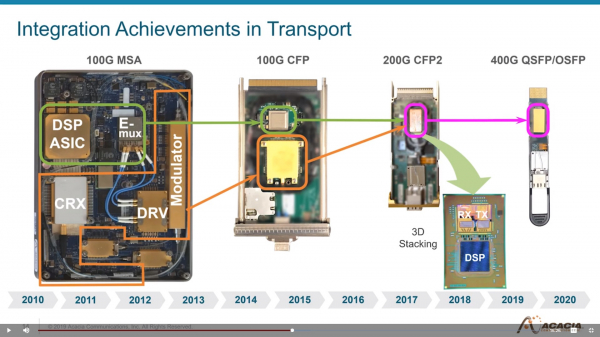
However, in the overwhelming majority of cases, classical non-modular linear interfaces are used for Ultra long haul (ULH) solutions, which allow for greater range, better OSNR, and higher modulation levels. Thus, the main area of application for coherent modules is primarily metro/regional networks. If we look at , it becomes evident that they probably have promising prospects.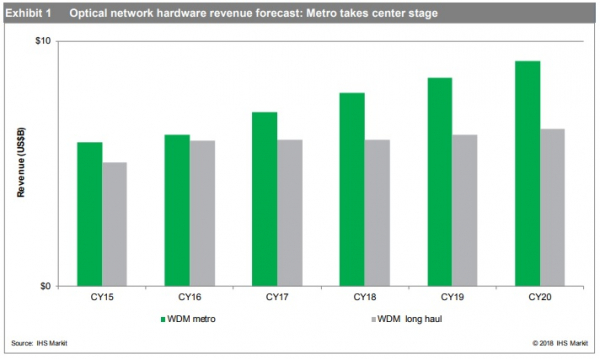
DSP manufacturers.
The global manufacturers of coherent DSP that sell them to third-party companies are:
Manufacturers of CFP2-ACO/DCO
Manufacturers of coherent ACO/DCO modules:
- CFP2-ACO; CFP2-DCO; CFP-DCO
- Oclaro (at the time of writing, acquired by Lumentum)
- CFP2-ACO and CFP2-DCO
- CFP-DCO
- CFP2-ACO; CFP4-ACO
Considering that some of these companies are in a state and acquisitions, the market for such solution providers, it seems to me, will shrink. The production of such modules is complex technological manufacturing, therefore, buying them from suppliers in the Celestial Empire will likely be quite impossible for a long time.
Impact on the industry
The emergence of such modules has led to a slight transformation of the ecosystem of solutions offered on the market.
- Firstly
Manufacturers have started to use them in classic (transponder) DWDM solutions, as ordinary linear interfaces. This brings modularity, flexibility, and cost reduction (by the way, such solutions are often chosen as Alien Wavelength). For example:
- (Juniper)
- (Infinera)
- Secondly
manufacturers already supplying telecom equipment — switches and routers, have expanded their range and added support for such modules, additionally . For example:
- Juniper (MX/QFX/ACX)
- Cisco (NCS / ASR)
- Nokia (SR)
- Arista (7500R)
- Edge-Core (Cassini AS7716-24SC)
All of the listed manufacturers already have boards for routers or switches in their equipment lines that support coherent CFP2 modules.
- Separately
it is worth mentioning interesting trends in the global community, such as the project one of its focuses is the development of . Building such networks will allow integrating equipment into management systems with open code, making interaction between manufacturers of optical systems more transparent and open. In addition, various suppliers' software is planned to be used on the devices themselves (both on transponders using DCO modules and on ROADM/EDFA), for example, ). Therefore, the trend of recent years remains the unification of the component base for solutions and the uniqueness of software developments, where a significant emphasis is placed on open source.
Thank you for your attention. I hope this article was interesting and useful to you. You can ask additional questions in the comments or personally. If you have anything to add on this topic, I would be very glad.
the main image for the article is takenFrom the site , I hope they don't mind.
Only registered users can participate in the survey. , please.
Are you interested in the topic of DWDM?
Yes, this is my work (or part of it)!
Yes, I find it interesting to read about your DWDM sometimes.
No, what am I doing here? (Travolta.gif)
3 users voted. No abstentions.
Source: habr.com
