

The "lifespan" of technology has shortened — smartphones can be replaced every year. But there are still devices that work for decades and will likely continue for many years. One such system is the Japanese FACOM 128B, commissioned in 1958.
Photo - — PD / In the photo: sequence FACOM 128B — FACOM 201A
How FACOM came to be
In the early 1950s, computers were built using vacuum tubes — they were used in the first commercial computer These components were difficult to maintain and often failed. Therefore, some companies chose a different path and began developing based on relays and switches. Among them was the Japanese corporation Fujitsu. It planned to compete with the American "».
In 1954, Toshio Ikeda, head of the computer technology department at Fujitsu, initiated the development of a new computing system. In it, the role of logical elements switching relays used in telephone exchanges. The company’s engineers used 4,500 of these relays to assemble the Two years later, an improved version of the system was introduced — and in 1959 — FACOM 128B.
Features of the computer
Fujitsu's performance was significantly lower than that of tube-based machines. For example, the IBM 701 about 60 milliseconds for addition. The FACOM 128B completed the same task 100–200 milliseconds. Multiplying two numbers took up to 350 milliseconds, and much longer for complex logarithmic operations.
The performance deficiency of the FACOM 128B was compensated by reliability and ease of maintenance. All arithmetic operations were performed in decimal, and numbers were encoded in a bi-quinary code (). Seven bits were allocated to represent a number in memory — 0 5 and 0 1 2 3 4, allowing any digit from zero to nine to be encoded by "lighting" up two bits in sequence.
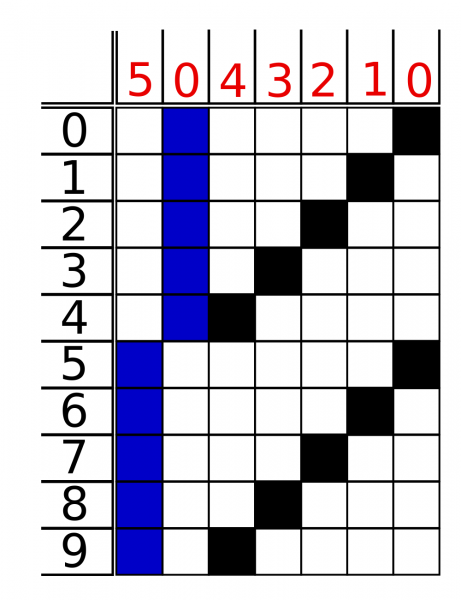
This approach the search for stuck relays. If the number of active bits was not equal to two, it was obvious that a failure occurred. Finding the faulty component afterwards was also not difficult.
The FACOM 128B computer was used until the 1970s. It was used to design special lenses for cameras and — the first passenger aircraft built by the Japanese after the end of World War II.
How is FACOM doing today?
The FACOM 128B is no longer used for any serious calculations or computations. The machine has become a fully functional museum exhibit, installed in the 'Hall of Fame' of the Fujitsu Numazu Plant in Numazu City.
The operation of the computer is monitored by a single engineer — Tadao Hamada. According to his , he will 'stay in position' for the rest of his life, as he wants to preserve Japan's technological heritage for future generations. He notes that the system's maintenance does not require significant effort. The FACOM 128B is so reliable that it only requires one relay to be replaced per year, despite daily demonstration runs.
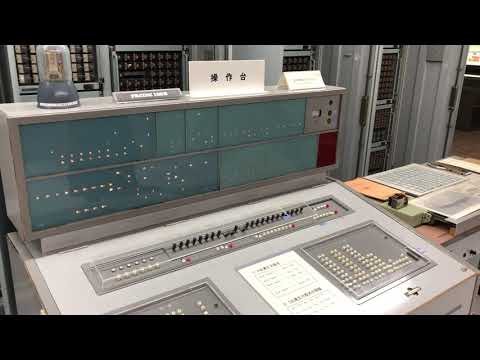
Most likely, the computer will last for many more years, even after Tadao Hamada's departure. The confidence is bolstered by the fact that last year, the National Museum of Nature and Science in Tokyo the FACOM 128B in the list of technologies of great historical significance.
Other 'long-lifers'
Another computer that has been operational since the 1950s at the American company Sparkler Filters (which supplies filtration devices). This machine is , which is an electromechanical calculator that reads information from 80-column punch cards. It is believed to be the last fully functioning IBM 402 on the planet.
Unlike the FACOM 128B, which is a display exhibit, this machine is used for accounting and financial reporting. The relevant programs for the computer are stored in the form of switching panels, where technological sockets are connected by wires that define the operation algorithm.
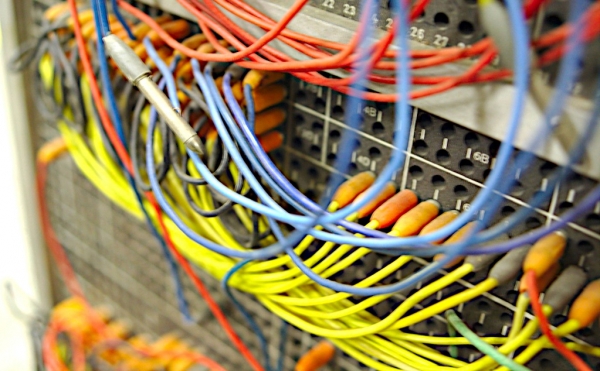
Photo - — CC BY-SA
So far, the company has no plans to transition to modern computing systems or to abandon its unique computer. However, there is a possibility that in the future, the IBM 402 will make its way into the Computer History Museum. Its representatives have previously , but at that time, the negotiations led to nothing.
Another example of a long-lasting computer is , which has been in use since 1987. at Hecla Mining, a company extracting silver and other precious metals. The computer is installed at a station in Alaska, where it assesses ore parameters and prints labels for samples. Interestingly, the same old printer is responsible for the latter. Notably, seven years ago, one of Hecla Mining's engineers mentioned in a themed post on Reddit that "there's no need for him to play the series , since he already works on a 'post-apocalyptic' PC. There is some truth to this — definitely adds to the atmosphere.
 At 1cloud.ru, we offer the service "". It is suitable for storing backups and archives, as well as for sharing corporate documents.
 The storage system on three types of drives: HDD SATA, HDD SAS, and SSD SAS with a total capacity of several thousand TB.
 All equipment in data centers DataSpace (Moscow), Xelent/SDN (St. Petersburg), and Ahost (Almaty).
What else is in our blog on Habr:
Source: habr.com
