


We depict the portrait of the modern viewer across different corners of the world. Feel the difference between the United States and Latin America in the BROADVISION analysts' report.
Who is the modern viewer? Who gathers in the evening with family and friends to watch a match or their favorite show? How well do you know your subscribers? We have collected data on audiences around the world to help you answer these questions.
In the first part of the research, we will examine the Western Hemisphere, namely: the USA and Latin America.
Viewer Preferences
As surprising as it may sound, after a long working day, a person prefers not to be stressed. Instead, they want others to make choices for them. After all, modern advertisers and service providers already have the necessary knowledge base: data on TV viewing times, preferences, work, or leisure—this is enough to understand what the subscriber needs.
It is important to note that in this dynamic world, people lack time to spend with loved ones, and they value the moments when family gathers in front of the television screen.

An experiment called 'TV Detox' demonstrated people's dependence on watching TV. Viacom Global Insights, in partnership with the research company Think, conducted this unique study. Its aim was to examine the feelings and behaviors of people who were isolated from watching TV content on any devices for several days.
Over 16,000 people aged 6 to 44 from 14 countries participated in the experiment. In the first five days, respondents were prohibited from watching almost any TV: paid, free broadcast, cable networks, video on demand, TV in channel and provider apps. Only streaming subscriptions—SVOD—were allowed.
The following five days went the other way: study participants were denied access to subscription video but were allowed to watch TV.
At the end of the experiment, viewers reported that during the five-day isolation from television, they missed the emotions and sensations that TV provides: feelings of relaxation, a sense of connection to family, shared interests, and family time, as well as the desire to stay informed and learn something new. At the same time, most noted that living without video streaming was much easier than without the ability to watch TV in the usual way.
United States
New research indicates that the average person in the United States watches TV for nearly five hours a day, which is an hour more than the average in the largest countries worldwide.
In fact, the peak of television viewing occurred in 2009-2010. At that time, the average American family spent 8 hours and 55 minutes per day in front of the television. The 2000s saw the most significant increase in TV viewing time over the decade. Over the last eight years, content sources like Facebook, YouTube, Netflix, and others have only reduced TV viewing time by an hour. However, the American family still spends more than 7 hours and 50 minutes a day near the television.
Contrary to expert predictions, 'cord-cutting'—that is, canceling traditional paid TV subscriptions in favor of on-demand streaming services—has not yet become a widespread phenomenon in the United States.
Although there has been a decline of over three million subscribers since the second quarter of 2009, this is by no means the widespread trend that many anticipated after Netflix, Amazon Prime, and other online services reached their peak.
While the growth of online video has certainly complicated things for cable TV providers, most consumers do not seem to plan on giving up their paid TV subscriptions just yet.
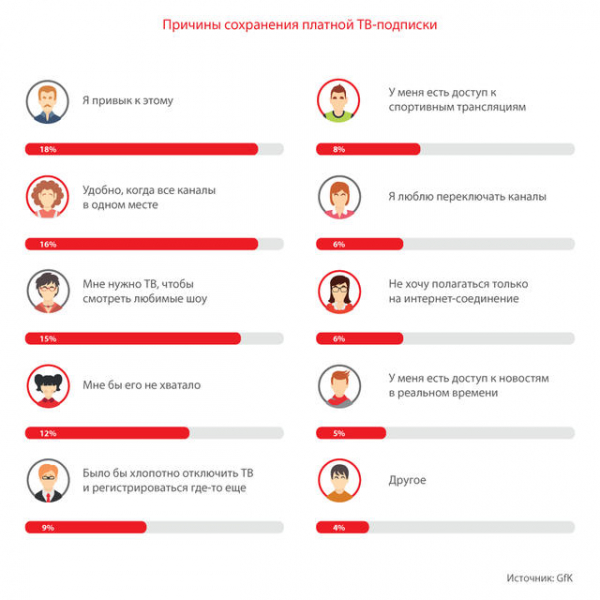
71% of consumers in the U.S. watch cable or satellite TV and do not plan to give it up. When asked about the main reason for 'not cutting the cord,' 18% of respondents said they simply got used to it, while 16% pointed to the convenience of watching many channels in one place.
Latin America
As part of a large-scale TGI Latin study, respondents were asked if they plan to watch TV. 32.6% answered that it is part of their daily schedule. This should be seen as a remarkable phenomenon, where one third of the population schedules their lives around television programs.
The survey results help to better understand viewers and their preferences. For instance, in every age group, women show a higher inclination towards TV. Among men, the highest commitment is observed in teenagers. Interestingly, the highest rates pertain to the very young and the oldest groups.

The following chart shows the socio-economic indicators for quality of life.
Highest — A = 10%,
Lowest — D = 40%.
It can be concluded that the overall level of television viewing decreases as the socio-economic level rises. While television is the primary form of entertainment for the lower class, it is less significant for the upper social strata.
TV viewing time is directly related to the standard of living in a country. Mexico has the lowest rate. Nonetheless, Mexico is the largest exporter of Spanish-language programs for all of Latin America.
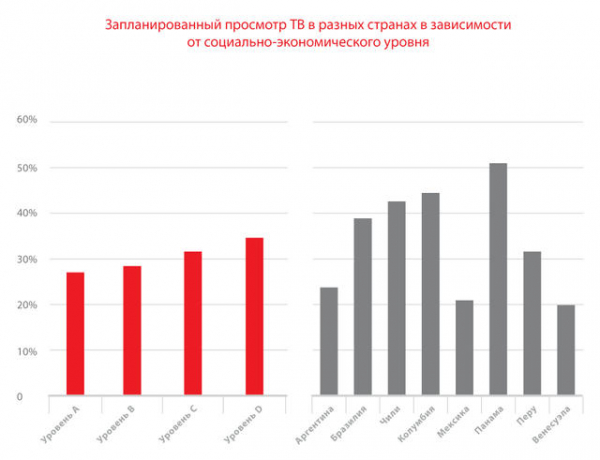
The conclusions from the study indicate what types of video content will be more relevant in each country. For example, those who are more inclined to watch TV on a schedule are more likely to follow the developments of series, talk shows, and religious programs.
Television in Brazil

Brazilians spend more than five hours a day in front of the TV.
In Brazil, having a television signifies social engagement. It is the most popular content source in the country: at least one TV is present in 95% of Brazilian households. Brazilians directly associate TV with status: the larger and more advanced the television, the wealthier the family.
Brazilians eagerly watch virtually any content: from football to soap operas, which men watch just as avidly as women, and see nothing wrong with it.
Output

Television has long been an important part of our lives. However, people consume content in different ways. The older generation rarely gets distracted and seldom switches channels. Men tend to be spontaneous, while women often plan their leisure time in advance. Yet, there are no groups that completely avoid watching TV—it's present everywhere in one form or another.
Viewers don't always need a choice. In front of the television, people want to relax, unwind, and spend time with family. Therefore, the significance of TV in the life of a modern person is hard to overstate, despite the differences in generations and mentalities.
Source: habr.com
