

One of the main objectives for businesses is growth and development. In today's reality, increasing the number of production premises, as well as the emergence of new employees and contractors, implies a constant increase in load on the enterprise's IT infrastructure. That is why, when implementing any solution, an IT manager needs to consider its scalability. The ability to handle larger workloads by adding significant computing demands is especially critical for ISPs. Let’s take a look at the scaling options offered by the Zimbra Collaboration Suite, a product used by various SaaS providers around the world.

Scalability comes in two types: vertical and horizontal. In the first case, performance gain is achieved by adding computational and other resources to existing nodes in the IT infrastructure, while in the second case, performance is increased by adding new computing nodes that take on part of the load. The Zimbra Collaboration Suite supports both horizontal and vertical scaling.
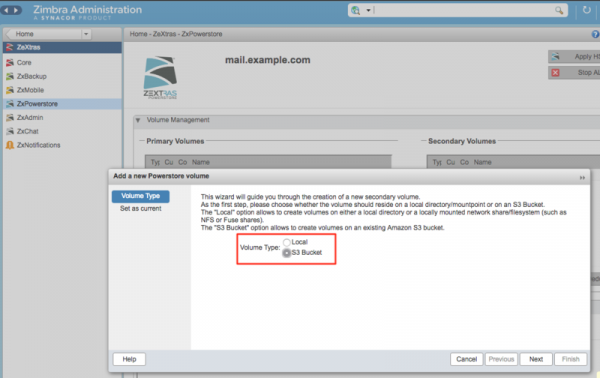
Vertical scaling, in the case that you decide to add computing power to your server, will not differ much from migrating to a new, more powerful server with Zimbra. However, if you decide to add secondary storage for email to the server, you will certainly encounter limitations imposed by Zimbra Open-Source Edition. The fact is that in the free version of Zimbra, secondary volumes for storing email cannot be attached. The extension Zextras PowerStore aims to address this issue for users of the free Zimbra edition, allowing physical and cloud S3 secondary storage to be attached to the server. Additionally, PowerStore includes algorithms for data compression and deduplication in Zimbra, which can enhance the efficiency of data storage on existing media.
The creation of secondary volumes is especially in demand among ISPs that use fast but expensive SSDs as primary storage and slower, cheaper HDDs for secondary storage. By utilizing transparent links stored on SSDs, the system continues to operate fairly swiftly, and with compression and deduplication, each server can store significantly more emails. As a result, economic efficiency servers with secondary storage and Zextras PowerStore is significantly higher than when using the standard functionality of Zimbra OSE.
Horizontal scaling can only be used in a multi-server infrastructure by definition. Since, in a multi-server installation, all Zimbra modules are distributed across different machines, the administrator has the ability to practically infinitely add new LDAP replicas, MTA, and proxy servers, as well as mail storage.
The process of adding new nodes repeats the process described on multi-server installation of Zimbra. It's enough to simply install the necessary Zimbra modules on the server, specify the Master LDAP address, and input the authentication data. After that, the new nodes will become part of the Zimbra infrastructure, and Zimbra Proxy will ensure the load balancing among servers. Meanwhile, all previously created mailboxes and their contents remain on the storage where they were located before.
Typically, new mail storage is added to the Zimbra infrastructure at the rate of one server for every 2500 active web client users of Zimbra, and up to 5-6 thousand users of desktop and mobile email clients. This number of users allows the server to operate most responsively and avoid issues with availability and long loading times.
Additionally, administrators of multi-server infrastructures can also access secondary storage connections, as well as compression and deduplication for each email store using Zextras PowerStore. Using this zimlet can save up to 50% of disk space, while also enhancing the overall economic efficiency of the entire infrastructure. For large ISPs, the economic impact of such infrastructure optimization can reach significantly high levels.
Source: habr.com
