

Introduction
This article is intended for those who are familiar with the concept of ontology at least at a basic level. If you are not familiar with ontologies, you may find the purpose of ontologies and this article in particular unclear. I recommend familiarizing yourself with this phenomenon before starting to read this article (perhaps just a Wikipedia article will suffice).
So Ontology is a detailed description of a particular subject area being considered. Such a description must be provided in some clearly defined language. The IDEF5 methodology can be used to describe ontologies, which has 2 languages in its arsenal:
- The IDEF5 Schematic Language. This language is visual and uses graphical elements.
- The IDEF5 Textual Language. This language is presented in the form of structured text.
This article will discuss the first option — the schematic language. We will talk about the textual one in future articles.
Objects
In the schematic language, as already mentioned, graphical elements are used. First, let's look at the basic elements of this language.
Often, both generalized entities and specific objects are used in ontology. Generalized entities are called types. They are depicted as circles with a label (the name of the object) inside:

Types represent a collection of individual instances of that type. For example, a type like 'Cars' can represent a whole collection of individual cars.
As a instances of that type may be specific cars, or specific types of equipment, or specific brands. It all depends on the context, subject area, and its level of detail. For example, for a car workshop, specific cars as physical entities will be important. For maintaining some statistics on sales in a car dealership, specific models will be important, etc.
Individual instances of types are marked similarly to the types themselves but are denoted with a point at the bottom of the circle:

Also, within the discussion of objects, it is worth mentioning objects such as processes.
If types and instances are so-called static objects (unchanging over time), then processes are dynamic objects. This means that these objects exist within a strictly defined period.
For instance, one can highlight an object such as the process of manufacturing a car (since we are talking about them). It is intuitively clear that this object exists only during the actual manufacturing of the car (a strictly defined period). It should be noted that this definition is conditional, as objects like cars also have their lifespan, expiration date, existence period, etc. However, we won't delve into philosophy, and within most subject areas, it can be accepted that instances, and even more so types, exist eternally.
Processes are depicted as rectangles with a label (name) of the process:

Processes are used in diagrams to transition from one object to another. More about this will be discussed further.
Besides processes, such diagrams use logical operators. This is quite straightforward for those familiar with predicates, Boolean algebra, or programming. Three main logical operators are used in IDEF5:
- logical AND;
- logical OR;
- exclusive OR (XOR).
In the IDEF5 standard (http://idef.ru/documents/Idef5.pdf — most information is sourced from this document), logical operators are defined as small circles (compared to types and instances) with labels represented by symbols. However, in the developed graphical environment of IDEF5, we have deviated from this rule for several reasons. One of them is the complex identification of these operators. Therefore, we use a textual designation of operators with an identification number:
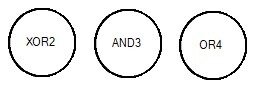
Perhaps we will conclude our discussion on objects here.
Relationships
There are relationships between objects that in ontology denote the rules governing interactions between objects and from which new conclusions are drawn.
Typically, relationships are defined by the type of diagram used in ontology. Scheme — this is a collection of objects in the ontology and the relationships between them. The following main types of diagrams are distinguished:
- Composition diagrams.
- Classification diagrams.
- Transition diagrams.
- Functional diagrams.
- Combined schemes.
There is also sometimes a type of scheme called existential. An existential scheme refers to a collection of objects without relationships. Such schemes simply show that in a certain subject area, there exists a set of objects.
Now let's discuss each type of scheme in order.
Composition schemes
This type of scheme is used to represent the composition of an object, system, structure, etc. A typical example is the parts of a car. In the most generalized composition, a car consists of a body and transmission. The body, in turn, is divided into a frame, doors, and other parts. This decomposition can continue further — it all depends on the required level of detail for a given task. An example of such a scheme:
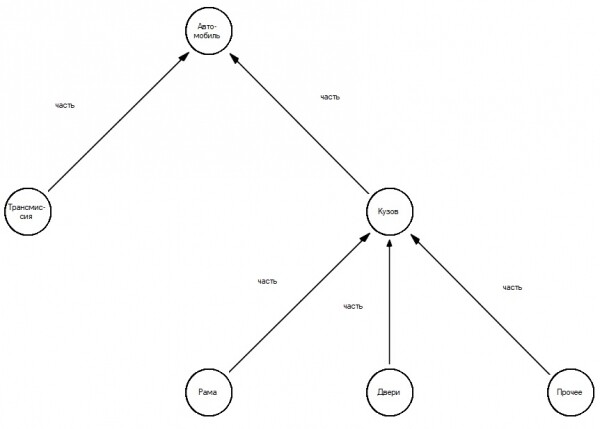
Composition relationships are displayed as an arrow with a point at the end (unlike, for example, classification relationships, where the point is at the beginning of the arrow, more on that later). These relationships can be labeled as shown in the illustration (part).
Classification schemes
Classification schemes are designed to express definitions of types, their subtypes, and instances of types. For example, cars can be passenger and cargo. That is, the type "Car" has two subtypes. The VAZ-2110 is a specific instance of the subtype "Passenger car," while the GAZ-3307 is an instance of the subtype "Cargo car:"
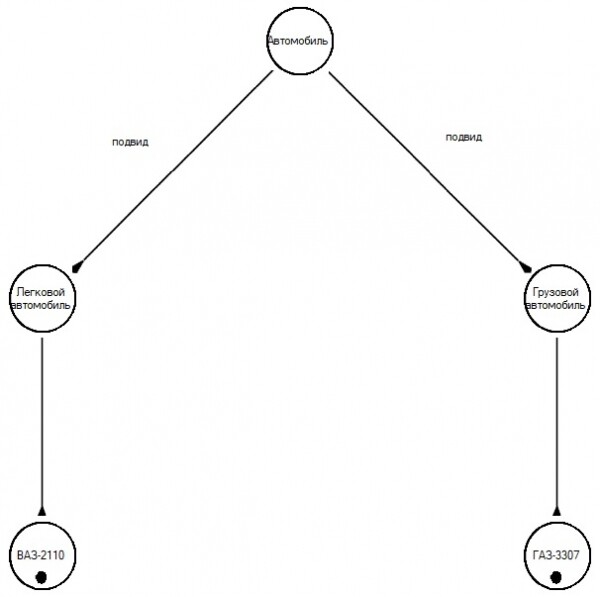
Relationships in classification schemes (subtype or specific instance) are represented as an arrow with a point at the beginning and, like in the case of composition schemes, can have a label naming the relationship.
Transition schemes
This type of scheme is necessary to display the processes of objects transitioning from one state to another under the influence of a certain process. For example, after the process of painting with red paint, a black car becomes red:
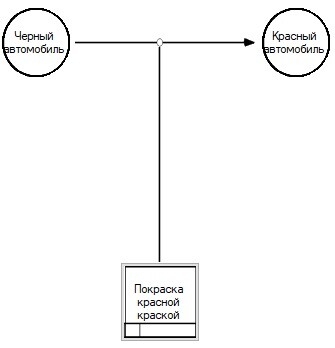
The transition relationship is indicated by an arrow with a point at the end and a circle in the center. As shown in the diagram, processes relate to relationships, not to objects.
In addition to the ordinary transition illustrated in the diagram, there is a strict transition. It is used in cases where the transition is not obvious in the given situation, but it is important for us to emphasize it. For example, mounting a rearview mirror on a car is not a significant operation when considering the assembly process of the car as a whole. However, in some cases, it is necessary to highlight this operation:
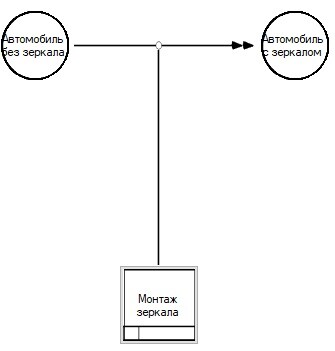
The strict transition is indicated similarly to the ordinary transition, except with a double arrowhead at the end.
Ordinary and strict transitions can also be marked as instantaneous. For this, a triangle is added to the central circle. Instantaneous transitions are used in cases where the transition time is so minimal that it is negligible within the subject area being considered (less than the minimally significant time interval).
For example, with even the slightest damage to the car, it can be considered damaged and its price drops sharply. However, most damages occur instantaneously, unlike aging and wear:
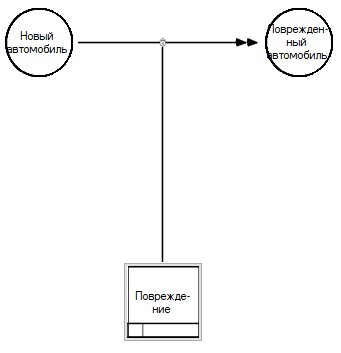
The example presents a strict transition, but an ordinary transition can also be used as instantaneous.
Functional diagrams
Such diagrams are used to indicate the structure of interaction between objects. For instance, a mechanic performs maintenance on cars, while the service manager accepts repair requests and passes them to the mechanic:
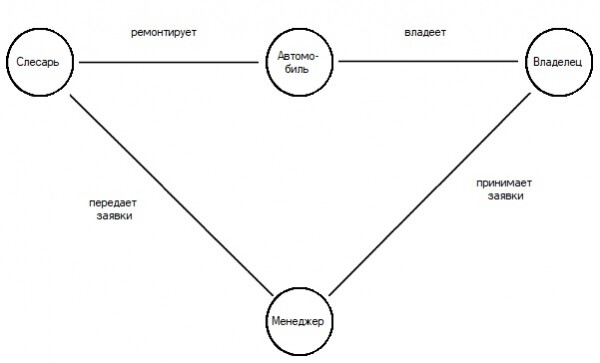
Functional relationships are depicted with a straight line without an arrowhead, but sometimes with a label indicating the name of the relationship.
Combined diagrams
Combined diagrams are a mixture of the previously discussed diagrams. Most diagrams in the IDEF5 methodology are combined, as ontologies using only one type of diagram are rare.
Logical operators are often used in all diagrams. With their use, it is possible to realize relationships among three, four, or more objects. A logical operator can express a common entity over which a process is performed or which participates in another relationship. For example, the previous examples can be combined into one as follows:
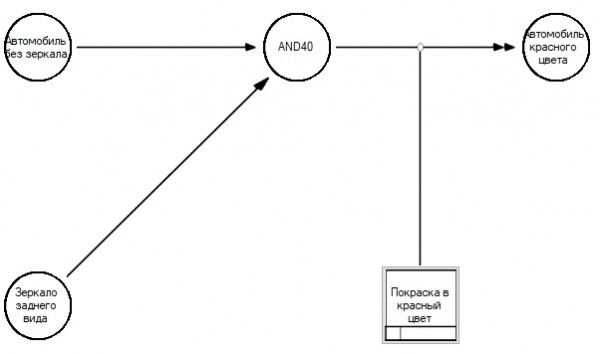
In this particular case, the combined scheme uses a composition scheme (mirror + car without a mirror = car with a mirror) and a transition scheme (a car with a mirror, under the influence of the painting process with red paint, becomes a red car). The car with the mirror is not expressed explicitly — instead, a logical operator AND is indicated.
Conclusion
In this article, I attempted to describe the main objects and relationships in the IDEF5 methodology. I used the automotive domain as an example, as building schemes on this example proved to be much simpler. However, IDEF5 schemes can be applied in any other field of knowledge.
The ontology and knowledge analysis of the subject area is quite a broad and labor-intensive topic. However, within the framework of IDEF5, everything turns out to be not so difficult; at least, the basics of this subject can be learned quite easily. The goal of my article is to attract a new audience to the problem of knowledge analysis, even if it's through such a primitive tool as IDEF5's graphical language.
The problem of the graphical language is that it cannot adequately articulate certain relationships (axioms) of the ontology. For this, there is the textual IDEF5 language. However, at the initial stage, the graphical language can be very useful for formulating initial requirements for the ontology and determining the vector for developing a more detailed ontology in the textual IDEF5 language or any other means.
I hope this article will be useful for beginners in this field, and perhaps even for those who have been dealing with the issue of ontological analysis for a long time. The main material of this article has been translated and thoughtfully sourced from the IDEF5 standard I referred to earlier (). I was also inspired by a wonderful book from the authors at NOU INTUIT ().
Source: habr.com
