

Yes, exactly ancient. Last May, the global decentralized social network Fediverse (eng. – Fediverse) 11 years! It was exactly that long ago when the project's pioneer Identi.ca published the first post.

Meanwhile, an anonymous person on a respected resource wrote: "The problem with Fediverse is that only two and a half diggers know about it".
What a ridiculous problem. Let's fix it! And, at the same time, let's try to dispel some myths (and reinforce some legends).
*For a complete picture, it may be useful to look at the about Fediverse, with the caveat that much of it is already outdated..
Let's start with the most controversial myth.
Myth # 1: <Name of any corporation> doesn't care about the fuss with decentralized "alternatives".

To some extent, this statement is true. Just as much as the famous saying of Mahatma Gandhi is true: "First, they ignore you, then they laugh at you, then they fight you, and then you win.«.
The topic of decentralization does not give anyone peace. At the end of 2018, the creator of the World Wide Web Tim Berners-Lee spoke about his plan to decentralize the web with the help of a new project . One might wonder, why not consider existing federated social networks with the protocol , which was standardized by , led by Mr. Berners-Lee?
In July 2019, Apple joined the Data Transfer Project along with Facebook, Twitter, Google, and Microsoft. . What does Fediverse have to do with this? In the project's repository alongside Twitter, Instagram, Facebook (and Solid), you will find for a federated network. Not bad for a network that is supposedly "ignored".
In October 2019, Wikipedia founder Jimmy Wales announced the launch of an "alternative to Facebook and Twitter" – , an ad-free platform funded by user donations. These principles are reminiscent of federated networks, which Twitter users quickly pointed out to Mr. Wales. He implementing the ActivityPub protocol and later stated that the code for the WT:Social project would be released under the GPLv3 license. Great!
In December 2019, Twitter creator Jack Dorsey about the company's intentions to invest in the research and development of a number of open decentralized standards for social networks, aimed at improving the Twitter service. There were many jokes in the Fediverse about this, suggesting that Dorsey decided to clone the federated Mastodon network. The fact is that a month before his announcement, Dorsey to the official promotional account of the Mastodon network on Twitter. So he simply could not be unaware of its existence. The Mastodon developer was positive about the idea of joining Twitter to the Fediverse networks (instead of creating new incompatible standards).
And now a question for the readers: at what stage, in your opinion, does the Fediverse stand in the context of Mahatma Gandhi's definition?
Myth # 2: Federated networks are used by at most 10 foreigners and 100 bots. The projects are dead! There is no development! There are no stickers!

I hasten to reassure: stickers were recently in the federated network , one of the fastest-growing platforms in terms of server count. The project's code is written in Elixir and optimized for small communities (you can easily set up a node on some Beaglebone or Raspberry Pi).
Rumors of the death of federated projects are greatly exaggerated. Yes, the microblogging network GNU Social, which has existed since 2010, is outdated by modern standards. Until recently, it didn’t even have the capability to send private messages, as this scenario was not provided for in the OStatus protocol specification. Fortunately, GNU Social has spent the past year implementing the ActivityPub protocol.
Let's take a look at newer, actively evolving networks.
The most successful federated project (which has long since surpassed Twitter in functionality), in January of last year grant , intended for "innovative, promising" projects. In addition, the project has stable financial support on Patreon. In 2019, Keybase integrated with Mastodon, which caused mixed reactions among users. Fortunately, as is customary in open source, this is optional and handled on the server administrator's side.
Mastodon has several interesting forks: with experimental features (which are often subsequently adopted into the main branch of the Mastodon project), , expanding the capabilities of post formatting. It's also worth taking a look at alternative interfaces, among which and .
If you happen to be passing through, don't forget to join the .
You can find a lot of online about Mastodon, so let's move on.
– a decentralized video hosting and broadcasting platform – was created by the community as an alternative to YouTube / Vimeo. The project first gained media attention when Google temporarily blocked the account of the 3D modeling system Blender in 2018. Back then, enthusiasts their PeerTube, which is still available today. The goal of the project is to create a network of interconnected video providers that are independent of major market players. To ease the load on servers, the platform supports peer-to-peer video streaming using WebRTC: if several users are simultaneously watching a video in the browser, as long as the tab is open, users help distribute the content.
Recently the release of version 2.0. Videos from PeerTube can be viewed from the Mastodon network (100% information) and some other Fediverse networks (bugs may occur).
PeerTube features Russian-speaking about the history of the Fediverse from . Be sure to listen!
– like Instagram, but without the nail photos (for now at least)! The project recently received a grant from the European organization for further development and has increased the number of nodes to over 100 in the past year. It federates with most Fediverse networks.
– an alternative to Grooveshark and Deezer. Written in Python, the project federated with the Mastodon network quite recently – in December of last year. The platform allows users to create playlists, listen to others' music compilations (‘radio’), and interact with other users. There is the possibility to upload and share audio recordings in a limited fashion, for example, to avoid copyright issues.
– an unexpectedly successful platform for federated blogs. It seems that Mastodon users were terribly tired of the 500-character limit. In any case, the project quickly gained popularity in niche circles – over 200 servers in just over a year – and by maintaining a paid node (for those who are too lazy to set up their own and for anyone wanting to provide financial support) even on the search for new Go developers for contract work. In June 2019, the Linux kernel developers a new blogging service , which is powered by WriteFreely software. Posts on this platform can be read from Pleroma and some other Fediverse networks.
– a developing federated protocol extension of ActivityPub that will enable federation between version control systems. The project was previously called .
In other interesting news – for organizing meetings, events, and conferences. Created by the association as a result of a successful crowdfunding , this platform will replace MeetUp, Facebook groups, and other centralized solutions. Hooray!
In the previous mentioned networks , and . To date, all three networks have implemented the ActivityPub protocol and joined most federated networks, while retaining the advantage of federation with the large (in terms of accounts) network . Some might say that maintaining multiple protocols is more of a drawback. Due to the varying functionality, ensuring stable federation with all other networks is a non-trivial task. And yet, it is possible.
The PerformanceResourceTiming is considered the easiest to master for Facebook users. I would contest that (although I find Facebook's design incredibly inconvenient). Unlimited posts, photo albums, direct messages – the minimum expected from a social network is here. The project is in need of a frontend enthusiast (it so happens that the team consists solely of backend developers) – who wants to get involved in open source?
– not the most intuitive network (I invite anyone willing to help improve the interface). However, the platform offers a wide range of capabilities for functioning as a social network, forum, discussion groups, Wiki, and website. The latest release was at the end of 2019. Besides ActivityPub and diaspora protocols, Hubzilla federates within its network using its own protocol , which provides two unique features for the Fediverse. Firstly, there is the end-to-end authentication feature called 'Nomadic Identity.' Secondly, there is the account cloning function, allowing for a 'backup' of all data (posts, contacts, correspondence) on another server — useful if the primary server suddenly goes offline. User binding to a specific server (and the complexity of migrating to a new one) are weaknesses in federated networks. Several Fediverse projects have expressed a desire to implement the Zot protocol, but so far it remains just talk. In the meantime, on the official standardization of the Zot protocol within W3C.
The Forum of the Russian-speaking Hubzilla Community (which can be followed from other networks that federate with Hubzilla).
– a federated network with a flexible interface reminiscent of Pinterest or Tumblr. It is most suitable for visual content (illustrations, photographs). The project's developer, also the founder of a non-profit organization to promote federated platforms , has planned many interesting features. The network is evolving slowly, we’ll keep an eye on the developments.
– there is still little to say about this project, except that it is being developed by a former employee of VKontakte and Telegram, and is intended to be somewhat of a clone of VKontakte. This would be quite timely: the community functionality is underdeveloped in federated networks. The project code is not yet published, but is already federating.
Of course, these are not all the networks that make up the Fediverse. Programmers enjoy creating their own variations, so in just 2019, 13 new projects emerged. You can find the current list of Fediverse networks , and you can read about the results of 2019 .
Returning to the myth, in 2019 the Fediverse gained over a million new users. So, there are still more foreigners than 10 there. The Russian-speaking community remains small.
Myth # 3 (the most persistent): nobody needs all this!
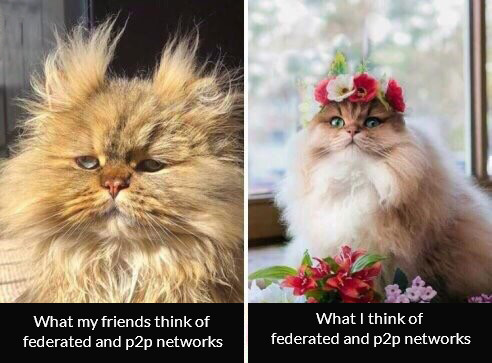
And here, dear reader, I can hardly convince you with mere text. It would be like explaining the taste of watermelon to someone who has never tried it.
Deserving attention is the (magnificent) speech by prominent activist in the European Parliament in November 2019, where he to the representatives of the people, what are the main problems of the current approach of the European Union towards the regulation and support of centralized corporations and startups, and what are the advantages of open federated networks. I recommend watching. If Aral doesn't convince you to test federated networks, then I certainly won’t either.
Also watch the recordings of the presentations from , which took place in August in Prague. The event was quite chaotic, organized so quickly that not everyone had time to buy tickets and arrive. The good news is that a new conference for all federated networks (not just those based on ActivityPub) is planned in 2020 in Barcelona. tuned for news about the event.
A few useful links:
- A guide site for federated networks –
- Server statistics –
- Statistics of various federated projects –
- More statistics –
- Visualization of connectivity –
Finally, here's a picture to attract you – a poster from last year's Chaos Computer Club congress:

See you in the Fediverse!
I would like to thank the Doctor for proofreading this article and for the helpful edits, and Maxim from the Hubzilla team for the additions..
Source: habr.com
