

Reflections on the Source of the Desire to Pass Certification AWS Solutions Architect Associate.
Motive One: "Axes"
One of the most useful principles for any professional is "Know Your Tools" (or in one of its variations, "»).
We've been in the cloud for a long time, but until recently, they were just monolithic applications with databases deployed on EC2 instances — cheap and simple.
But gradually we felt confined within the monolith. We shifted focus toward splitting it — into modularization, and then on to the trendy microservices. And very quickly on this path, "hundreds of flowers bloom."
There's no need to look far — the activity logging project I'm currently leading includes:
- Clients in the form of various applications of our product — from the deep corners of dated legacy systems to ultra-modern microservices on .Net Core.
- Amazon SQS queues, where logs about client activities are stored.
- A microservice on .Net Core that retrieves messages from the queue and sends them to Amazon Kinesis Data Streams (KDS). It also has a Web API interface and Swagger UI as a duplicate channel for manual testing. It is wrapped in a Docker Linux container and hosted under Amazon ECS. Autoscaling is configured in case of a high volume of logs.
- From KDS, data is directed like fire hoses into Amazon Redshift with intermediate storage in Amazon S3.
- Operational logs for developers (debug information, error messages, etc.) are formatted in a visually appealing JSON and sent to Amazon CloudWatch Logs.
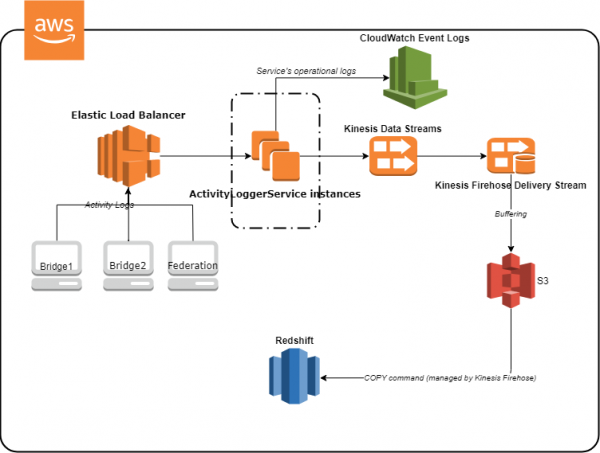
Working with such a zoo of AWS services, it’s important to know what’s available and how best to use it.
Imagine having an old, trusted axe that cuts trees well and drives nails decently. Over the years, you've learned to handle it well, built a doghouse, a couple of sheds, and maybe even a cabin. Sometimes challenges arise; for instance, screwing in a screw with an axe isn't always quick, but usually solvable with patience and some ingenuity.
And then a wealthy neighbor appears nearby, who has a ridiculous amount of various tools: electric saws, nail guns, screwdrivers, and God knows what else. He is ready to rent out all this wealth around the clock. What to do? The option to take an axe and seize the property is dismissed as politically illiterate. The most reasonable thing would be to study what tools he has, how they can complement each other for different jobs, and under what conditions they are rented out.
Since this motive was the main one for me, the preparation was built accordingly – to find a fundamental guide and study it thoroughly. And such a guide The book is written dryly, but that is unlikely to deter people who studied calculus with Fikhtengolts.
I read it cover to cover and consider that it fully meets its intended purpose – it provides a good overview of both the services and the more general concepts that may appear on the exam. Additionally, a pleasant bonus is the possibility to go through a somewhat strange registration process on Sybex and answer all the review questions and practice exams from the book online.
An important point: I trained using the 2016 edition of the book, but AWS changes quite dynamically, so look for the freshest edition available at the time of preparation. For example, practice tests often include questions about the availability and durability of various S3 and Glacier classes, but some of the numbers have changed since 2016. Additionally, new ones have been added (for instance, INTELLIGENT_TIERING or ONEZONE_IA).
Motive two: "65 Shades of Orange"
Intense thinking requires certain efforts. But it's no secret that many programmers derive masochistic pleasure from puzzling tasks, questions, and sometimes even exams.
I think this pleasure is much like playing "What? Where? When?" or, let's say, a good game of chess.
In this sense, the current AWS Solutions Architect Associate exam is very good. Although during preparation, among the practice questions, there were occasionally some that required rote memorization, such asHow many maximum elastic IP addresses can be held in a VPC?” or “What is the availability of S3 IA?During the actual exam, I didn't encounter such questions. Essentially, almost every one of the 65 questions was a mini-task related to design. Here's a fairly typical example from the official documentation:
A web application allows customers to upload orders to an S3 bucket. The resulting Amazon S3 events trigger a Lambda function that inserts a message to an SQS queue. A single EC2 instance reads messages from the queue, processes them, and stores them in a DynamoDB table partitioned by unique order ID. Next month, traffic is expected to increase by a factor of 10, and a Solutions Architect is reviewing the architecture for possible scaling problems. Which component is MOST likely to need re-architecting to be able to scale to accommodate the new traffic?
A. Lambda function B. SQS queue C. EC2 instance D. DynamoDB table
As far as I know, the previous version of the exam contained 55 questions and was allotted 80 minutes. Apparently, they have worked on it quite well: now there are 65 questions and 130 minutes for them. The time per question has increased, but there are practically no passing questions. Each one required thought, sometimes more than two minutes.
By the way, there is a practical takeaway from this. The usual winning tactic is to quickly skim through all the questions and answer those that can be answered immediately. In the case of SAA-C01, this doesn't really work; practically every question will need to be flagged, otherwise, there's a risk of missing some detail and answering incorrectly. In the end, I spent a minute or two on each question, and then returned to the flagged ones, using up the remaining 20 minutes on them.
Third motive: "If only youth knew, if only aging could"
As is well known, one of the most common reasons for rejections that programmers over 40 receive is a lower ability to learn compared to younger individuals.
Meanwhile, I have the impression that in some areas my ability to learn has even increased compared to my student years—due to greater perseverance and experience that allows me to draw on familiar analogies for unfamiliar questions.
But the impression can be deceiving; an objective criterion is needed. Preparing for the exam and passing it—what could be a better option?
I believe the preparation was successful. I prepared on my own, and the process went quite smoothly. Sure, I fell asleep in the hammock while reading the manual a couple of times—but that can happen to anyone.
Now I have a certificate and decent points for the exam as a sign of readiness.
And a little bit about what could be motivating, although it was probably not the case for me.
Not the first motivation: 'The Money'
There are interesting on which specialists with which certifications are the highest paid in the world, and AWS SAA is in an honorable 4th place there.
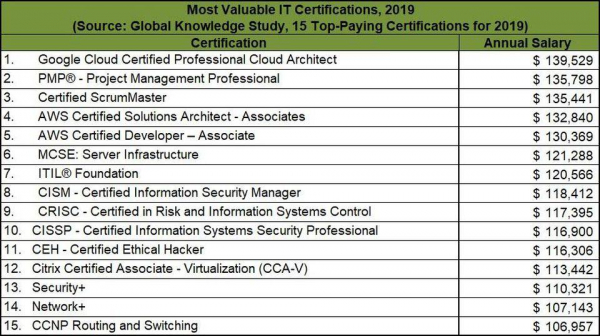
But, first of all, what's the cause and what's the effect here? I suspect that these guys earn well
due to certain skills, and those same skills help in passing certification. Secondly, I have vague doubts that anyone would pay $130K a year outside the US, even if they get certified from head to toe.
And in general, as we know, after satisfying the lower levels of the pyramid, salary ceases to be the main factor.
Not the second motivation: 'Company Requirements'
Companies may encourage certifications or even require them (especially if they're necessary for partnership, such as entering AWS APN in the case of Amazon).
But in our case, an independent product is being produced, and moreover, we try to avoid vendor lock-in. So no one requires certifications. They may praise and pay for the exam as recognition of certain efforts – and that's all the formalities.
Not the third motivation: 'Employment'
Having certifications might be a certain plus for getting a job, all else being equal. But I have no plans to change jobs. It's interesting to work on a complex product that actively uses many trendy approaches and AWS services. There is plenty of this at my current job.
No, of course, situations vary: in my 23 years in IT, I've changed jobs about 5 times. It's not a fact that I won't have to change again if I last another 20 years. But if they beat us – we'll cry.
Useful
In conclusion, I would like to mention a few materials that I used in preparation for the exam and simply as 'sharpening the saw':
- Video courses and . The latter, they say, are especially good if you buy a subscription that gives access to all practice exams. But I had as one of the conditions of the game that I wouldn't spend a cent on preparation, and buying a subscription didn't align well with that. Moreover, I generally consider the video format to be less dense in terms of information volume per unit time. However, when preparing for SA Professional, I will most likely get a subscription.
- Tons of Amazon's official documentation, including F.A.Q and White Papers.
- Well, the last but significant thing - . I found them a couple of days before the exam and practiced well. There's nothing to read there, but the online interface and answer comments are good.
Source: habr.com
