

DNA storage is not yet ready for the masses, but some experts , believe that the situation will change soon. More and more companies are starting to focus on this issue.
Photo / Flickr /
Why DNA storage is being explored by
According to Cambridge Consultants. Soon, these storage solutions will struggle to keep up with the evolving requirements for storing and processing increasing volumes of data in data centers. Several IT industry experts are convinced that the solution lies in the development of alternative storage media.
When it comes to recording density, Nature magazine , states that all the world's data could be recorded in a DNA storage medium weighing as little as one kilogram. As for the lifespan of such a storage device, it could reach (by various estimates) or years.
Another reason why experts consider DNA storage promising is the consistently decreasing cost of recording data on this medium. While in 2002, the cost of recording one character into a molecule was $10, by 2016 it dropped to $0.05. If this trend continues over the next decade, the technology could pave the way for a new niche in the data storage market. According to estimates , the annual turnover of the DNA storage segment could reach hundreds of millions of dollars within the next ten years.
Who is creating DNA storage
The prospects of this medium are attracting large IT companies, which are considering its use in archival data storage. For example, Microsoft plans to launch DNA storage by 2020. Notably, the company's specialists have already managed 200 megabytes of data on artificial DNA spirals, achieving a recording speed of 400 bytes per second. New developments will improve these figures, although for now, they are talking about quite large data storage systems, old photocopying machines from the 1970s.
Another company working on DNA storage is called Catalog. This startup a modular laboratory, the size of a bus. It is fully equipped with everything necessary for DNA molecule synthesis and their subsequent storage. They plan to start selling the installation in 2021.
The technology is also of interest to bioengineers. The potential in DNA storage is immense. Harvard professor George Church. He and his colleagues want to create a special 'biological' camera. It will have no electronic or mechanical components, and photos or videos will be stored directly in DNA molecules.
Another project in this field is SGI-DNA. The team is a DNA printer that is comparable in size to a standard office device. The system is already being used to print molecules for biological and medical research. However, the developers plan to use the printer for encoding information into DNA.
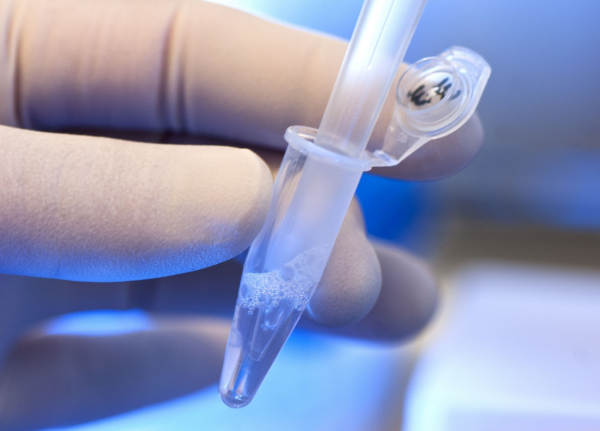
Photo / Flickr /
The flip side of the coin
In the IT industry, there are more cautious opinions regarding this new medium of information. According to , widespread adoption of the technology will take several decades.
The first reason is the high cost of recording. Although it has been decreasing in recent years, storing data in molecules is still expensive: to encode a one-megabyte file into DNA, it costs about eight thousand dollars.
The second reason is the low data write speed. Companies like Microsoft and their partners 400 bytes per second. However, according to the engineers at the company, to achieve widespread adoption, the bandwidth needs to be 100 MB/s.
The third reason is the potential issues with cybersecurity. Researchers from the University of Washington have already , that it's possible to store computer viruses in DNA molecules. In the future, this could give malicious actors the ability to introduce malware within specialized laboratory networks and compromise storage systems with personal data.
Alternatives to DNA storage
It's still premature to talk about the widespread implementation of DNA storage, so several companies are working on developing alternatives and improving existing technologies. One of them is magnetic tape. It has been used for decades in data centers for archiving purposes. Its lifespan can reach years. Although this is incomparable to the durability of DNA, tape outlasts hard drives and solid-state drives. The latter typically last up to ten years. Another important advantage of tape is its cost. The cost of storing one gigabyte of data is only two cents.
For these reasons, magnetic tape is still used by large IT companies, particularly IBM. According to representatives of the IT giant, this medium will be utilized in data centers at least until 2030.
The second alternative to DNA storage is nanostructures. For instance, in 2016, engineers from Delft University a plate made of copper, on the surface of which a lattice of chlorine atoms was formed. By changing the arrangement of the 'holes' in the lattice, the authors encoded bits in the strands. Up to ten terabytes of data can be recorded on one square centimeter of this material's surface.
Another technology related to nanostructures was developed by Chinese scientists in 2018. It involves a film made of titanium dioxide and silver, which is 80 times thinner than a human hair. In this case, information is stored in nanoparticles that change color when exposed to a laser beam.
According to the technology's creators, a piece of film measuring 10x10 centimeters can store a thousand times more data than a DVD disc. Moreover, the writing speed to such a storage medium reaches one gigabyte per second.
Posts from our blog:
Source: habr.com
