

The growth of computing power and the development of x86 virtualization technologies on one side, and the spread of IT outsourcing on the other, have led to the concept of utility computing (IT as a utility). Why not pay for IT just like water or electricity – exactly as much and exactly when needed, and no more.
At that moment, the concept of cloud computing emerged – consuming IT services from the 'cloud', i.e., from some external pool of resources, without worrying about how and from where these resources come. Just like we don't worry about the infrastructure of water supply pumping stations. By that time, another side of the concept had also been worked out – namely, the notion of IT services and how to manage them within ITIL / ITSM.
A whole series of definitions for clouds (cloud computing) have been developed, but they should not be considered as ultimate truths – they are merely a way to formalize the ways of providing utility computing.
- ‘Cloud computing is a technology of distributed data processing, where computing resources and power are provided to the user as an Internet service’ Wikipedia
- ‘Cloud computing is a model for enabling convenient network access to a shared pool of configurable computing resources (e.g., networks, servers, storage systems, applications, and services) that can be rapidly provisioned and released with minimal management effort or service provider interaction’ NIST
- ‘Cloud computing is a paradigm for enabling network access to a scalable and flexible pool of distributed physical or virtual resources that are provisioned on-demand and managed autonomously’ ISO/IEC 17788:2014. Information technology — Cloud computing — Overview and vocabulary.
According to NIST, there are three main types of clouds:
- IaaS – Infrastructure as a Service
- PaaS – Platform as a Service
- SaaS – Software as a Service
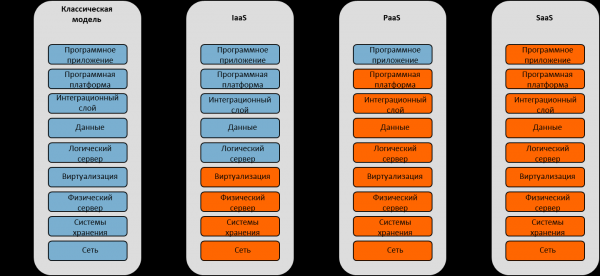
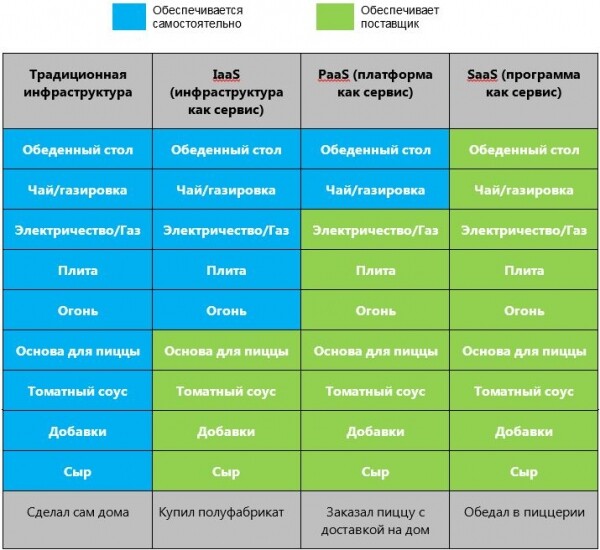
For a simplified understanding of the difference, let's consider the Pizza-as-a-Service model:
NIST defines the following necessary characteristics of IT services that can be considered cloud-based.
- Universal network access (broad network access) – the service must have a universal network interface, allowing anyone to connect and use the service with minimal requirements. For example, to use a 220V electrical network, you only need to plug into any outlet with a standard universal interface (plug), which does not change whether it’s a kettle, a vacuum cleaner, or a laptop.
- Measurable service (measured service) – a key characteristic of cloud service is its measurability. Returning to the analogy with electricity – you will pay exactly for what you consumed, with minimal granularity, even down to the cost of boiling a kettle, if you were only at home once during the month and had a cup of tea.
- On-demand self-service (on demand self service) – the cloud provider gives the customer the ability to reasonably configure the service without the need to interact with provider staff. To boil a kettle, you do not need to contact the energy supplier in advance to inform them and obtain permission. As soon as the house is connected (the contract is signed), all consumers can independently manage the provided power.
- Rapid elasticity (rapid elasticity) – the cloud provider offers resources with the capability for instant scaling up or down (within reasonable limits). As soon as the kettle is turned on, the provider immediately delivers 3 kW of power to the network, and as soon as it is turned off, the supply is reduced to zero.
- Resource pooling (resource pooling) – the internal mechanisms of the service provider allow pooling individual generating capacities into a common pool of resources, subsequently providing those resources as a service to various consumers. Including the kettle, we are least concerned about which specific power plant the power comes from. All other consumers draw this power along with us.
It is important to understand that the characteristics of cloud computing described above are not arbitrary but rather a logical conclusion drawn from the concept of utility computing. A public service must possess these characteristics within this framework. If any characteristic is not met, the service does not become inferior or 'toxic'; it simply ceases to be classified as cloud-based. But who said all services must be?
Why am I highlighting this separately? Over the past 10 years since the NIST definition emerged, there has been much debate about 'true cloudiness' according to this definition. In the US, the phrase 'meets the letter of the law but not the spirit' is still sometimes used in legal contexts — and when it comes to cloud computing, the spirit is what matters, with resources available for rent at the click of a mouse.
It should be noted that the five characteristics listed above apply to public clouds, but when transitioning to private clouds, most of them become optional.
- Broad network access — within a private cloud, the organization has complete control over both generating power and client consumers. Thus, this characteristic can be considered automatically fulfilled.
- Measured service — this is a key characteristic of the utility computing concept, where payment is based on actual consumption. But how does an organization pay itself? In this case, there is a division between generation and consumption within the company, with IT acting as the provider and business units as consumers of services. Financial settlements occur between departments. There are two modes of operation: chargeback (with actual settlements and financial movements) and showback (in the form of reports on resource consumption in rubles, but without financial transactions).
- On-demand self-service — within the organization, there may be a general IT service, and in this case, the characteristic loses its meaning. However, if there are dedicated IT specialists or application administrators in business units, it is necessary to organize a self-service portal. The conclusion is that this characteristic is optional and depends on the business structure.
- Rapid elasticity loses its meaning within an organization due to the fixed set of equipment for building a private cloud. It may have limited use in internal settlements. Conclusion: it is not applicable for a private cloud.
- Resource pooling – today, there are practically no organizations that do not use server virtualization. Therefore, this characteristic can be considered automatically fulfilled.
Question: So what exactly is this private cloud of yours? What does a company need to purchase and implement to build it?
Answer: A private cloud is a shift to a new administrative model of IT-Business interaction, which consists of 80% administrative measures and only 20% of technologies.
Paying only for consumed resources and easy entry, without the need to invest hundreds of millions in capital expenses, has shaped the new technological landscape and given rise to billionaire companies. For example, modern giants like Dropbox and Instagram started as startups on AWS with zero own infrastructure.
It should be emphasized that cloud service management tools are becoming significantly more intermediated, and the key responsibility of the IT director is to select providers and control quality. Let's examine the challenges of these two new responsibilities.
Emerging as an alternative to traditional heavy infrastructure with proprietary data centers and hardware, clouds may appear deceptively simple. It's easy to enter the cloud, but the issue of exit is often overlooked. Like any other industry, cloud providers aim to protect their business and complicate competition. The only significant competitive moment arises during the initial choice of a cloud service provider; thereafter, the provider will make every effort to ensure the customer does not leave. Not all of these efforts will focus on the quality of services or their variety. Primarily, it involves delivering unique services and utilizing non-standard system software, making it difficult to switch to another provider. Consequently, when selecting a service provider, it’s crucial to simultaneously develop a transition plan away from this provider (essentially a full disaster recovery plan) and consider data storage and backup architecture.
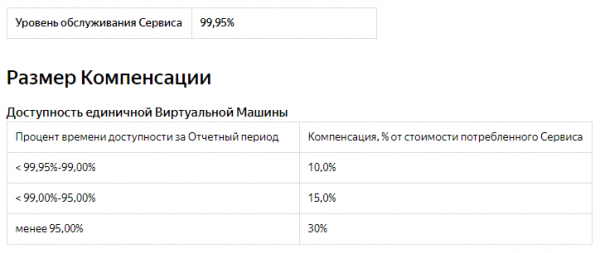
The second important aspect of the new responsibilities of the IT director is quality control of services from the provider. Almost all cloud providers comply with SLAs based on their internal metrics, which may have a very indirect relevance to the client's business processes. Accordingly, implementing a dedicated monitoring and control system becomes one of the key projects when transferring significant IT systems to a cloud provider. Continuing on the topic of SLAs, it should be emphasized that the vast majority of cloud providers limit their liability for SLA breaches to the monthly subscription fee or a percentage of that fee. For example, AWS and Azure will grant a 100% discount on the subscription fee when availability exceeds a threshold of 95% (36 hours per month), while Yandex.Cloud provides a 30% discount.
And of course, it’s essential to remember that clouds are not only offered by giants like Amazon and Yandex. There are smaller clouds as well—some the size of a cat, or even a mouse. As demonstrated by CloudMouse, sometimes a cloud can simply cease to function. You won't receive any compensation or discount—you'll get nothing but a total loss of data.
Due to the aforementioned issues with the implementation of high-class IT systems critical to business in cloud infrastructures, a phenomenon known as ‘cloud repatriation’ has been observed in recent years.
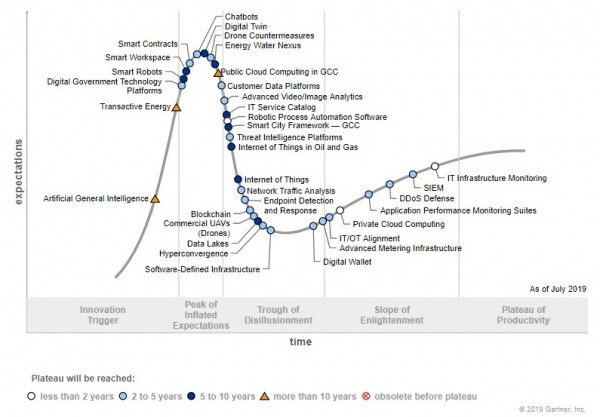
By 2020, cloud computing has passed the peak of inflated expectations, and the concept is on its way to the trough of disillusionment (according to the Gartner hype cycle). According to studies, and up to 80% of corporate clients are returning and planning to return workloads from the cloud to their own data centers for reasons:
- To increase availability/performance;
- To reduce costs;
- To comply with security requirements.
What should be done and how is it all ‘really’?
There is no doubt that clouds have come to stay. And their role will increase each year. However, we do not live in a distant future, but in 2020, in a very specific situation. What should be done with clouds if you are not a startup, but a classic corporate client?
- Clouds are primarily a place for services with unpredictable or distinctly seasonal loads.
- In most cases, services with predictable stable loads are cheaper to maintain in one’s own data center.
- Work with clouds should begin with test environments and low-priority services.
- The consideration of placing information systems in the cloud starts with developing a method for moving from one cloud to another (or back to your own data center).
- Placing an information system in the cloud starts with developing a backup scheme to infrastructure controlled by you.
Source: habr.com
