

Organizations with multiple branches eventually have to choose a solution that can support a unified phone network for communication between remote divisions.
The main factors influencing the company's choice are:
- no charges for calls between offices;
- fault tolerance and reliability of the solution;
- high quality of voice communications;
- no time loss when connecting with other offices.
Most modern IP PBXs address the problem at a basic level: for example, an employee in Yekaterinburg can always call colleagues in Minsk or Krasnodar for free. The main challenges arise in the details. For example, employees will not see the statuses of extension numbers in other offices, will not be able to transfer calls to a colleague in another city, and incoming requests will not be placed in a common queue, etc. This creates problems when different stages of a business process take place in different offices and in the case of distributed call centers tackling a single common task.
Such issues and many other tasks are successfully resolved using the 3CX software IP PBX deployed on server the customer's premises or in the cloud:
- the consolidation of internal numbers across all offices into a common numbering plan (with any grouping and order) or, conversely, their inclusion in different numbering plans if required by business processes;
- routing calls by groups across different branches;
- a unified IVR under the common numbering plan;
- call parking within the common numbering plan;
- call transfer within the common numbering plan;
- BLF statuses visible to all users.
Let's consider the last point with a concrete example. When using PBXs that cannot transmit statuses to each other, the BLF DSS button field on the Yealink SIP-T48G phone looks like this, including numbers from both the 'home' office and other cities:
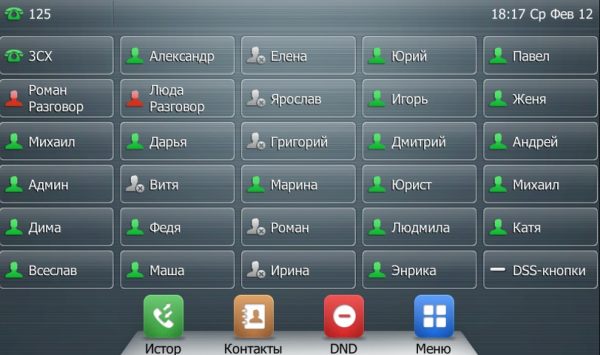
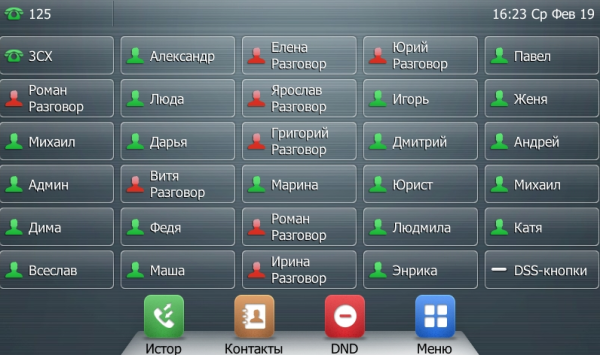
The numbers of out-of-town colleagues are marked in gray, and their statuses are not displayed. 3CX effectively addresses this issue as well. It will look like this, without any gray values:
There are several other advantages to using a software IP PBX (3CX) over a hardware telephone station in a branch network:
- no logistics costs.: there is no need to physically distribute 'hardware' PBXs to all offices;
- no need for additional personnel: remote configuration eliminates the need for a trained engineer's presence at the branch office;
- end-to-end configuration: 3CX has an end-to-end logic for configuring IP-PBXs (shared computing center), while using multiple hardware PBXs makes unified configuration impossible in principle;
- simple configuration: configuring 3CX is much simpler due to a unified administration interface (management from a single window);
- infrastructure monitoring: 3CX allows for monitoring infrastructure in a distributed branch network (statuses of external trunks and internal lines, resource usage, logging) and sending notifications to email on specific events;
- easy system upgrade: thanks to 3CX, the phased transition from an outdated telephone network to modern IP audio and video communications is smooth and cost-effective; upgrading the PBX with integration of all necessary channels (SIP, E1, PSTN, etc.) can be done at any time and as many times as needed.
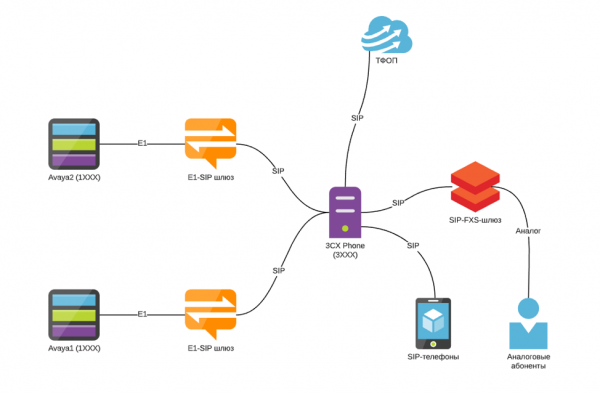
When discussing the use of 3CX across multiple offices, let's consider two main scenarios:
- one 'large' IP-PBX for the entire pool of subscribers;
- a 'small' IP-PBX in each department.
There are both technical and economic differences in implementing these scenarios.
Cost
Let's consider an organization with a central office of 100 employees, two call centers with 20 operators each in the regions, and a remote R&D center with 50 engineers.
When installing a unified IP-PBX, one must consider the number of employees (about 200), the high call density (call centers), and the necessary functionality for the call centers. The 3CX Enterprise license meets these requirements for 64 simultaneous calls with an estimated retail price of 326,232 rubles per year.
In the case of distributed IP-PBXs, it may occur that some departments will require a full set of features while others will only need basic capabilities (a small number of calls, primarily outgoing). The approximate calculation will be as follows:
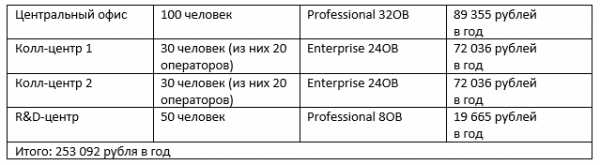
There is a saving of 73,140 rubles per year.
Considering a simpler example — two identical offices — it can be noted that, for instance, two IP PBXs with 16 simultaneous calls cost 11.5% less than one IP PBX with 32 channels.
Technical Implementation
In both examples, a number of constraints need to be considered:
- the need to configure two IP PBXs (which may incur additional costs and time);
- it is impossible to control the load distribution. For example, in two offices in different time zones, there can be a maximum of 100 simultaneous calls, but individually (during non-overlapping peak load periods) — up to 80.
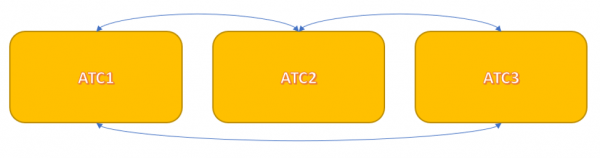
One of the advantages of using multiple IP PBXs on different servers is the potential increase in system reliability overall. If one server fails or there is no internet in one of the branches, the others can still communicate with each other via alternative routes. External lines can also be configured independently.
Conclusion
Regardless of the connection scheme, 3CX provides users with extensive functional capabilities, including specialized options for various business sectors (such as hotels and call centers).
Moreover, the ability to conduct web conferences with up to 250 participants, along with useful features for mobile employees, makes 3CX solutions quite attractive for modern companies that actively use unified communication tools. Thus, the corporate communication system based on 3CX solutions offers an optimal combination of invested resources and the scope of resolved tasks.
Only registered users can participate in the survey. , please.
What type of PBX do you use?
61,5%Software
30,8%Hardware
7,7%Virtual
13 users have voted. 4 users abstained.
Source: habr.com
