

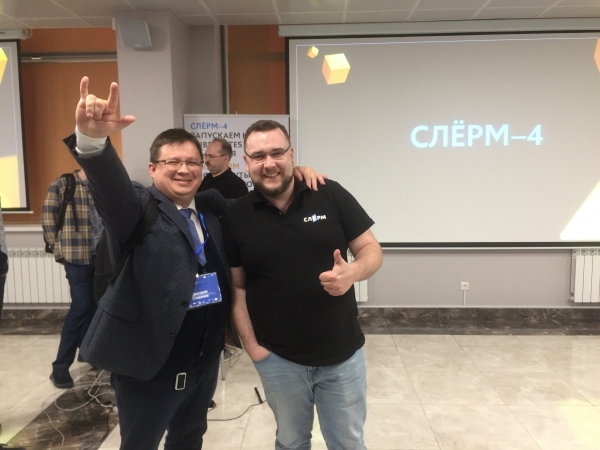
In April, the organizers of Slyrm reached out to me to test their Kubernetes courses and share my impressions.
Dmitry, Slyrm is a three-day intensive on Kubernetes, a focused educational event. It’s unlikely you can write about it if you just sit for two hours in the first lecture. Are you ready to participate fully?
Before Slyrm, it was necessary to complete preparatory online courses on Ansible, Docker, and Ceph.
Then, you need to take the code from the repositories and precise instructions, which will help you go through each command line step-by-step during the lectures with the instructors.
— I confirm that I am ready to fully participate in both courses.
And after that, there’s guaranteed intense work for 6 days (basic Slyrm and MegaSlyrm) in a classroom packed with system administrators.
Fountains
What is the complexity of developing services? For example, the business asks to conduct a promotional push notification campaign! It seems straightforward, there’s a full-stack developer with a website and mobile developers with a mobile app. A task that should take 15 minutes. Let’s tell the business we’ll manage it in a day!
And then it turns out that push notifications have never been sent before. They haven’t set up a third-party or self-hosted push notification platform in advance. And that’s no longer 15 minutes or even an hour; it’s good if they can set it up within a week. Magic and wonders begin. Everything is unclear, strange, and unpredictable.
Development has become completely unpredictable for one reason: it was not taken into account that besides the layer of business tasks, there is also an infrastructure layer.
If the layer of business tasks is a fountain spewing out a multitude of small tasks, hypothesis testing, and visual gimmicks, then infrastructure is its pipes. Here, a planning horizon of at least six months ahead is needed.
Pipes for fountains
Due to the complexity and the need to pay very careful attention to details, the development of the 'pipes' is handled by specially trained people: DevOps, who have grown out of the most experienced admins and developers. Their work is systematic and strictly sequential. They are like bridge builders—any mistake turns a simple 15-minute business task into an infrastructure re-planning that can take many days and significant costs.
Slerm is currently the only course in Russia (to my knowledge) that teaches how to build infrastructure in a standardized way, allowing for some mitigation of planning errors. I attended courses on Kubernetes, and I plan to enroll in a new DevOps course in September.
Slerm was created by Southbridge, an outsourcing company that has built dozens of fountains in various shapes. Southbridge is a certified KTP and KCSP (CNCF, Linux Foundation Member).
What exactly is taught in the Kubernetes courses?
How to organize everything developers create so that it doesn’t crash?
- Working with Kubespray
- Installing additional components
- Testing and troubleshooting the cluster
How to set up user (developer) authorization in the cluster for working with the cluster itself?
- LDAP (Nginx + Python)
- OIDC (Dex + Gangway)
How to protect against hackers at the network level?
- Introduction to CNI
- Network Security Policy
And overall security!
- PodSecurityPolicy
- PodDisruptionBudget
We don’t hide anything – we explain in detail what’s under the hood
- Controller structure
- Operators and CRD
Stateful applications in the cluster
- Launching a Database cluster using PostgreSQL as an example
- Launching a RabbitMQ cluster
How not to store numerous passwords and configs in plain text
- Secrets management in Kubernetes
- Vault
Horizontal scaling at the click of a button
- Theory
- Practice
Backups
- Backup and restoration of the cluster using Heptio Velero (formerly Ark) and etcd
Easy rollout to test, staging, and production
- Lint
- Templating and deployment tools
- Deployment strategies
There’s also a hardcore course that covers everything. Nevertheless, after the basic course, you can already start building your own fountain.
After Slerm, participants were left with artifacts – recordings of all days, detailed instructions on each topic with exact recipes whose commands can simply be copied to assemble either a backup solution, a testing environment, or something else.
So it’s that simple. Yes. You come for a few days, dive into the subject, get exact recipes, and return to your workplace to build the project infrastructure – simply, correctly, and, most importantly, predictably on timelines. The magic and sorcery are over; it’s just work now.
What’s the result?
At the end of the race, there is a feeling that real serious projects are built almost exclusively by DevOps professionals. It’s remarkable that all the material we covered is clear, and I apply it on my own servers every day.
Fortunately, the entire audience has moved to the Telegram chat, where there is still activity even weeks later.
What's next?
Organizers are preparing for Slorm DevOps this autumn, and I am getting ready too. I will write about this soon in my .
Source: habr.com
