

Friends, as you already know, we are working hard on — "Server in the Clouds 2.0", or "Space Data Center". In short: on April 12, we will launch a homemade server on a stratospheric balloon to an altitude of about 30 km, we will transmit data to it through a space communication system, and from the server, we will broadcast data back to Earth via radio communication.
Today, we want to talk about three space communication systems that we will test in our project — Iridium, GlobalStar, and "Gonets". For this, we will install receiving equipment next to our cloud server.
Brief History
All three described systems were created and deployed around the same time in the 1990s. The American Iridium is not only the oldest in conception (work began in 1990) but also the largest — it was initially planned to launch 77 satellites, corresponding to the atomic number of iridium, but today 66 satellites (+ 6 spare) are operational in orbit. Commercial operation of the system began in 1998. Within a year, the company went bankrupt, and in 2000, its assets were acquired by a company acting in the interests of the U.S. Department of Defense. Commercial operation resumed in 2001, and in 2009, the owner of Iridium changed again. Since then, this satellite communication network has been thriving.
GlobalStar was also founded in the U.S., although corporations from France, England, Germany, and South Korea participate in the project. The satellite constellation deployment began in 1998, and in 2000, GlobalStar went into commercial operation. There was also a bankruptcy, and in the early 2000s, the network changed owners. Today, 48 GlobalStar satellites (+ 4 spare) are operational in orbit.
The Russian "Gonets" system is an originally state project, not a private one. Development began back in 1989, and the first satellites were launched in 1996. It was initially planned for the constellation to consist of 24 satellites, but only 12 are currently in operation. In the coming years, the launch of several dozen more satellites is planned, including to replace aging ones.
Specifications and Capabilities
Iridium
Iridium offers the largest coverage with the highest data transfer speeds. Its satellites orbit the Earth at an altitude of 780 km on orbits inclined at 86.5°, covering the entire surface of the planet from pole to pole.
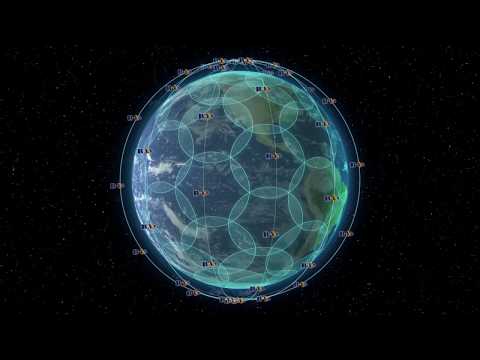
Currently, the ideal data transfer speed for Iridium reaches 352 Kbps, with plans to increase it to 704/352 Kbps (download and upload) by the end of the year. However, actual values are typically lower. When communicating by voice, the sound quality is not very good and there are noticeable distortions.
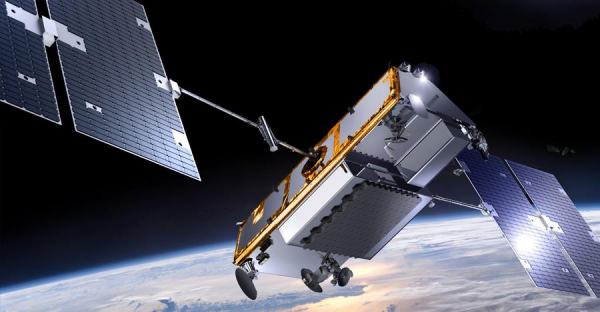
Iridium supports direct communication between satellites, which means the system can technically operate without numerous gateway stations in various countries for internet and landline telephone data transmission, unlike GlobalStar. Instead, all traffic can be sent through the satellite network to a main gateway station located in the USA. However, for reliability, gateway stations are likely still being constructed, although not in large numbers.
Iridium phones are among the most expensive on the market, although they come with rich features and capabilities. Both cellular modems and devices for text communication (which are much cheaper than voice communication) are available. To transmit data via Iridium, in addition to the phone, a computer is required with the proprietary Iridium Data Kit software installed. The communication services of this satellite network are priced higher than those of competitors. For instance, an annual voucher for 250 minutes within Russia costs 28,700 rubles, and a two-month voucher for 150 minutes worldwide costs 17,400 rubles. In postpaid plans, one minute of conversation starts at 58 rubles, SMS at 22 rubles, plus a subscription fee starting at 12,000 rubles (for less than six months) and 3,100 rubles (for more than six months). Additionally, the company has yet to establish roaming agreements with anyone, so GSM operator SIM cards cannot be used in Iridium devices, only 'native' ones.
GlobalStar
GlobalStar's satellites fly at an altitude of 1400 km and have an orbital inclination of 52°. The satellites do not exchange data with one another, which is why the system includes a network of gateway stations that act as a link between the relay satellites, the internet, and the landline telephone network.
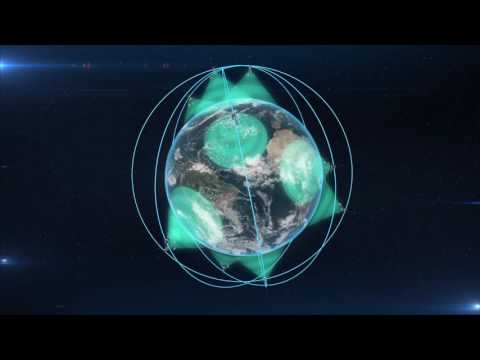
Iridium satellites are shown in red, GlobalStar in blue:
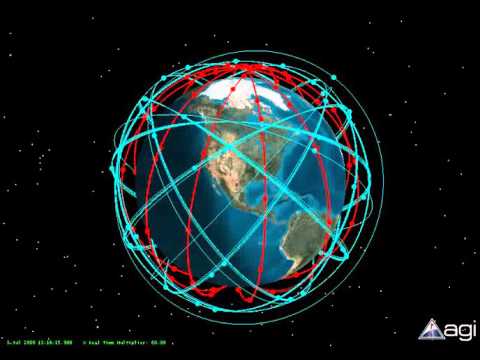
GlobalStar's coverage is modest — up to 70° north and south latitude, meaning polar regions are not covered by this network. However, reviews indicate that coverage can be unstable at other latitudes. Nevertheless, if the satellite is in direct line of sight, there will be no communication issues. Data transmission speeds with GlobalStar are lower than with Iridium, but the call quality is comparable to that of a mobile phone.
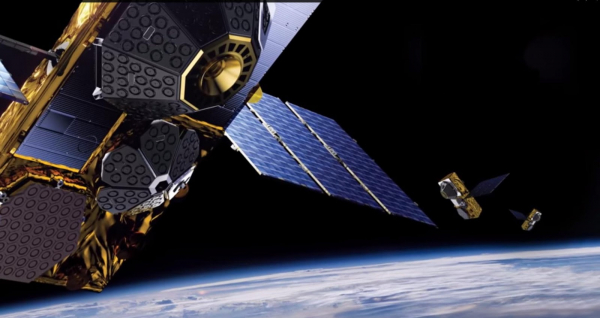
Formally, the network supports CDMA and GSM standards, but in practice, not all gateway stations work with GSM, although this is not relevant for our country. In most countries, you can insert SIM cards from 'regular' mobile operators into phones compatible with GlobalStar. Devices for GlobalStar are noticeably cheaper than those for Iridium. There are phones for various levels of sophistication, gadgets for text communication with a mechanical keyboard, hotspots, trackers for installation on vehicles or personal wear, and much more. There’s no subscription fee, and communication services are cheaper than Iridium: for example, a six-month package for calls within Russia with 250 minutes costs 9,800 rubles, while in postpaid rates, a minute starts at 44 rubles, SMS costs 4 rubles, and internet access starts at 13 rubles.
Gonets
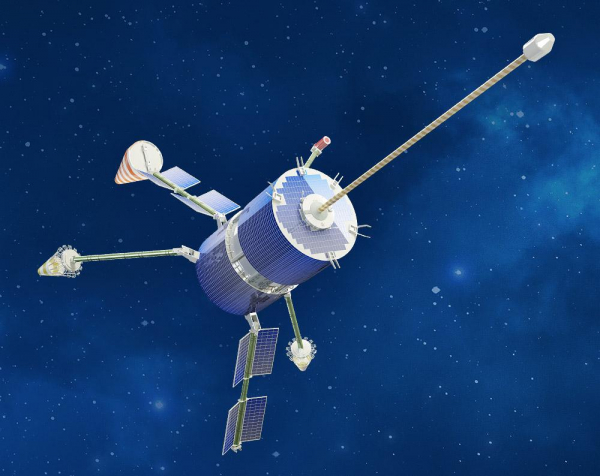
The satellites of this system orbit the planet at an altitude of 1500 km on orbits inclined at 82.5°. As a result, the coverage of the Earth's surface is complete, though not simultaneously.
In Russia, three gateway stations have been built (and one more is planned) that connect the satellite constellation to the internet.
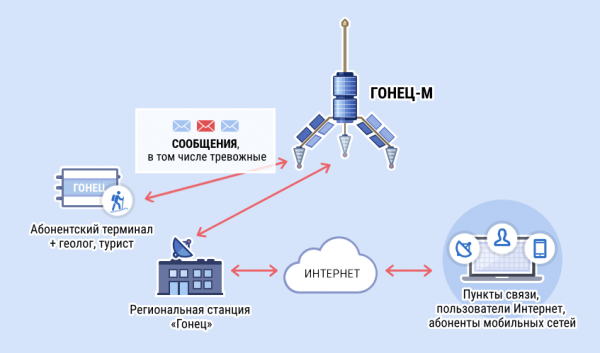
Interestingly, Gonets does not compete with other systems in the area of voice communication. Instead, this Russian project specializes in transmitting text messages. To use it, you need to purchase a subscriber device and an antenna, and connect a smartphone, laptop, or desktop computer to them. In short, it's an introvert's dream — all communication is in chat, with no unexpected calls.
Gonets also offers M2M communication services for automatic monitoring of the status and telemetry collection of various stationary and mobile objects.
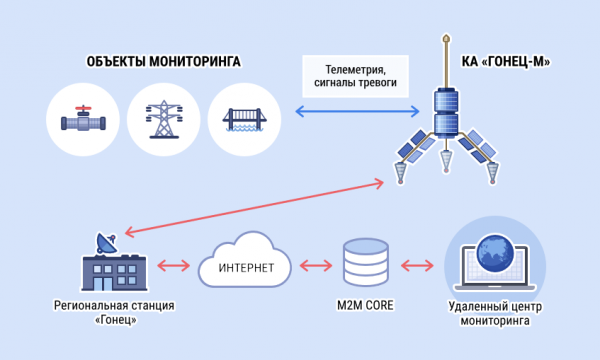
Additionally, it provides extra services such as retransmitting transportation geocoordinates and sending alerts.
Telecommunication services are paid based on a subscription fee — essentially, these are prepaid monthly packages of kilobytes of data. For example, with a zero subscription fee, they charge 26 rubles for each kilobyte of data transmitted, and there are a number of packages ranging from 470 rubles (30 KB) to 8,650 rubles (2,000 KB). Additionally, there is a charge of 10 rubles for each outgoing message to mobile networks in Russia. Every kilobyte over the limit is charged separately, from 11 to 26 rubles.
What should we choose?
Our requirements are as follows: to equip the 'cloud' server with a tracker for location tracking and a module for data exchange via satellite. Theoretically, these features can be offered by all three networks. We have already acquired Iridium and GlobalStar modems, and the device from 'Gonets' is on its way to us. We will definitely share more details about our communication system in one of our future publications.
In the meantime, we invite you in our experiment, guess the landing point of the probe, and win the grand prize — a trip to Baikonur.
Don't disconnect!
Source: habr.com
