

Recently, Cloud4Y conducted , dedicated to TCO issues, specifically the total cost of ownership of equipment. We received many questions on this topic, indicating a strong interest from the audience to understand it better. If you're hearing about TCO for the first time or want to learn how to properly assess the benefits of using your own or cloud infrastructure, it’s worth reading on..
When it comes to investing in new hardware and software, debates often arise over which infrastructure model to use: on-premise, cloud platform solutions, or hybrid? Many opt for the first option because it seems "cheaper" and "everything is right at hand." The calculation is made simply: compare the prices of your own hardware to the costs of cloud providers' services, and then draw conclusions.
This approach is flawed. Cloud4Y explains why.
To accurately answer the question of "how much does your own equipment or the cloud cost," it is essential to evaluate all expenses: capital and operational. This is precisely why TCO—total cost of ownership—was developed. TCO encompasses all costs directly or indirectly associated with acquiring, implementing, and operating a company's information systems or hardware-software complex.
It is important to understand that TCO is not merely a fixed figure. It represents the total amount of resources that a company invests from the moment it becomes the owner of the equipment until it disposes of it.
How TCO Was Conceptualized
The term TCO (Total Cost of Ownership) was officially introduced by the consulting firm Gartner Group in the 1980s. Initially, it was used in their research for calculating the financial costs of owning Wintel computers, and in 1987, the total cost of ownership concept was fully articulated for business use. This means that the model for analyzing the financial side of using IT equipment was created back in the last century!
The widely accepted formula for calculating TCO is:
TCO = Capital Expenses (CAPEX) + Operational Expenses (OPEX)
Capital expenses (or one-time, fixed costs) refer only to the costs associated with the acquisition and implementation of IT systems. They are called capital because they are required only once, in the initial stages of creating information systems. They also incur subsequent ongoing costs:
- Cost of project development and implementation;
- Cost of external consultancy services;
- Initial purchase of essential software;
- Initial purchase of additional software;
- Initial purchase of hardware.
Operational costs arise directly from the operation of IT systems. They include:
- Costs of maintenance and modernization of the system (staff salaries, external consultants, outsourcing, training programs, obtaining certifications, etc.);
- Costs related to comprehensive management of the system;
- Costs associated with active use of information systems by users.
The new approach to calculating costs has become popular among businesses for a reason. In addition to direct costs (equipment costs and salaries of support staff), there are also indirect costs. These include salaries of managers who are not directly involved in working with the equipment (IT directors, accountants), advertising expenses, rental payments, and representation expenses. There are also non-operating expenses, which include interest payments on loans and securities held by the organization, financial losses due to currency instability, penalties in the form of payments to counterparties, etc. This data also needs to be included in the total cost of ownership calculation formula.
Example of calculation
To clarify, let's list all the variables in our total cost of ownership calculation formula. We will start with capital costs for equipment and software. The total expenditure includes:
- Server equipment
- NAS
- Virtualization platform
- Information security equipment (cryptogates, firewalls, etc.)
- Network equipment
- Backup system
- Internet (IP)
- Software licenses (antivirus software, Microsoft licenses, 1C, etc.)
- Disaster recovery (redundancy in 2 data centers, if necessary)
- Hosting in data centers / rental of additional space
From ancillary costs, we need to consider:
- Designing the IT infrastructure (hiring a specialist)
- Installation of equipment and commissioning work
- Infrastructure maintenance costs (staff salaries and consumables)
- Lost profits
We will calculate for one company:
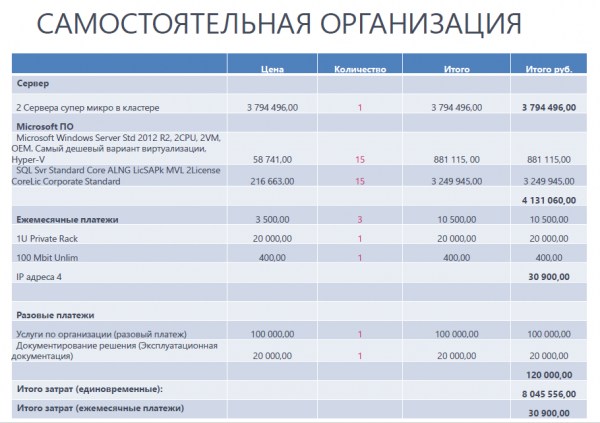
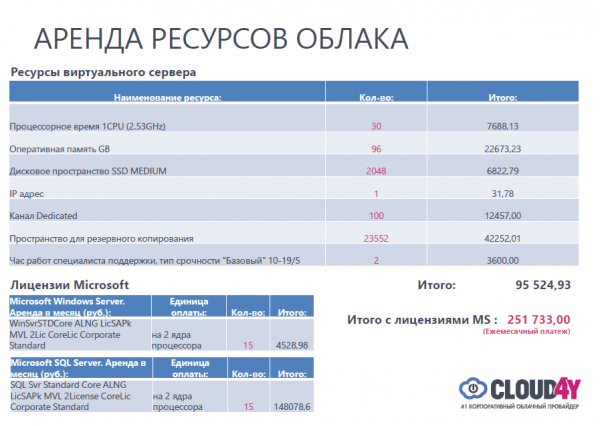
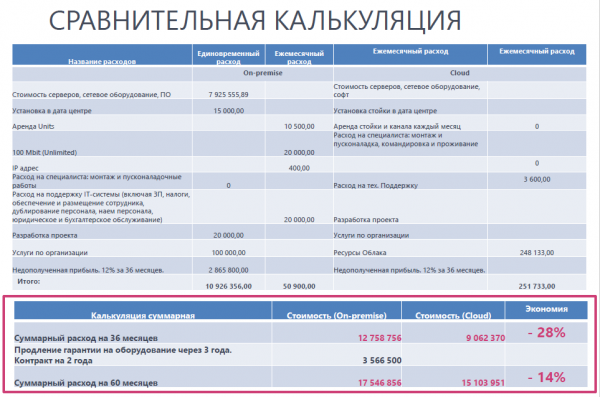
As this example shows, cloud solutions are not only comparable in price to on-premise options but can even be cheaper. Yes, to get objective figures, you need to do the calculations yourself, and this is more complicated than the usual statement that 'own hardware is cheaper.' However, in the long run, a meticulous approach proves more effective than a surface-level one. Efficient management of operational costs can significantly reduce the total cost of ownership of IT infrastructure and save part of the budget for new projects.
Moreover, there are other arguments in favor of the cloud. The company saves money by avoiding one-time equipment purchases, optimizes its tax base, gains instant scalability, and reduces risks associated with owning and managing information assets.
What else is interesting in the blog
→
→
→
→
→
Subscribe to our -channel so you won't miss the next article. We write no more than twice a week and only when necessary.
Source: habr.com
