

Hello Habr.
In recent years, the introduction of the digital radio standard DAB+ has been discussed in Russia, Ukraine, and Belarus. While the process has not yet advanced in Russia, it seems that Ukraine and Belarus have already moved on to test broadcasting.
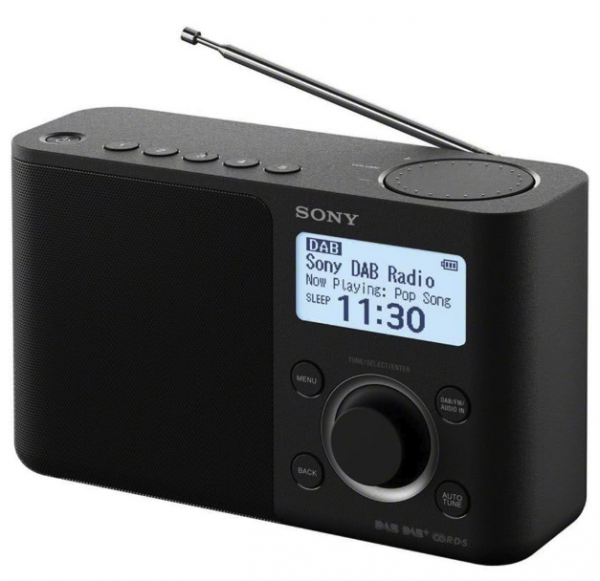
How does it work, what are the pros and cons, and is it even necessary? Details below.
Technology
The idea of digital radio began to emerge in the late 1980s, when it became clear that the "space" in the conventional FM band was no longer sufficient for everyone — in large cities, the available spectrum between 88 and 108 MHz had been exhausted. In this regard, DAB was considered a decent alternative — this digital standard allows for more stations to be broadcast due to more efficient encoding. The first version of DAB used the MP2 codec, while the second version (DAB+) employs the newer HE-AAC. The standard itself is quite old by modern standards — the first DAB station started operating in 1995, and the DAB+ station followed in 2007. In fact, the age of the standard is more of an advantage than a disadvantage in this case — there is now no problem finding a radio receiver to suit any taste and budget.
There are quite a few differences between DAB and conventional FM. It's not just that one is "digital" and the other is "analog". The principle of content transmission itself differs. In FM, each station broadcasts independently, while in DAB+, all stations are combined into a "multiplex", with up to 16 stations in each multiplex. Different frequency channels are provided, allowing different countries to choose those that are free from other services.
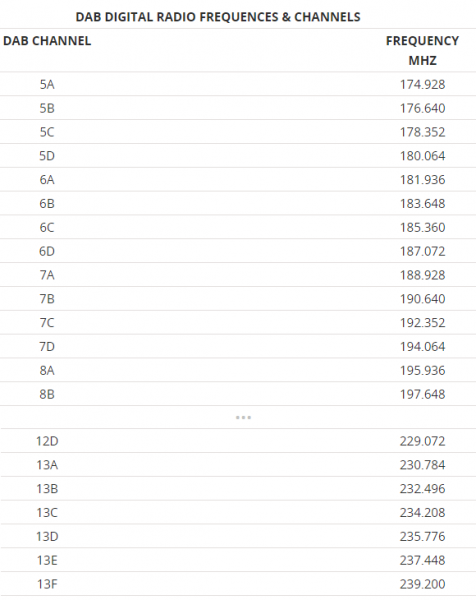
From a business perspective, this distinction raises several debates among broadcasters regarding how to operate within the multiplex. Previously, broadcasters obtained licenses for frequencies themselves, purchased antennas and transmitters, but now the license will be issued to the multiplex operator, who will then lease the channels to radio stations. Whether this is better or worse is hard to say; some find it more convenient to own all their equipment, while others prefer leasing.
Interestingly, in this regard, DAB has a significant downside for listeners — the cost of leasing a multiplex depends on the bitrate.And if you have to choose between 192 and 64 kbps, I think everyone understands what will be chosen. While broadcasting in FM with poor quality is quite difficult, in DAB it is even economically encouraged (though this isn’t the fault of the standard's developers). Currently, Russian prices are unknown, but English prices can be referenced as an example. .
From a technical standpoint, the DAB+ multiplex is a broadband signal with a bandwidth of around 1.5 MHz, which is clearly visible using an RTL-SDR receiver.
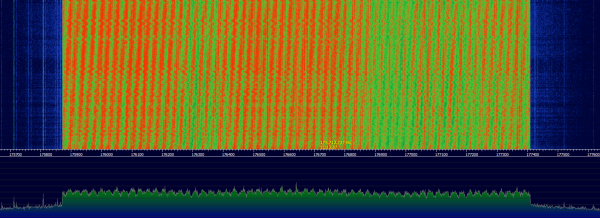
A more detailed description can be found in the PDF. .
Competing standards
There aren’t that many of them. In Europe, DAB+ is used, while in the USA the standard is popular. , and in India, experiments were conducted with the standard. , but the outcome of those is hard to say.
The map is slightly outdated (DRM was also tested in Russia, but it was ultimately abandoned), but the overall idea can be understood:
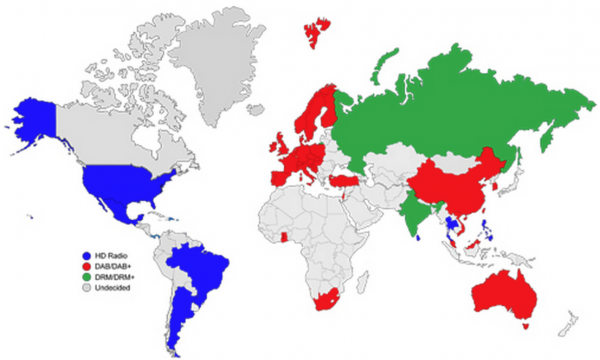
(source )
In contrast to DAB, the creators of the HD Radio standard took a different path — the digital signal is placed right next to the analog one, allowing broadcasters to use their own antennas and masts.
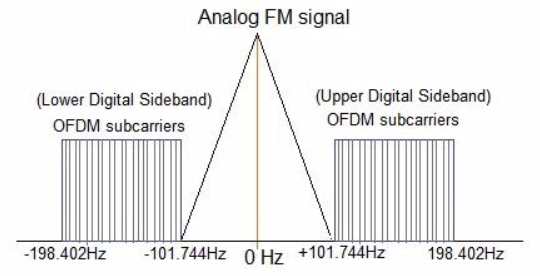
However, this doesn’t solve the problem that started it all — the lack of free spectrum. And geographically (and perhaps politically), adopting the European standard in former CIS countries seems more logical than using the American standard — there's simply a wider selection of European products and it's easier to buy receivers. In 2011, there were still mentions , but it was all ultimately shelved (thankfully so, as an incompatible proprietary digital standard would have been the worst thing to have for radio listeners).
Testing
Finally, let’s move on to the practical part, i.e., testing. DAB is currently not operational in Russia, so we will be using SDR recordings from the Dutch multiplex. Interested parties from other countries can also join in and send me IQ format recordings, which I will process and compile into a summary table.
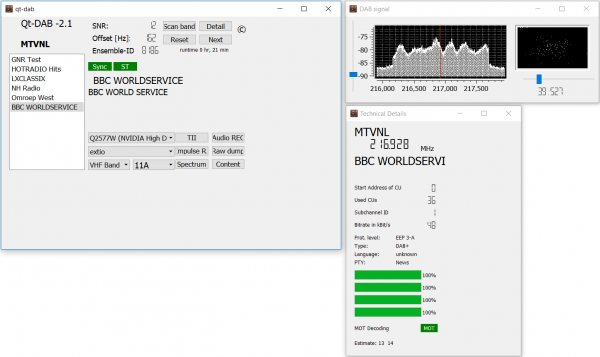
What can you use to listen to DAB? Since it’s a digital standard, it can be decoded using a computer and an rtl-sdr receiver. There are two programs — and , both of which work with rtl-sdr.
It looks like a student's term paper, and the author clearly did not care about the design—the fonts don't fit in the controls, and the windows do not scale. But the most important thing for us is that it allows reading and writing IQ files.
It's still in beta, but it works much better and decodes more efficiently. There's also the option to output quite a bit of additional debugging information:
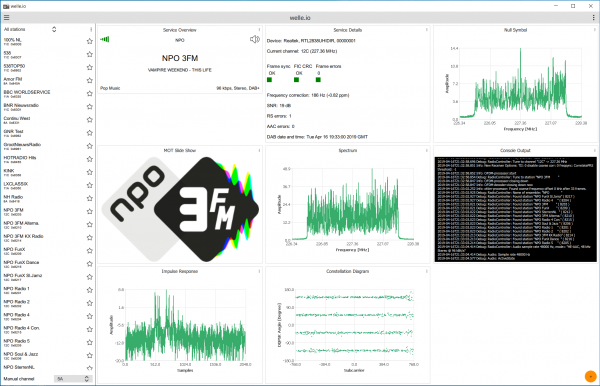
However, welle.io still cannot work with IQ files, so we'll be using Qt-dab.
For testing, I uploaded three files to cloud.mail.ru, each containing a one-minute recording of the DAB multiplex, with a file size of about 500MB (this is the size of IQ recordings for SDR with a bandwidth of 2.4MHz). The files can be opened in Qt-dab, the download link for which is given above.
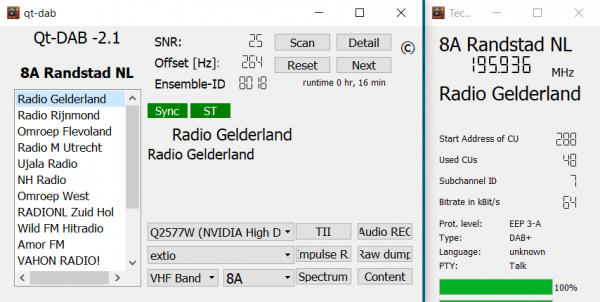
File-1: DAB-8A.sdr — . The 8A multiplex operates at a frequency of 195.136MHz and contains 16 stations. The bitrate for all stations is 64Kbps.
File-2: DAB-11A.sdr — . The 11A multiplex is at a frequency of 216.928MHz. It contains 6 stations, with bitrates of 48, 48, 48, 48, 64, and 48KBps respectively.
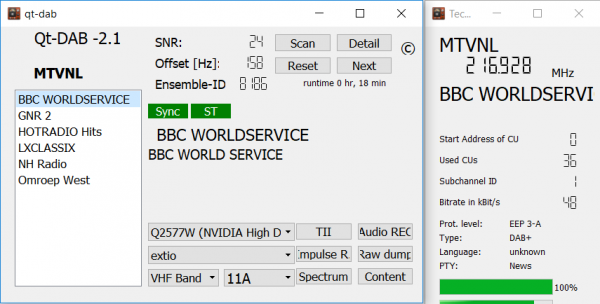
File-3: DAB-11C.sdr — . The 11C multiplex operates at a frequency of 220.352MHz, also containing 16 stations. The bitrates for all stations are: 80, 80, 80, 80, 56, 96, 80, 64, 56, 48, 64, 64, 64, 96, 80, and 64Kbps.
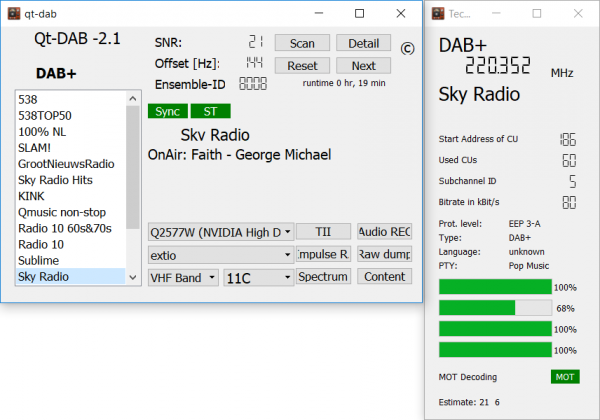
As you can see, there are no issues with the number of stations, but the main problem is the low bitrate. Regarding the content itself, tastes vary, and I won't discuss it; those interested can download the files and listen for themselves. Not all multiplexes are included in the recordings, but I hope the general idea is clear.
Conclusions
When it comes to the prospects of digital broadcasting, unfortunately, they are quite bleak. The main advantage of DAB is more efficient spectrum usage, allowing more stations to be broadcast. In this respect, DAB+ only makes sense for cities where there is no free space left in FM. For Russia, this is probably just Moscow and St. Petersburg; in all other cities, there are no such problems.
Regarding sound quality, technically, DAB+ can provide a bitrate of up to 192 Kbps, which will give almost HiFi sound. In practice, as we see above, broadcasters save and do not even reach the threshold of 100 Kbps. Among the three multiplexes, there was only one (!) station broadcasting at 96 Kbps (and I can only call broadcasting music at 48 Kbps sacrilege — such broadcasters should have their licenses revoked;). Unfortunately, we can confidently say that transitioning from FM to DAB will result in worse quality than before. Of course, the situation may be better in other countries, but for example, there is an English review on YouTube with the telling title . Technically, DAB is good and there are no complaints about it, but economically, "money defeated evil."
Returning to Russia, is it worth starting to broadcast in DAB at all? From the perspective of international prestige, probably yes, in order not to appear as a backward third-world country in the eyes of neighbors, and as a bonus, so that cars and radios bought in Europe can fully receive all stations. However, from the viewpoint of listeners and sound quality, likely, there will be no benefits in sound quality or content for users.
If we think about the distant future, probably a radio receiver will become a device with an integrated e-sim card and subscription to Yandex Music, Spotify, or Apple Music upon purchase. The future undoubtedly lies with streaming services and personalized content. How soon this will happen remains to be seen; time will tell.
Source: habr.com
