

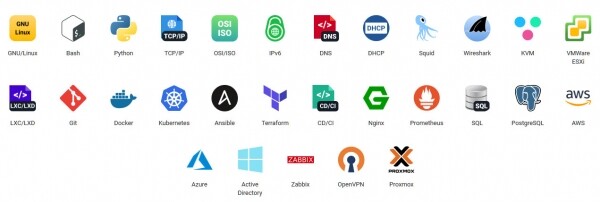
Technologies and tools that a DevOps engineer needs to master.
DevOps is an emerging trend in IT, and the popularity and demand for this profession are gradually increasing. Recently, GeekBrains has opened a , where specialists of the relevant profile are being trained. By the way, the profession of DevOps is often confused with related fields like programming, system administration, etc.
To clarify what DevOps is and what representatives of this profession do, we spoke with Nikolai Butenko, an architect . He participated in the development of the DevOps faculty course program and concurrently teaches third-quarter students.
What should a good DevOps know and be able to do?
It's better to start by stating what he shouldn't be able to do. There's a myth that a representative of this profession is a jack-of-all-trades who can write excellent code, then test it, and in his free time goes and fixes his colleagues' printers. Perhaps he even helps in the warehouse and substitutes as a barista.
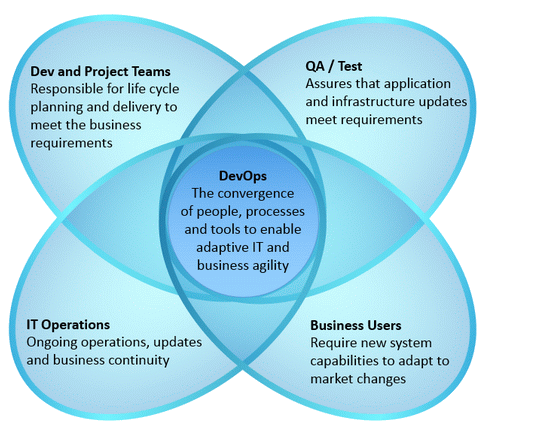
To know what a DevOps specialist should be capable of, let's return to the definition of the concept itself. DevOps is the optimization of the time from product development to market release. Accordingly, the specialist optimizes the process between development and operations, communicates in their language, and builds a proper pipeline.
What needs to be known and done? Here are the essentials:
- Good soft skills are necessary since interaction with multiple departments within the same company is required.
- Analytical and structured thinking to view processes from above and understand how to optimize them.
- One must understand all aspects of development and operations processes. Only then can they be optimized.
- Excellent planning, analysis, and design skills are also needed to create a unified production process.
Are all DevOps representatives the same, or are there differences within the profession?
Recently, several branches have emerged within the same specialty. However, in general, the concept of DevOps primarily includes three areas: SRE (Site Reliability Engineer), Developer, and Manager (who is responsible for interaction with the business). A DevOps specialist understands the business needs and organizes efficient work among everyone by creating a unified process.
They also have a good grasp of all the processes in the product development cycle, architecture, and have knowledge of information security to the extent that they can assess risks. Furthermore, DevOps professionals are familiar with automation approaches and tools, as well as pre- and post-release support for software and services. Overall, the goal of DevOps is to perceive the entire system as a whole, directing and managing processes that contribute to the development of that system.
Unfortunately, both in Russia and abroad, employers do not always understand the essence of DevOps. Browsing published job listings reveals that when companies refer to a DevOps position, they are often seeking system administrators, Kubernetes administrators, or even testers. Particularly striking is the highly varied mix of knowledge and skills in DevOps job listings on HH.ru and LinkedIn.
It is important to note that DevOps is not just a profession; it is, first and foremost, a methodology for treating infrastructure as code. As a result of implementing this methodology, all team members in development see and understand not only their area of work but also gain insights into the functioning of the entire system.
How can DevOps assist the company you work for?
One of the most important metrics for business is Time-to-Market (TTM). This is the time it takes to bring a product to market, meaning the period from the idea of creating the product to its release for sale. TTM is especially crucial for those industries where products quickly become obsolete.
With the help of DevOps, a number of well-known retailers in Russia and abroad have started to develop new directions. These companies are increasingly transitioning online, completely or partially abandoning offline platforms. In these conditions, rapid development of applications and services is needed, which is impossible without using DevOps tools.

As a result, some retailers managed to speed up the process of deploying the necessary applications and services literally in a day. This is a crucial factor in competition in today's market.
Who can become a DevOps?
Certainly, it will be easier for those with technical backgrounds: programmers, testers, system administrators. Those who are entering this field without the appropriate education need to be prepared to learn the basics of programming, testing, process management, and system administration. Only after mastering all this can one begin to study the DevOps concept as a whole.
To better understand the concept and gain insight into the necessary knowledge and skills, it is advisable to read "The DevOps Handbook," study "The Phoenix Project," and explore the methodology. Another great book is .
DevOps is typically best suited for individuals with an analytical mindset who can employ a systematic approach. It's hard to say how long it will take a newcomer to become a proficient DevOps engineer. This largely depends on their initial knowledge base, the environment, the tasks they need to address, and the size of the company. Among the companies in need of DevOps engineers are many tech giants: Amazon, Netflix, Adobe, Etsy, Facebook, and Walmart.
In conclusion, it can be said that more than half of the job postings for DevOps are actually intended for experienced system administrators. Nevertheless, the demand for DevOps is gradually increasing, and there is currently a great shortage of skilled professionals in this field.
To become such a specialist, one must study new technologies, tools, employ a systematic approach in their work, and effectively apply automation. Without this, it is very difficult, if not impossible, to properly organize DevOps.
Source: habr.com
