


There are people who enjoy using quality components from the enterprise segment in their daily lives. They want to be sure that their SSD won't suddenly fail due to power loss or during daily downloads of huge 4K torrents on a fragmented NTFS partition with or during another Gentoo compilation from source.
Of course, such concerns rarely materialize in practice, but it's very pleasant to use an SSD with Power Loss Protection (, , ), which has an almost unlimited write endurance. Even when its capacity becomes insufficient for current tasks, it can still be used as a USB drive or given away or sold.
This article presents a list of enterprise SSDs with a capacity of 1.92TB, which have recently dropped to the level of consumer SSDs (< $300) but have a write endurance of 2 Petabytes and more.
So, thanks to the recent drop in SSD prices, we can afford to install multi-terabyte server monsters in home PCs and laptops.
The SATA III interface itself has not evolved for a long time, so SSDs released for enterprise use several years ago still work well for upgrading laptops or desktops with SATA interfaces, but their prices have fallen drastically.
I consider this size of ~2TB optimal for upgrading an old system:
- This is the maximum size supported by MBR. So if your BIOS does not support UEFI, this is your option. You're maxing out your disk subsystem (which is relevant for laptops with a single disk).
- These drives have a sector size of 512 bytes, allowing them to be used with any software. Even with Windows XP.
In addition to their enormous write endurance, enterprise SATA SSDs differ by:
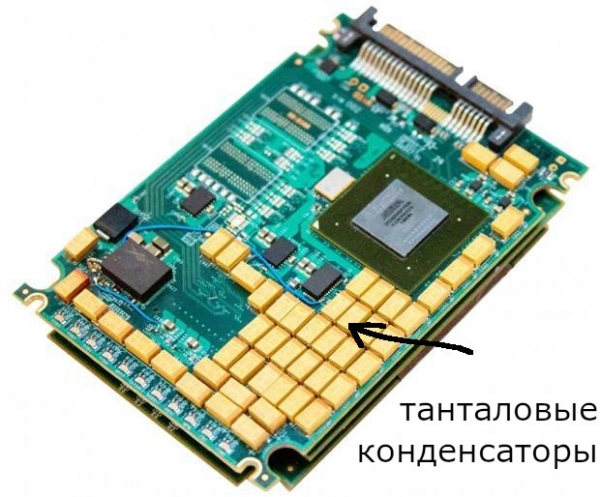
- Power protection. In the event of a power failure, tantalum (or occasionally ceramic) capacitors provide SATA SSDs with enough power to write the cache, preventing the filesystem from being corrupted.

- Stability of performance characteristics. Consumer SSDs often use SLC cache, which, once filled, can significantly reduce speed.
- Manufacturers sort flash memory chips by quality. The best ones are used in enterprise SSDs.
- Sometimes MLC memory is used instead of the cheaper TLC, 3D-NAND TLC, QLC.
Here is a table of reasonably priced (up to $300) 2TB enterprise SSD models. I primarily checked prices on online auctions and sites like Avito. However, some disks from the list can also be purchased in regular stores for about 25% more. The higher a disk is in the table, the more advantageous its price.
This table contains SSDs not only with MLC, otherwise there would be only 2 entries.
Title
PBW
Type of flash memory
4k read iops, K
4k write iops, K
read, MB/s
write, MB/s
Example model
3.5
MLC
75
14
524
503
THNSN81Q92CSE
2.1
MLC
75
14
530
460
SDLF1CRR-019T-1Hxx
2.8
32 layer V-NAND MLC
99
18
540
480
MZ7LM1T9HCJM
2.733
32 layer V-NAND MLC
97
28
520
480
MZ7LM1T9HMJP
2.8
V-NAND MLC
up to 98
up to 28
up to 560
up to 520
MZ-7LH1T9NE
2.1
Micron 3D eTLC
93
9-31
540
380-520
MTFDDAKxxxTBY
8.8
Micron 3D eTLC
78-93
26-43
540
250-520
MTFDDAKxxxTCB
3.5
Micron 64-layer 3D TLC NAND
95
22
540
520
MTFDDAK1T9TDC-1AT1ZABYY
5.95
Micron 64-layer 3D TLC NAND
95
32
540
520
MTFDDAK1T9TDD-1AT1ZABYY
To understand what speeds we will achieve after the upgrade, I will provide several screenshots from CrystalDiskMark 6.0.2. Many outdated motherboards lack the SATA III interface, so I will add some results obtained on SATA II and SATA I.
Toshiba HK4R 1.92TB
SATA II
Intel ICH10R SATA AHCI
SATA III
AMD SB7x0/SB8x0/SB9x0 SATA AHCI
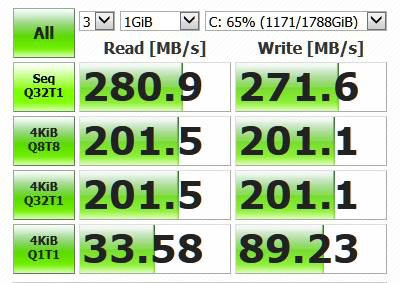
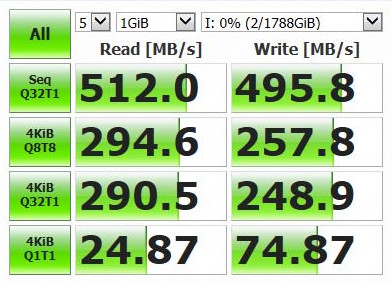
An interesting fact — the SATA II controller turned out to be so successful that it surpassed the SATA III controller in a single-threaded random read/write test with a queue depth of 1.
The difference in performance between SATA I (still found on older motherboards) and SATA III is worth noting.
SanDisk CloudSpeed Eco II 1.92TB
SATA I
Intel 82801GBM/GHM (ICH7-M Family) SATA AHCI
SATA III
AMD SB7x0/SB8x0/SB9x0 SATA AHCI
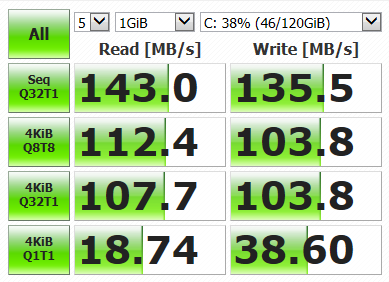
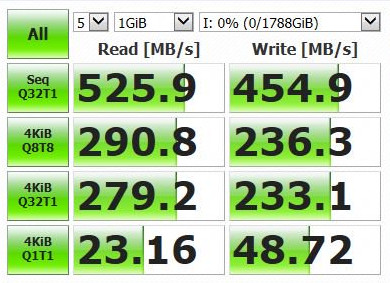
This time, the victory of SATA III is more convincing. However, in single-threaded random access with a queue depth of 1, the difference does not exceed 20%.
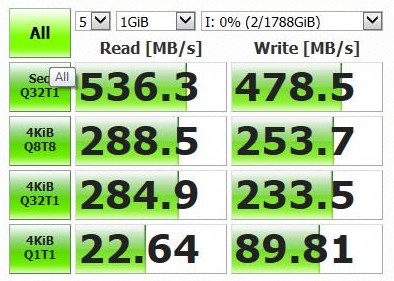
Unfortunately, I couldn't obtain all the SSDs from the aforementioned table for testing. Therefore, here is the last image:
Samsung PM863 1.92TB
SATA III
AMD SB7x0/SB8x0/SB9x0 SATA AHCI
Conclusions
1.92TB SSD with endurance measured in petabytes will satisfy any data paranoid and is perfect for upgrading both laptops and desktop computers with SATA interfaces.
P.S. Thanks for the image .
P.P.S. Please send any noticed errors via private message. I am rewarding karma for this.
Source: habr.com
