

When one of our employees told his sysadmin friend, "We now have a new service — VDS with a graphics card," the friend chuckled in response: "What, are you going to push the office folks into mining?" At least he didn’t joke about gaming, so that’s something. He understands little about the life of a developer! But deep down, we couldn’t help but wonder if anyone really thinks that a graphics card is only for miners and gaming enthusiasts? In any case, it's better to check seven times and also discuss why VDS with a graphics card was conceived and why it’s so important.

Certainly, if you need a rented VDS with a graphics card for gaming, don’t read any further, just head to the service page and check the terms/prices — you’re sure to like it. For everyone else, we invite you to discuss: is a VDS with a graphics card really necessary as a service, or is it easier to deploy your own software-hardware complex?
The answer to this question depends on the business and how its processes are organized. In fact, such an offer may interest advertising agencies with their Photoshop and CorelDRAW users, design agencies that utilize 3D software, and project organizations using AutoCAD. Employees of these companies will be able to work from anywhere, thus allowing hiring from anywhere without incurring significant expenses for powerful equipment.
Currently, graphic card resources are actively used by developers of popular software: any modern browser will render web pages significantly faster if it can leverage a graphics accelerator, not to mention that there are 3D applications and games for these browsers that run on WebGL.
Therefore, it can be assumed that a VDS with a graphics card will suit many IT companies, online stores, advertising and design agencies, companies involved in data analysis, and so on. Let's attempt to classify and describe in more detail the most relevant use cases.
The first obvious application is graphics processing. A VDS with a graphics card will provide the computational power needed for quick work with 3D graphics, animation, and 2D graphics. This configuration is optimal for designers and gaming companies, as it can handle modeling, Corel, Photoshop, AutoCAD, etc. Additionally, as we discussed earlier, this service offers a significant advantage: companies can easily form distributed teams without incurring massive costs.
Also VDS Companies that need to quickly solve complex tasks or handle a large number of discrete simple tasks may be interested in a VDS with a graphics card. These are companies that collect and process data from numerous sensors or IoT infrastructure, have billing requirements, work with big data, and need ultra-fast metric collection, etc. If you are working with business applications based on Big Data, you will appreciate the speed of data analysis and processing. The computational advantages of VDS with graphics cards in tackling these tasks stem from the fact that the graphics card is supported by powerful RAM and has more arithmetic logic units than a CPU, allowing for significantly more operations to be executed simultaneously.
The third application area, and the first in terms of importance, for VDS configurations with graphics cards is information security tasks, such as traffic monitoring and control in high-load networks, as well as creating test benches for running penetration testing cases.
Such a server will also assist companies or individual developers working on training neural networks — a domain where processing power is always a benefit.
Finally, a VDS with a graphics card is ideal for streaming, meaning live broadcasts of events, music, and video content. This option is suitable for streaming from public cameras and may attract conference organizers, etc.
Another scenario suggested by developers using VDS with graphics cards in real-time is that this configuration works well for launching Android emulators when developing mobile applications (especially games).
Among private tasks, we would highlight two main ones that involve a set of frequent computational operations. The first is mining (is anyone doing that?). The second is more interesting and less demanding. It involves working with trading systems like QUIK. This configuration is comfortable for high-frequency trading.
And lastly, the most basic task addressed by a VDS with a graphics card. It doesn't matter whether you are a private or corporate client, nor what software you use: accounting, modeling, or design. Fast interface rendering will always be crucial, especially when using multiple RDP connections.
Testing
Of course, the tests provided will have nothing in common with your real tasks, business processes, and implementation ideas, so treat them as examples.
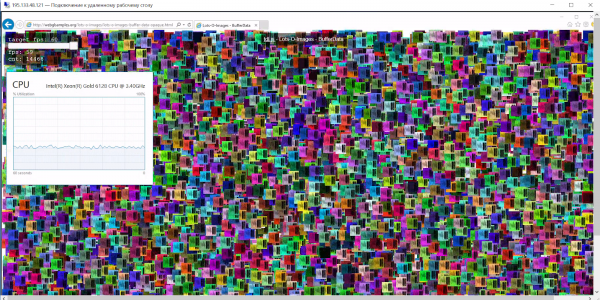
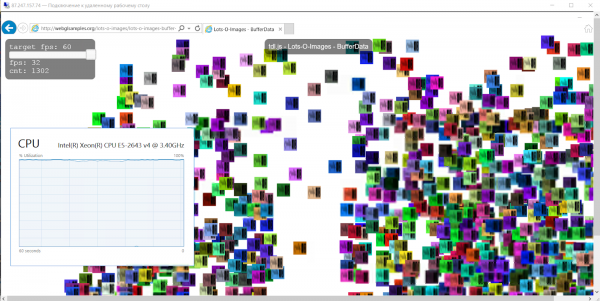
For testing, we compared a virtual server with 2 CPU cores and 4 GB of RAM with a virtual graphics card of 128MB and without a graphics card. We ran the same WebGL in Internet Explorer on both virtual machines. the extension's page. On the page, squares of size 32×32 were rendered at a speed of 60 frames per second.
This is the picture we obtained on the virtual server with the installed graphics card. The rendering speed was 59-62 frames per second, the entire space was filled, and the number of sprites reached 14,000.
Clickable:
The result on a similar VPS without a graphics card. The rendering speed was 32 frames per second, with the CPU fully loaded at 100%, we had 1302 sprites, and an unfilled area.
Clickable:
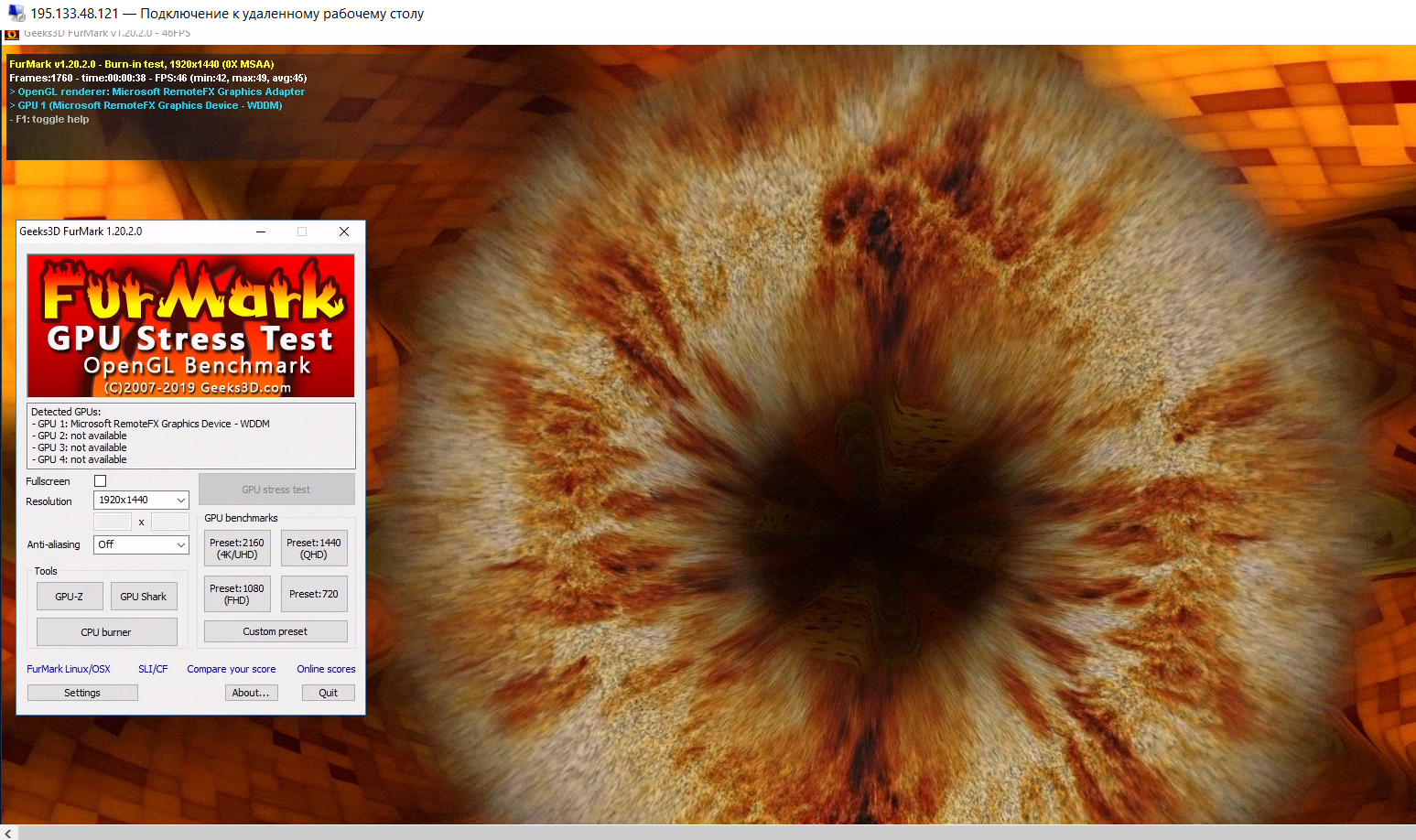
We also tested our graphics card using the FurMark benchmark at a resolution of 1920 by 1440 pixels, achieving an average of 45 frames per second.
Clickable:
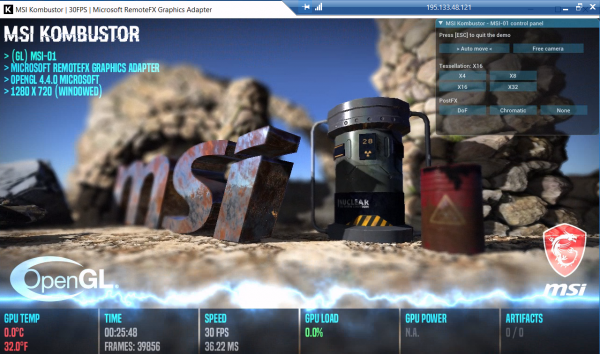
Another stress test for the graphics card using MSI Kombustor, where we checked the card for various artifacts. During the testing, no multicolored spots, geometric shapes, stripes, or other artifacts should appear on the screen. After 25 minutes of testing the graphics card, everything was normal, and no artifacts appeared.
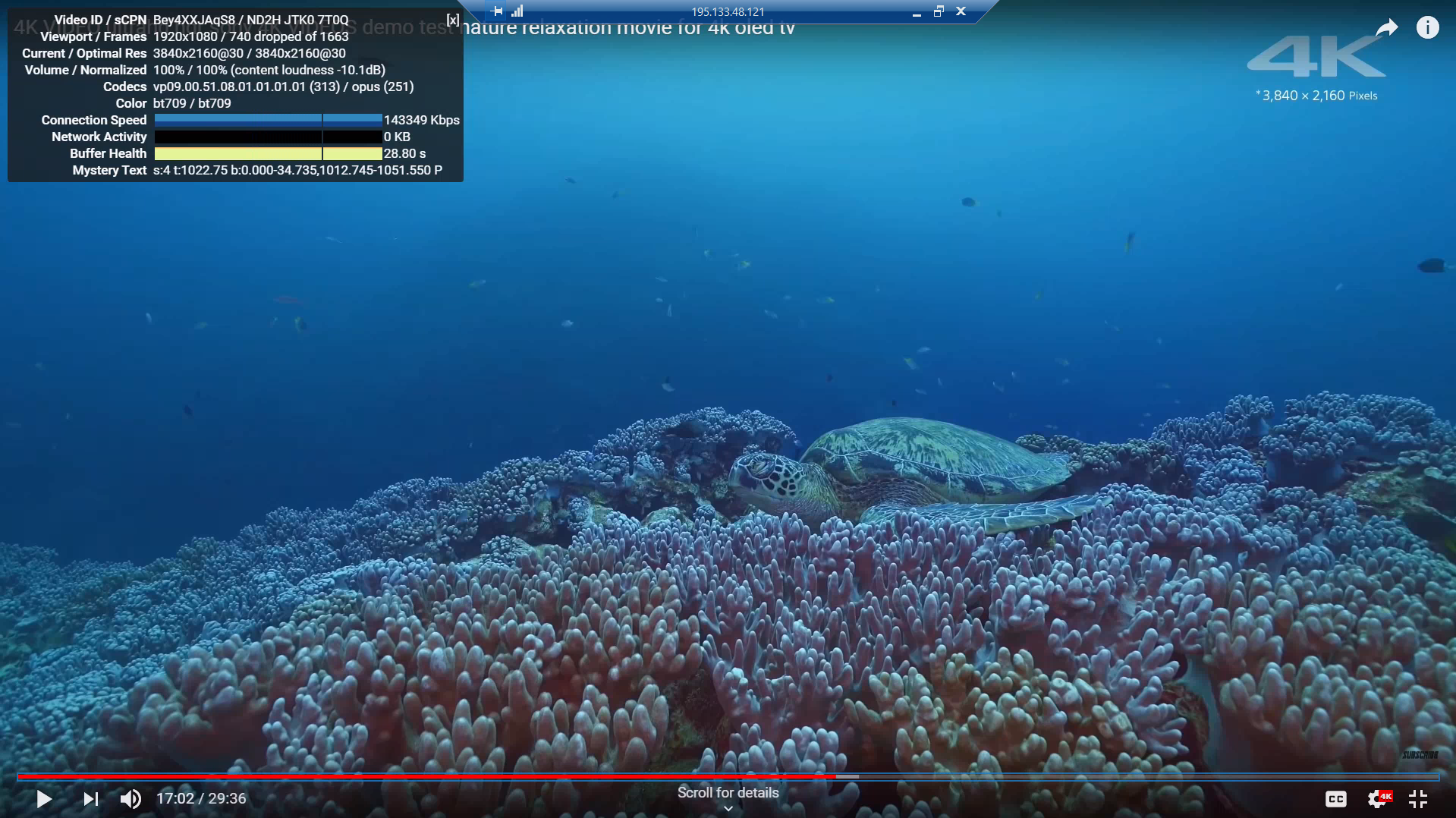
We played a video on YouTube in 4K. Clickable:

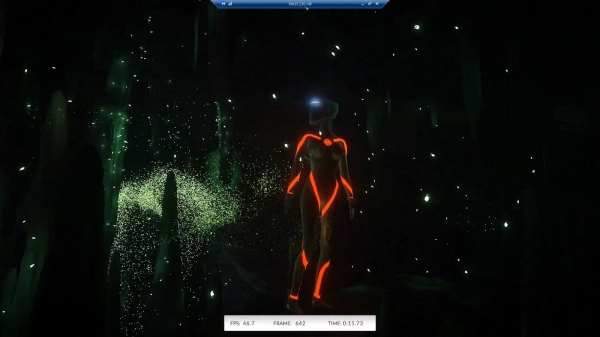
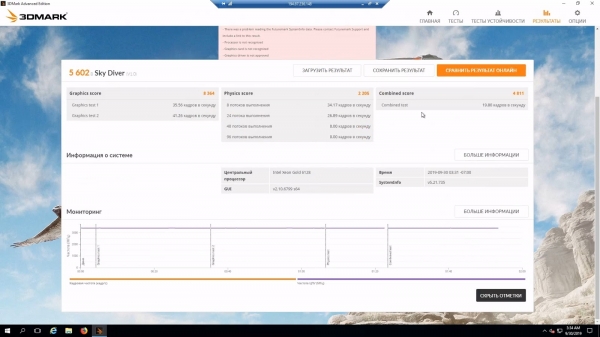
We also ran tests in 3DMark. We got an average of about 40 frames per second.
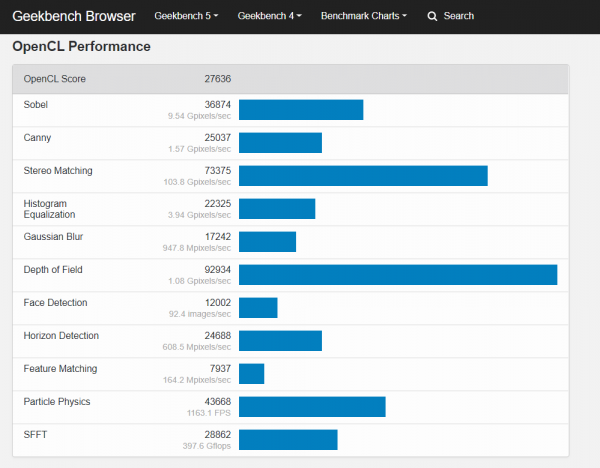
We conducted a test using the Geekbench 5 benchmark for OpenCL.
We were pleasantly surprised by the test results. Try it out, test it, share your experiences.
By the way, has anyone tried the VDS configuration with a graphics card? What did you use it for, and how did it work for you?
Source: habr.com
