

August 6, 1991, can be considered the second birthday of the Internet. On this day, Tim Berners-Lee launched the world's first website on the world's first web server, accessible at . The resource defined the concept of the "World Wide Web" and contained instructions for setting up a web server, using a browser, etc. This site was also the world's first internet catalog because later, Tim Berners-Lee posted and maintained a list of links to other websites. This was a landmark beginning that made the internet what we know today.
We see no reason not to raise a glass and remember other first events in the world of the Internet. However, the article was written and edited with a chill: it’s scary to realize that some colleagues are younger than the first website and even the first messenger, while you remember a good half of it as part of your biography. Hey, when did we grow up?
Tim Berners-Lee and his the world's first website
Let's start with Habr
It’s logical to assume that the first post on Habr should have ID=1 and look like this: . But this link leads to a note by Habr founder Denis Kryuchkov about creating a Wiki-FAQ for Habr-habra (you remember that Habr's name used to be longer?), which doesn’t exactly correspond to the first welcome post.
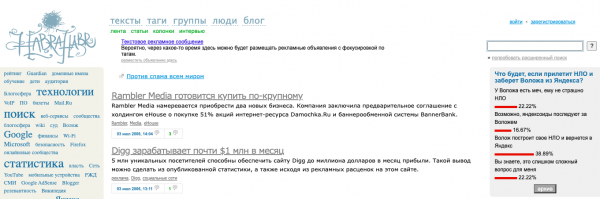
This is what Habr looked like in 2006
It turns out this publication was actually not the very first (Habr itself was launched on May 26, 2006) — we managed to find a publication from… January 16, 2006! . At this point, we already wanted to call Sherlock Holmes to untangle this puzzle (you know, the one on the logo). But we shall call upon a more experienced Habr user instead. How about that, ?
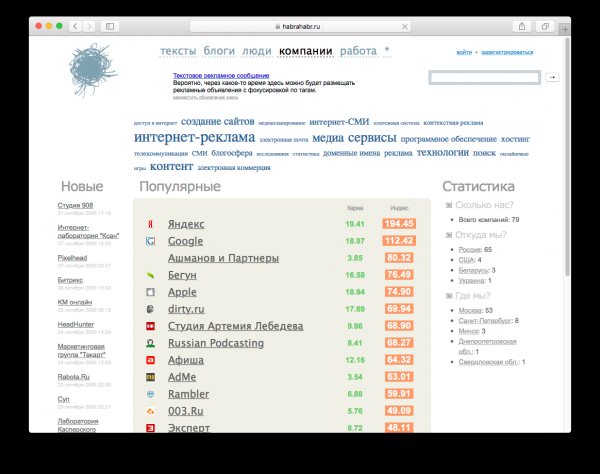
And this is what the first corporate blogs on Habr looked like.
By the way, comments can be left on both posts and no one has written there from 2020 (and this year certainly deserves a witness).
The first social network
The world's first social network is "Classmates." But don't rush to take pride in this fact or be surprised: it's about the American network Classmates, which appeared in 1995 and was exactly what you thought of in the first sentence of the paragraph. Upon starting, users choose a state, school, graduation year, and after registering, they immerse themselves in the unique atmosphere of such a social network. By the way, the site has undergone a redesign and exists today — moreover, it is still very popular.
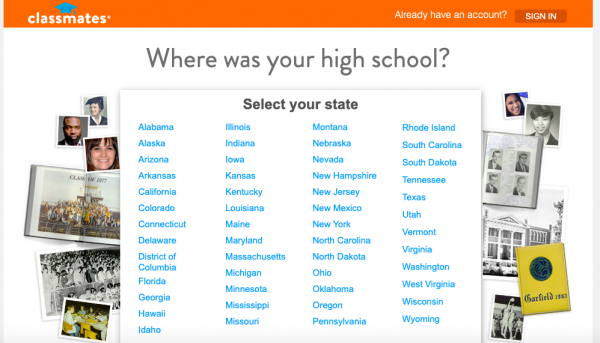
Oh, this orange!
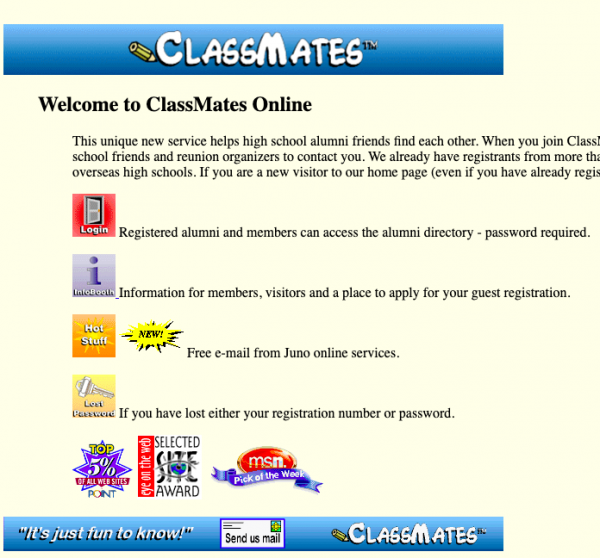
But the web archive remembers everything — this is what the site interface looked like at the beginning of its existence.
In Russia, the first social network appeared in 2001 — this is E-Xecutive, a popular and active network of professionals (by the way, there are many insightful materials and communities there). The domestic version of "Classmates" only appeared in 2006.
The first web browser
The first browser appeared in 1990. The author and developer of the browser was none other than Tim Berners-Lee, who named his application... World Wide Web. But the name was long, hard to remember, and inconvenient, so the browser was soon renamed to Nexus. The universally loved Internet Explorer from Microsoft was not even the third browser in the world, with Netscape, also known as Mosaic, intervening between it and Nexus, along with predecessors like Erwise, Midas, Samba, etc. However, it was IE that became the first browser in the modern sense, while Nexus served much narrower functions: it helped view small documents and files on remote computers (though this is the essence of all browsers, as link users say, everything is a file). By the way, the first website was opened in this browser.
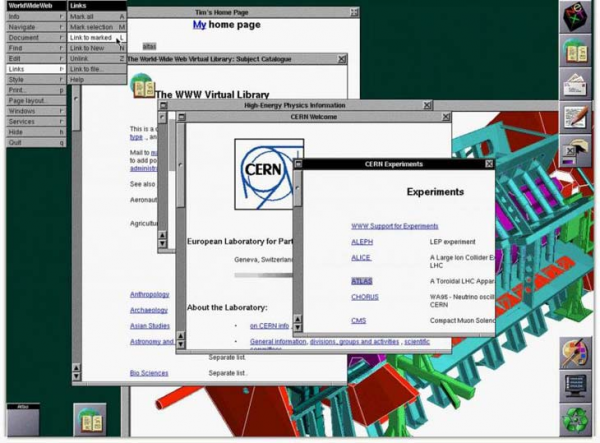
Nexus interface
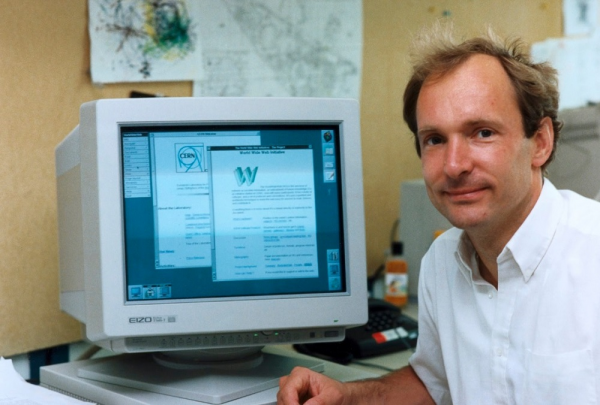
Once again, the creator with his creation
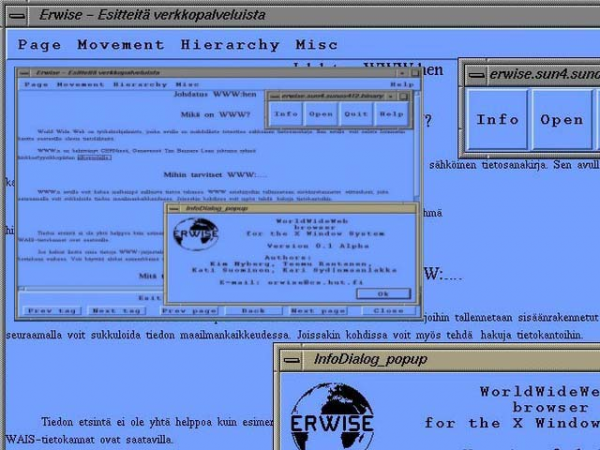
Erwise — the world's first browser with a graphical interface and the ability to search text on the page
The first online store
The emergence of the Internet as a network of interconnected computers certainly caught the attention of businesses, as it opened up new opportunities for profit and access to a nearly unregulated trading zone (this refers to the time after 1990; prior to that, the Internet was almost a super-secret realm). In 1992, airlines were the first to venture into online commerce, selling tickets "online."
The first online store sold books, and you’ve probably guessed who its creator was? Yes, Jeff Bezos. And if you think Mr. Bezos had a deep passion for books and dreamed of making the world educated and in love with reading, you are mistaken. The second product was toys. Both books and toys are popular items that are also easy to store, sort, and have no expiration date, requiring no special care for storage. Moreover, books and toys are easy to pack, without worrying about fragility, completeness, and other such issues. The birthday of Amazon is July 5, 1994.
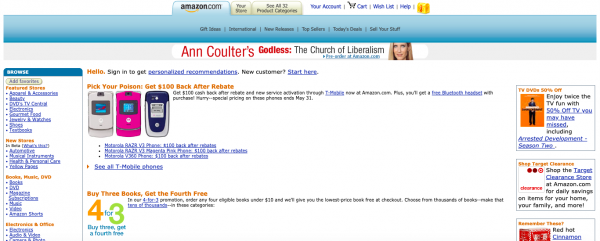
Time machine remembers Amazon only from the very end of 1998. DVD, Motorola — where are my 17 years?
The first online store in Russia started on August 30, 1996, and it was also a bookstore called books.ru (I hope you know it is alive and well today). However, it seems to us that in Russia, it was a bookstore out of love, as books are undoubtedly a product with lasting popularity in our country.

Books.ru in 1998
The first messenger
To avoid fights in the comments, let me clarify that we are not talking about messaging systems with restricted access, but about those messengers that became available in the era of the "global" Internet. Thus, the history of messengers begins in 1996 when the Israeli company Mirabilis launched ICQ. It featured multi-user chats, file transfer support, user search, and much more.
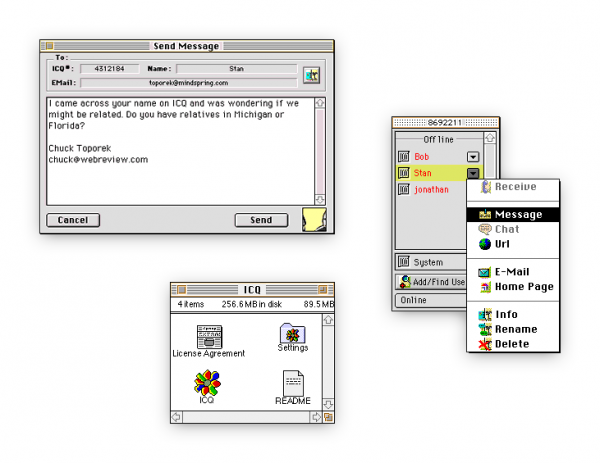
One of the first versions of ICQ. We took this image from Habr and immediately recommend
The first IP telephony
The beginning of IP telephony was marked in 1993-1994. Charley Kline created Maven, the first program for PCs that could transmit voice over a network. Around the same time, the CU-SeeMe program gained popularity for organizing video conferences, developed at Cornell University for Macintosh PCs. Both of these applications literally reached astronomical popularity — they transmitted the flight of the Endeavor space shuttle on Earth. Maven transmitted sound, while CU-SeeMe transmitted images. Soon after, the programs were integrated.
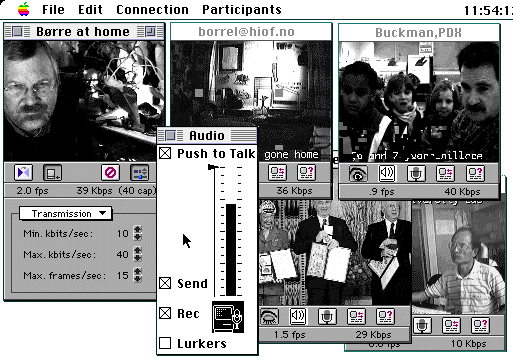
CU-SeeMe interface. Source: ludvigsen.hiof.no
The first video on YouTube
YouTube officially launched on February 14, 2005, and the first video was uploaded on April 23, 2005. The video featuring himself was uploaded by one of YouTube's creators, Jawed Karim, filmed by his school friend Yakov Lapitsky. The clip lasts 18 seconds and is titled "Me at the zoo." He had no idea of the zoo that would unfold on this service, oh, he had no idea.
By the way, this is the only surviving video from the "test," the very first ones. I won't retell the plot, watch for yourself:

The first meme
The first internet meme infected the souls and minds of hundreds of thousands of users in 1996. It was launched by two graphic designers — Michael Girard and Robert Lurie. The video featured a toddler dancing to the track "Hooked on a Feeling" by Mark James. The creators distributed the "sticky video" to other companies, and then it spread via email to a vast number of users. I probably know little about memes, but it looks somewhat frightening.

By the way, this video was actually an advertisement — it showcased the new capabilities of Autodesk software. The movements of the "baby Uga-chaga" were replicated worldwide (at that time, they could not upload to YouTube). The meme was clearly a success.
And you know what we think. Could we have imagined back then, as children and teenagers, that fate would bring us together in one company, RUVDS, through whose servers about 0.05% of the Russian Internet flows? And we are responsible for every byte of this colossal volume of information. No, friends, this is not science fiction — this is life, laid out by the hands of the First.
This article includes far from all the "first artifacts" of the Internet. Share with us about the first thing you heard about on the Net? Let's indulge in nostalgia, shall we?
Source: habr.com
