

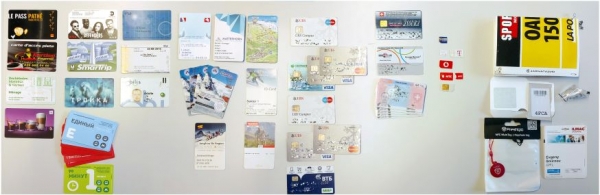
More RFID tags for the god of RFID tags!
Since the publication almost 7 years have passed. During these , I have accumulated a huge number of RFID tags and smart cards in my pockets: secure cards (like permits or bank cards), ski passes, public transportation tickets, which are absolutely essential in places like the Netherlands, and various other items.
In general, it’s time to sort through all this assortment represented at KDPV. In a new series of articles about RFID and smart cards, I will continue the long-standing narrative about the market, technologies, and the inner workings of these micro-chips, without which our daily lives are unimaginable, starting from inventory control (for example, ) and extending to the construction of skyscrapers. Moreover, during this time, new players (for instance, from China) have emerged alongside the well-known , which is worth discussing.
As usual, the narrative will be divided into thematic parts, which I will publish as my skills, opportunities, and access to equipment allow.
Preface
So, it's worth reminding that my exploration of tags stemmed from my hobby of working with electron microscopy and cutting back in 2012. The theory of how RFID tags function was briefly discussed, and several of the most common and accessible tags of that time were dissected and analyzed. Regarding this article, there's probably not much to add today: the same 3(4) most common standards
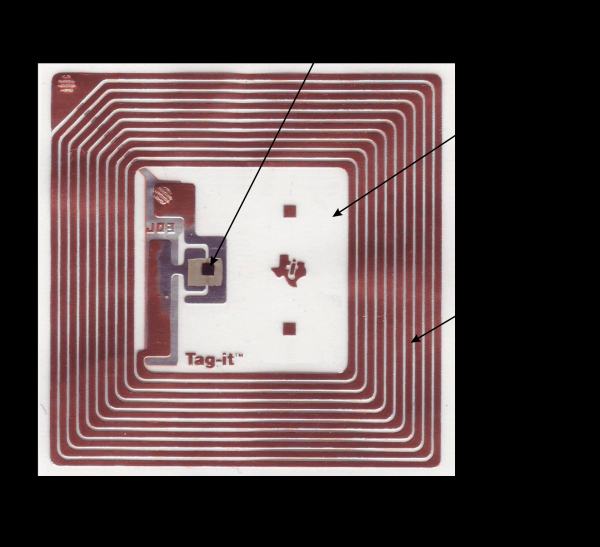
LF (120-150 kHz), (13.65 MHz – the vast majority of tags operate in this range), Hydrofluoric acid UHF (essentially, there are two frequency ranges 433 and 866 MHz), followed by a couple of lesser-known ones; In summary, an RFID tag looks something like this: a substrate, an antenna, and the chip itself.
The Tag-it tag from Texas Instruments
However, the application landscape for these tags in everyday life has significantly changed.
If in 2012 NFC (
Near-Field Communication) was a novelty in smartphones, and it was unclear how and where it could be used. Large companies like Sony actively promoted NFC and RFID as a means of connecting devices (like the speaker from the first Sony Xperia, which connects magically with a touch of the phone – Wow! Shocking content!) and changing states (for instance, when you come home, wave over the tag, the phone turns on sound, connects to WiFi, etc.), which, in my impression, did not gain much popularity.
By 2019, only the lazy weren't using wireless cards (basically the same NFC), smartphones with virtual cards (my sister insisted on having NFC when switching her phone), and other 'life simplifiers' based on this technology. RFID has become an integral part of our daily lives: single-use bus passes, access cards for many offices and buildings, mini wallets within organizations (like, for example, ) 'and so on, and so forth'.
In fact, this is precisely why there is such a vast number of tags, each one tempting to peel open and see what's inside: whose chip is installed? Is it protected? What kind of antenna is there?
But let's go through everything in order...
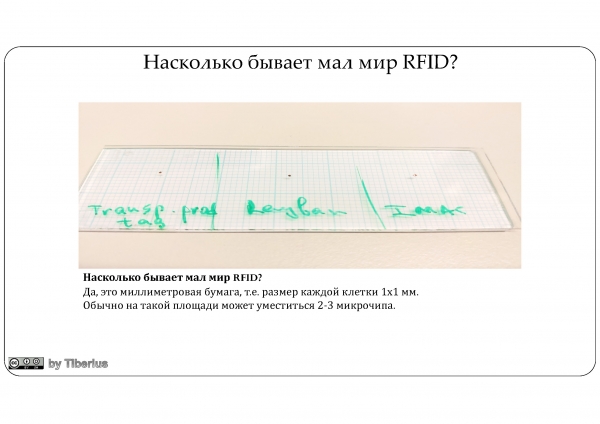
These tiny pieces of silicon are what have made our world as we know it today.
A few words about peeling tags.
I remind you that to access the chip, you need to deprocess the product using certain chemical reagents. For example, remove the casing (usually a card or a round tag made of plastic, containing an antenna), carefully detach the chip from the antenna, clean the chip from adhesive/insulator, sometimes remove parts of the antenna that are firmly soldered to the contact pads, and only then will you see the chip and its assembly.

Deprocessing – a complicated feeling.
In recent years, the materials used for chip bonding have significantly improved. On one hand, this has enhanced the reliability of the chip attachment and reduced the defect rate; on the other hand, simply boiling in acetone or concentrated sulfuric acid to dissolve or burn off organic materials no longer cleans the chip. One has to get creative, mixing acids to remove unwanted layers without damaging the chip's metallization.
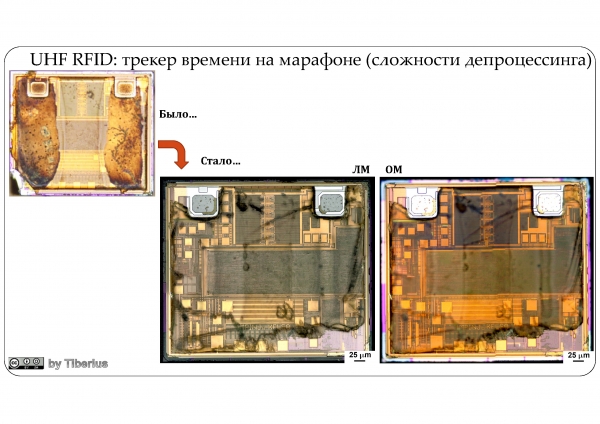
Depackaging challenges: when the adhesive on the chip cannot be removed under any conditions... Here and beyond LM – laser microscopy, OM – optical microscopy
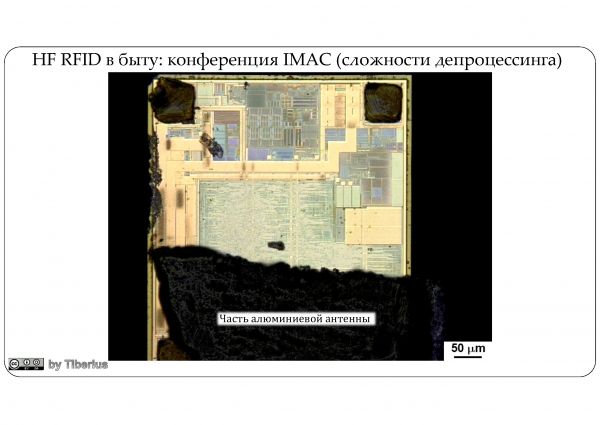
Or like this...
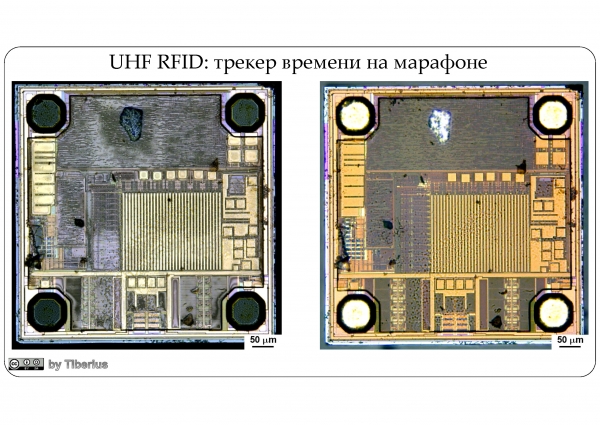
Sometimes, of course, luck is slightly on your side, and the chip, even with the insulating layer, ends up relatively clean, which doesn't significantly affect the image quality:
NB: Handling concentrated acids and solvents should be done in a well-ventilated area, preferably outside! Do not attempt this at home, in the kitchen!
Practical part
As I mentioned at the very beginning of the article, each section will present individual types or several tags: transport (public transport and ski passes), protected (mainly smart cards), 'everyday' and so on.
Let's start today with the simplest tags that can be found almost everywhere. We'll call them 'everyday tags' because they can be encountered nearly everywhere: from a marathon number to conferences and product deliveries.
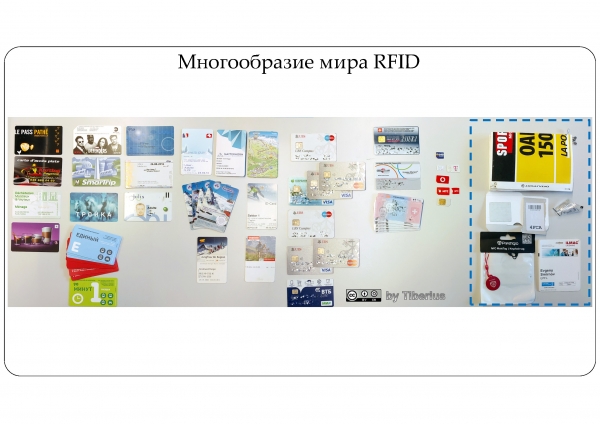
The tags discussed in this article are highlighted with a blue dotted line.
Long-range UHF tags
Many Habra readers are into and love sports. In recent years, there has been a noticeable trend to participate in various races, half-marathons, and even marathons. Sometimes, for a medal, running even .
Usually, before the start of an event, a participant is issued a number with small foam inserts on the sides, behind which — oh horror — hides the infamous RFID tag. Paranoids definitely need to be cautious when participating in such events! In reality, there's no need. Since mass starts are used in these competitions, it's necessary to record the time of each participant from the moment they cross the start line until they finish. As each participant runs through a special gate that serves as both the start and finish line, they trigger and subsequently stop an invisible stopwatch.
The tags look roughly like this:
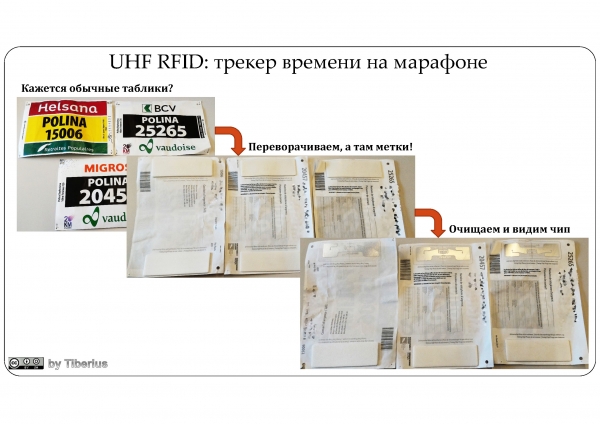
As experience shows, even in Switzerland, there are at least two tags that are used for such mass events. They differ in terms of antennas (conditionally, narrow and wide) and the chip design. However, in both cases, it's just a regular chip, without any protection, no frills, and apparently, with little memory. And as experience has shown, they also come from the same manufacturer — .
I find it hard to judge whether anything is recorded on the chip; it's more likely that it simply serves for identification. If you know more, please share in the comments!
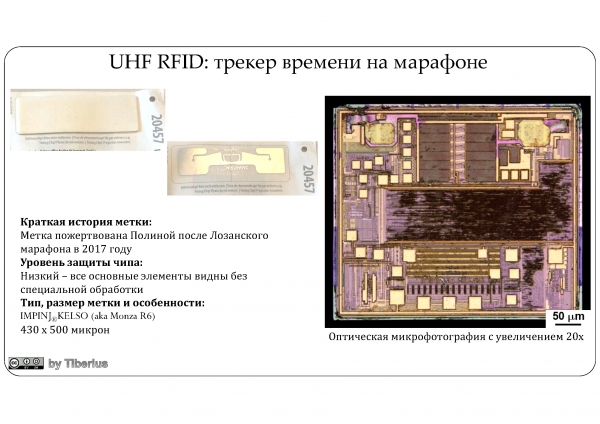
The chip from IMPINJ and the wide antenna
This tag has already appeared in . You can read more about the Monza R6 tag from the American manufacturer IMPINJ .
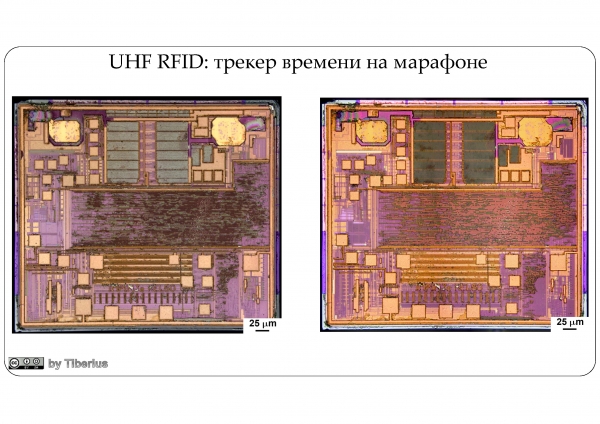
LM (left) and OM (right) images at 50x magnification.
You can download the HD image
Another time tracking method appears to be somewhat more complex than the Monza R6 chip, while the chip lacks any markings, making it difficult to compare them.
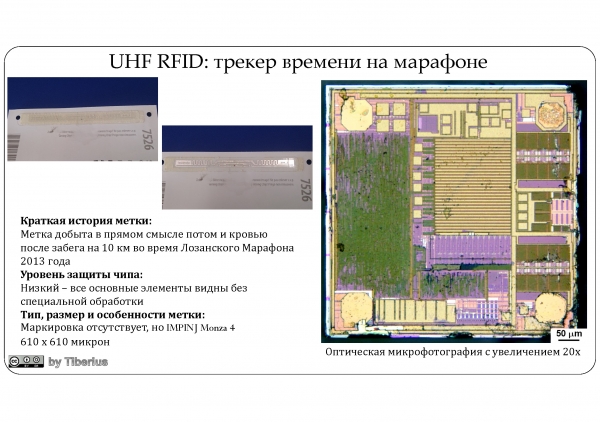
The 'UFO' chip from an 'unknown' manufacturer
As it turned out during the fiddling with this chip: the manufacturer is the same — IMPINJ, and the code name of the chip is Monza 4. You can learn more
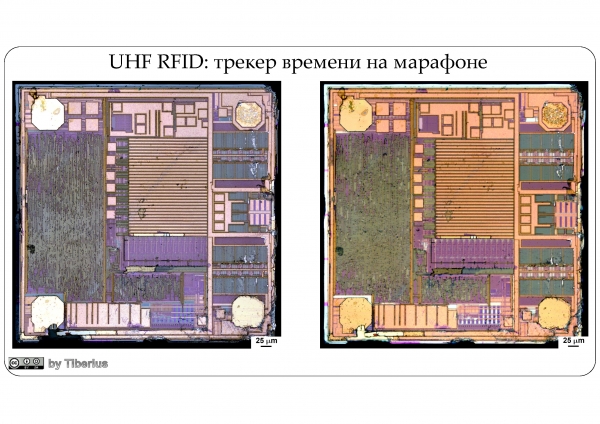
LM (left) and OM (right) images at 50x magnification.
You can download the HD image
Near-field tags in transportation and logistics
Moving on, RFID tags are successfully used in transportation and logistics for automated/semi-automated inventory management.
For example, when I ordered RayBan glasses, there was a similar RFID tag installed inside the box. The chip is marked as SL3S1204V1D from 2014 and is manufactured by NXP.
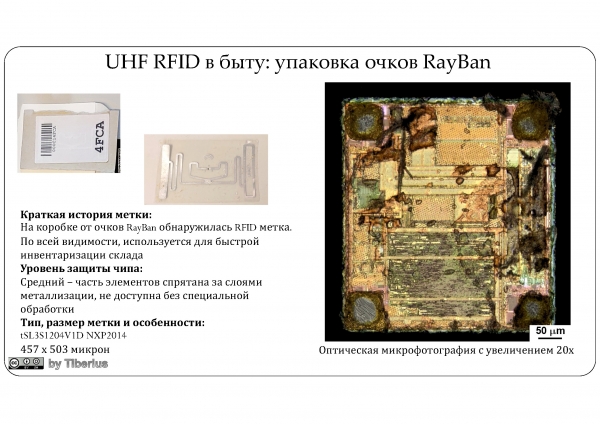
One of the challenges of working with modern RFID is cleaning the chip from glue and insulation...
You can read information about the tag . The class/standard of the tag is – RFID. By the way, it’s amusing to observe the change log at the end of the document, which partly demonstrates the process of bringing the tag to market. Applications include inventory management in retail and fashion. So, next time you’re purchasing a relatively expensive item (over $200), take a closer look; you might find a similar tag.
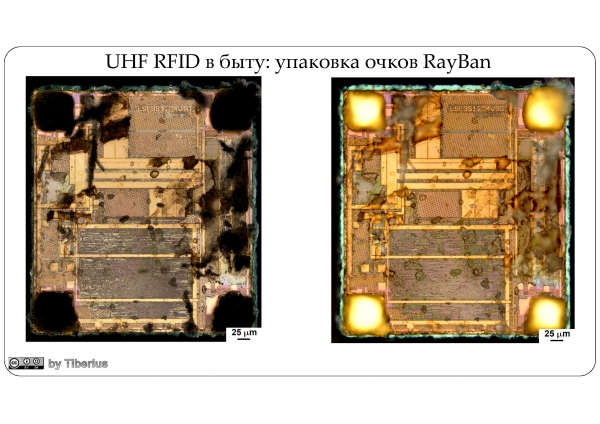
LM (left) and OM (right) images at 50x magnification.
HD decided not to make…
Another example is another box (though I no longer remember where it came from), on the inside of which a 'product' tag was affixed.
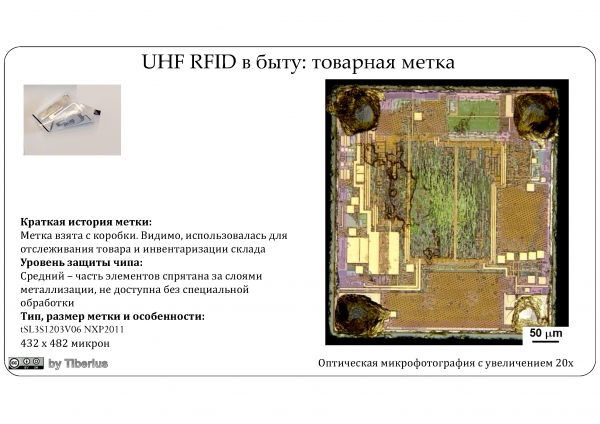
Unfortunately, I did not find documentation specifically for this chip, but there is a PDF on the NXP website about . The chip is manufactured within the EPC G2iL(+) standard and apparently has tamper protection. It works quite simply: breaking the OUT-VDD bridge triggers a flag, and the tag becomes non-functional.
Got something to add? Write in the comments!
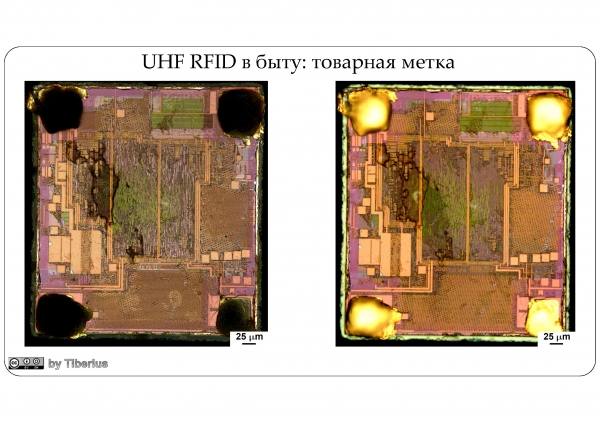
LM (left) and OM (right) images at 50x magnification.
You can download the HD image
Conferences and Trade Shows
A typical application of RFID for quick identification of people is various badges at conferences, trade shows, and other events. In this case, attendees are not required to leave their business cards or exchange contact information in the traditional way; simply bringing the badge close to the reader transfers all contact information to the counterpart. This is in addition to traditional registration and entry to the exhibition.
Inside the tag I received from the IMAС industry exhibition, there was a round antenna with an NXP MF0UL1VOC chip, in other words, a new generation of MIFARE. Detailed information can be found .
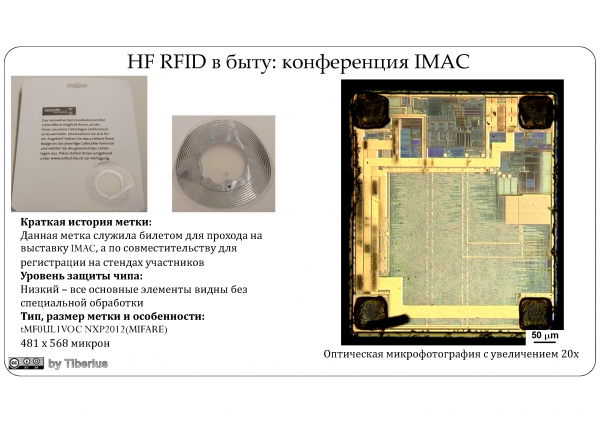
One illustrative example of using smart badges at the IMAС exhibition
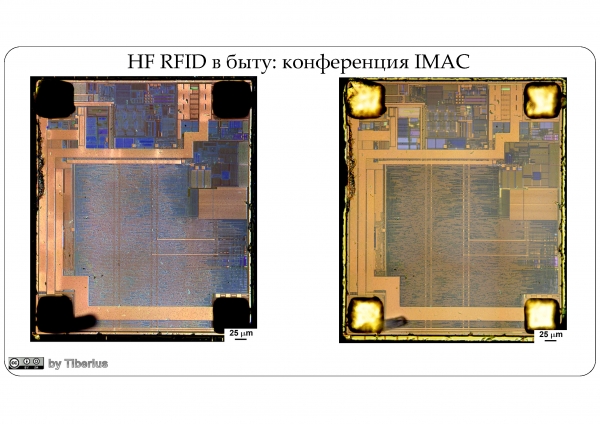
LM (left) and OM (right) images at 50x magnification.
You can download the HD image
By the way, for those interested in not just the hardware but also the software part of the tag – below are screenshots from the NFC-Reader program, where you can also see the type and class of the tag, memory size, encryption, and more.
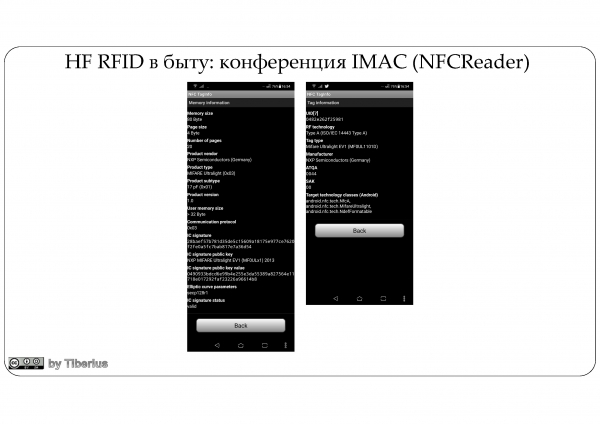
Unexpectedly protected chip
In conclusion, I would like to note the last tag that made it into the analysis of the first cohort of "everyday" tags. I got it during my collaboration with Prestigio. The main purpose of the tag is to perform some pre-set action, for instance, in the smart home ecosystem (turning on lights, starting music playback, etc.). I was quite surprised by the fact that, firstly, opening it turned out to be quite an adventure, and secondly, inside awaited me a surprise in the form of a fully protected chip.
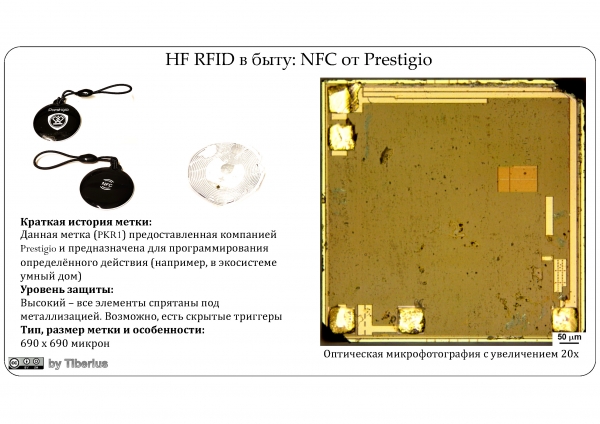
Well, I guess it will have to be set aside for better times when the matter reaches secure chips - we will get back to it. By the way, for those interested in delving deeper into the protection capabilities and application of RFID in various fields - I recommend this .
In conclusion
We are not done with "everyday" tags yet; in the second part, we will explore the amazing world of Chinese RFID and even Chinese chips. Stay tuned!
Don't forget to subscribe to : It's not a problem for you – it's a pleasure for me!
And yes, please send any noticed errors in the text via private message.
Only registered users can participate in the survey. , please.
In your opinion, does laser microscopy add informative value to optical microscopy (more or less clear lines, higher contrast, etc.)?
Yes
No
I find it difficult to answer.
I am bees
60 users voted. 18 users abstained.
Does it make sense to create a repository of images on Patreon? Is there a desire or need to help with a ringing coin, in exchange for HD, 4K wallpapers for the desktop, for example?
Yes, definitely
Yes, but the interested audience is quite limited
It's unlikely anyone will be interested
Definitely not
I am bees
60 users voted. 17 users abstained.
Source: habr.com
