

In our discussion, we described the rise of automatic telephone exchanges controlled by relay circuits. This time, we want to talk about how scientists and engineers developed relay circuits in the first—now forgotten—generation of digital computers.
Relays at their peak
As you may remember, the operation of a relay is based on a simple principle: an electromagnet operates a metal switch. The idea of the relay was independently proposed by several naturalists and entrepreneurs in the telegraph business during the 1830s. Then, in the mid-19th century, inventors and mechanics transformed the relay into a reliable and indispensable component of telegraph networks. It was in this field that the life of the relay reached its peak: it was miniaturized, and generations of engineers created countless designs, formally studying mathematics and physics.
By the early 20th century, not only automatic switching systems but almost all equipment in telephone networks contained various types of relays. One of the earliest applications in telephone communication dates back to the 1870s, in manual exchanges. When a subscriber turned the phone crank (the magneto handle), a signal was sent to the telephone exchange, activating a blinker. The blinker is a relay that, when triggered, caused a metal flap to fall at the operator's switchboard, indicating an incoming call. At that time, the female operator would insert a plug into the socket, the relay would reset, and then the flap could be lifted again, held in that position by the electromagnet.
By 1924, as written by two engineers from Bell, a typical manual telephone exchange served about 10,000 subscribers. Its equipment contained 40,000 to 65,000 relays, whose combined magnetic force was "sufficient to lift 10 tons." In larger telephone exchanges with machine switches, these figures were multiplied by two. Millions of relays were used throughout the U.S. telephone system, and their number constantly increased as telephone exchanges became automated. One telephone connection could be served by anywhere from a few to several hundred relays, depending on the number and equipment of the involved telephone exchanges.
The factories of Western Electric, part of the Bell Corporation, produced a vast array of relays. Engineers developed so many variations that even the most experienced dog breeders or pigeon fanciers would be envious of this diversity. The operational speed and sensitivity of relays were optimized while their size was reduced. In 1921, Western Electric produced nearly 5 million relays of the top 100 types. The most common was the universal Type E relay, a flat, almost rectangular device weighing several tens of grams. It was primarily made of stamped metal parts, making it technologically efficient to produce. The casing protected the contacts from dust and stray currents from neighboring devices: relays were typically mounted tightly next to each other in racks containing hundreds and thousands of relays. A total of 3,000 variants of Type E were developed, each differing in winding configurations and contact arrangements.
Soon, these relays began to be used in the most complex switches.
Coordinate Switch
In 1910, Gotthilf Betulander, an engineer at Royal Telegrafverket — the state-owned corporation that controlled most of the Swedish telephone market for decades — had an idea. He believed he could greatly improve the operational efficiency of Telegrafverket by constructing automatic switching systems entirely based on relays. More specifically, on relay matrices: grids of steel rods connected to telephone lines, with relays at the intersections of the rods. Such a switch should work faster, be more reliable, and easier to maintain compared to systems based on sliding or rotating contacts.
Moreover, Betulander conceived that the parts of the system responsible for selection and connection could be separated into independent relay circuits. The remaining part of the system should only be used for setting up the speech channel and then freed to service another call. In other words, Betulander came up with the idea that would later be known as 'common control.'
He referred to the scheme that stores the incoming call number as a "recorder" (another term is register). The scheme that finds and "marks" the available connection in the grid was called a "marker." The author patented his system. Several such stations appeared in Stockholm and London. In 1918, Betulander learned about an American innovation: the coordinate switch created by Bell engineer John Reynolds five years earlier. This switch was very similar to Betulander's design, but it used n + m relays for servicing n + m matrix nodes, which was much more convenient for further expansion of telephone exchanges. When establishing a connection, the holding rail pinched the "fingers" from the piano strings, while the selecting rail moved across the matrix to connect with another call. The following year, Betulander implemented this idea in his switch design.
However, most engineers considered Betulander's creation strange and overly complicated. When it came time to choose a switching system for automating networks in the largest Swedish cities, Telegrafverket preferred the design developed by Ericsson. Betulander's switches were only used in small telephone stations in rural areas: relays were more reliable than the motorized automation of Ericsson switches and did not require servicing technicians at every station.
However, American telephone engineers had a different opinion on this matter. In 1930, Bell Labs specialists visited Sweden and were "very impressed by the parameters of the coordinate switching module." Upon returning, the Americans immediately began working on what later became known as "coordinate system #1," which replaced panel switches in large cities. By 1938, two such systems were installed in New York. Soon, they became standard equipment for urban telephone exchanges until they were replaced by electronic switches more than 30 years later.
The most interesting component of the coordinate switch No. 1 was a new, more complex marker developed at Bell. It was designed to find a free route from the calling party to the called party through several interconnected coordinate modules, thus establishing a telephone connection. The marker was also supposed to test each connection for the status of 'free'/'busy.' This required the application of conditional logic. As historian Robert Chapuis wrote:
The choice is conditional because a free connection is maintained only if it provides access to the coordinate rail, which has a free connection to the next level as its output. If several sets of connections meet the necessary conditions, then 'preferential logic' selects one of the [existing] least numerous connections...
The coordinate switch is a great example of the mutual enrichment of technological ideas. Betulander created his fully relay switch, then improved it with Reynolds' switching matrix and proved the operability of the resulting design. Engineers at AT&T later revamped this hybrid switch, enhanced it, and created Coordinate System No. 1. This system then became a component of two early computing machines, one of which is now known as a milestone in computing history.
Mathematical labor
To understand how and why relays and their electronic cousins helped revolutionize computing, we need a brief excursion into the world of mathematical computations. After this, it will become clear why there was a hidden demand to optimize computational processes.
By the early 20th century, the entire system of modern science and engineering was based on the work of thousands of people performing mathematical calculations. They were called computers (computers) [To avoid confusion, the term calculators. — Note from the translator] In the 1820s, Charles Babbage created (although his device had ideological predecessors). Its main task was to automate the creation of mathematical tables, for example for navigation (calculating trigonometric functions through polynomial approximations at 0 degrees, 0.01 degrees, 0.02 degrees, and so on). There was also a great demand for mathematical calculations in astronomy: it was necessary to process raw results from telescope observations in fixed regions of the celestial sphere (depending on the time and date of observations) or to determine the orbits of new objects (for example, Halley's comet).
Since Babbage's time, the need for computational machines has grown exponentially. Power companies needed to understand the behavior of transmission systems with extremely complex dynamic properties. Guns made from Bessemer steel, capable of launching projectiles beyond the horizon (and thus, due to direct target observation, they were no longer aimed), required increasingly accurate ballistic tables. New statistical tools, which implied large volumes of mathematical computations (for example, the method of least squares), were being used more widely in both science and the growing state apparatus. Computational departments were emerging in universities, government institutions, and industrial corporations, usually employing women.
Mechanical calculators only eased the task of calculations but did not solve it. Calculators accelerated arithmetic operations, but any complex scientific or engineering tasks required hundreds or thousands of operations, each of which the calculator (human) had to perform manually, carefully recording all intermediate results.
The emergence of new approaches to the problem of mathematical computation was influenced by several factors. Young scientists and engineers, who toiled night after night on their calculations, wanted to give their hands and eyes a break. Project leaders were compelled to spend more and more money on salaries for numerous calculators, especially after World War I. Finally, many advanced scientific and engineering tasks could hardly be solved with manual calculations. All these factors led to the creation of a series of computing machines, developed under the guidance of Vannevar Bush, an electrical engineer from the Massachusetts Institute of Technology (MIT).
Differential Analyzer
Until this moment, history was often impersonal, but now we will speak more about specific individuals. The creators of the panel switch, the Type E relay, and the coordinate marker scheme have gone unrecognized. There are no even biographical anecdotes preserved about them. The only publicly available evidence of their lives are the fossil remains of the machines they created.
Now we can gain a deeper insight into individuals and their past. However, we will no longer meet those who worked tirelessly in attics and workshops at home — Morse and Weil, Bell and Watson. By the end of World War I, the era of heroic inventors was almost over. Thomas Edison can be considered a transitional figure: at the beginning of his career, he was a hired inventor, and by the end, he had become the owner of an 'invention factory.' By that time, the development of the most notable new technologies had become the domain of organizations — universities, research divisions of corporations, and government laboratories. The people we will be discussing in this section belonged precisely to such organizations.
For example, Vannevar Bush. He arrived at MIT in 1919, when he was 29 years old. After just over 20 years, he was among the people who influenced the U.S. involvement in World War II and helped increase federal funding, which forever changed the relationship between the government, academia, and the development of science and technology. However, for the purposes of this article, we are interested in a series of machines that were developed in Bush's lab from the mid-1920s and were designed to solve the problems of mathematical computation.
MIT, which recently moved from downtown Boston to the banks of the Charles River in Cambridge, was closely tied to the needs of industry. Bush himself, in addition to his professorship, had financial interests in several electronics companies. So, it should not be surprising that the problem that drove Bush and his students to work on a new computing device originated in the energy sector: there was a need to model the behavior of transmission lines under peak load conditions. Obviously, this was just one of many possible applications of computing machines: tedious mathematical calculations were being performed everywhere.
Bush and his colleagues first built two machines called product integraphs. But the most well-known and successful machine at MIT became another — differential analyzer, completed in 1931. It solved problems related to power transmission, calculated the orbits of electrons, the trajectories of cosmic radiation in the Earth's magnetic field, and much more. Researchers around the world who needed computational power created dozens of copies and variants of the differential analyzer in the 1930s. Some were even made from Meccano (the British equivalent of the American construction toy brand ).
The differential analyzer is an analog computer. Mathematical functions were calculated using rotating metal rods, the speed of rotation of which reflected some quantitative value. A motor drove an independent rod — a variable (usually representing time), which, in turn, rotated other rods (various differential variables) through mechanical connections, and based on the input rotation speed, a function was computed. The results were drawn on paper in the form of curves. The most important components were integrators — wheels that rotated disks. Integrators could compute the integral of a curve without tedious manual calculations.
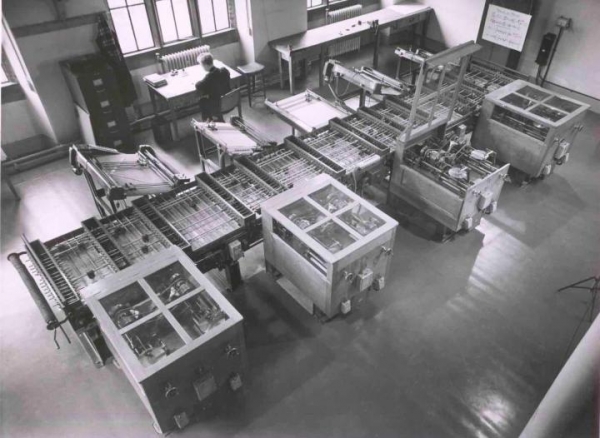
Differential Analyzer. The integral module is with a raised lid; there are tables with computation results near the window, and in the middle is a complex of computational rods.
None of the analyzer's components contained discrete switching relays or any digital switches. So, why are we talking about this device? The answer is provided by the fourth machine of the family.
In the early 1930s, Bush began courting the Rockefeller Foundation to secure funding for further development of the analyzer. Warren Weaver, the head of the Foundation's natural sciences department, was initially unconvinced. Engineering was not within his purview. However, Bush promoted the limitless potential of his new machine for scientific applications — especially in mathematical biology, Weaver's pet project. Bush also promised numerous improvements to the analyzer, including "the ability to switch the analyzer quickly from one problem to another, like a telephone switchboard." In 1936, his efforts were rewarded with an $85,000 grant allocated for the creation of a new device, which later became known as the Rockefeller differential analyzer.
As a practical computing device, this analyzer was not a groundbreaking innovation. Bush, who became the Vice President of MIT and the Dean of the School of Engineering, could not devote much time to leading the development. In fact, he soon distanced himself by taking on the responsibilities of the chair at the Carnegie Institute in Washington. Bush sensed the approaching war and had several scientific and production ideas that could serve the needs of the armed forces. He wanted to be closer to the center of power, where he could more effectively influence the resolution of various issues.
At the same time, the technical problems dictated by the new design were addressed by the laboratory staff, and soon they began to be diverted to work on military tasks. The Rockefeller machine was completed only in 1942. The military found it useful for the mass production of ballistic tables for artillery. But soon this device was overshadowed by purely digital computers — which represented numbers not as physical quantities but abstractly, using switch positions. It just so happened that the Rockefeller analyzer used quite a number of such switches made of relay circuits.
Shannon
In 1936, Claude Shannon was only 20 years old, but he had already graduated from the University of Michigan with a bachelor's degree in two fields: electrical engineering and mathematics. He was drawn to MIT by a flyer pinned to the bulletin board. Vannevar Bush was looking for a new assistant to work on the differential analyzer. Shannon applied without hesitation and soon began working on new problems, and only after that did the new device begin to take shape.
Shannon was nothing like Bush. He was neither a businessman, nor a builder of an academic empire, nor an administrator. Throughout his life, he loved games, puzzles, and entertainment: chess, juggling, mazes, cryptograms. Like many men of his era, during the war, Shannon devoted himself to a serious job: he held a government contract position at Bell Labs, which protected his fragile body from military conscription. His research on fire control and cryptography during that period led, in turn, to the emergence of foundational work in information theory (we won't touch on it). In the 1950s, when the war and its aftermath had subsided, Shannon returned to teaching at MIT, spending his free time on entertainment: a calculator that worked exclusively with Roman numerals; a machine that, when turned on, would produce a mechanical arm that turned off the machine.
The structure of the Rockefeller machine that Shannon encountered logically remained the same as that of the 1931 analyzer, but it was built from completely different physical components. Bush realized that the rods and mechanical transmissions in the old machines reduced their usability efficiency: to perform calculations, it was necessary to configure the machine, which took many man-hours of work by skilled mechanics.
The new analyzer lacked this drawback. Its design wasn't based on a table with rods but on a coordinate switch — a spare prototype donated by Bell Labs. Instead of transmitting power from a central shaft, each integral module was independently powered by an electric motor. To configure the machine for a new task, it was enough to simply set up the relays in the coordinate matrix to connect the integrators in the required sequence. The perforated tape reader (borrowed from another telecommunication device, the tape teleprinter) read the machine's configuration, and the relay circuit converted the signal from the tape into control signals for the matrix — it resembled establishing a series of phone calls between the integrators.
The new machine was not only much faster and easier to set up, but it also operated more quickly and accurately than its predecessor. It could solve more complex tasks. Today, this computer may be considered primitive, even extravagant, but at the time, it seemed to observers like some great — or perhaps terrible — working mind:
Essentially, it is a mathematical robot. An automaton powered by electricity, created not just to relieve the human brain of the burden of complex calculations and analysis but also to tackle mathematical problems that are beyond mental resolution and solve them.
Shannon focused on converting data from paper tape into instructions for the 'brain', and this operation was managed by a relay scheme. He noted the correspondence between the structure of the scheme and the mathematical structures of Boolean algebra, which he had studied in high school in Michigan. This algebra had operands of TRUE and FALSE, with operators of AND, OR, NOT etc. Algebra that corresponds to logical assertions.
Spending the summer of 1937 working at Bell Labs in Manhattan (a perfect place for thinking about relay schemes), Shannon wrote his master's thesis titled "A Symbolic Analysis of Relay and Switching Circuits." Along with Alan Turing's work, created a year prior, Shannon's thesis laid the foundation for the science of computing machines.
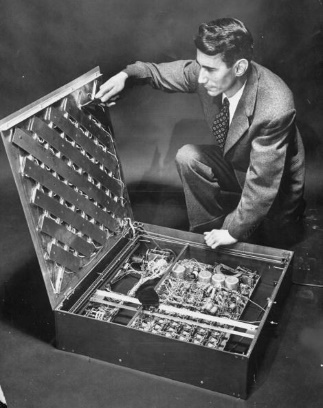
In the 1940s and 1950s, Shannon built several computing/logical machines: a calculator utilizing Roman numerals called THROBAC, a machine for chess endgames, and Theseus — a maze traversed by an electromechanical mouse (in the picture)
Shannon discovered that a system of propositional logic equations could be directly mechanistically transformed into a physical relay switch scheme. He concluded: "In fact, any operation that can be described in a finite number of steps using the words IF, AND, OR etc., can be automatically performed using relays." For example, two controlled relay switches connected in series form a logical I can useCurrent will flow through the main wire only when both electromagnets are activated to close the switches. At the same time, two relays connected in parallel form ORCurrent flows through the main circuit, activated by one of the electromagnets. The outputs of such a logic circuit can, in turn, control the electromagnets of other relays to achieve more complex logical operations like (A I can use B) or (C I can use D).
Shannon concluded his dissertation with an appendix containing several examples of circuits created using his method. Since Boolean algebra operations are very similar to arithmetic operations in the binary system (i.e., using binary numbers), he demonstrated how to assemble from relays an 'electric adder in binary system' — we call this a binary adder. A few months later, one of the scientists at Bell Labs built such an adder on a kitchen table.
Stibitz
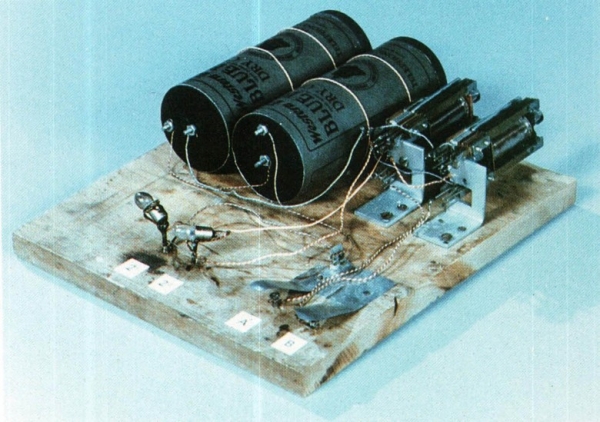
George Stibitz, a researcher from the math department at Bell Labs headquarters in Manhattan, brought home an odd set of equipment one dark November evening in 1937. Dry battery cells, two small bulbs for hardware panels, and a pair of flat Type U relays found in a trash bin. After adding some wires and a few odds and ends, he assembled a device that could add two single-digit binary numbers (represented by the presence or absence of input voltage) and output a two-digit number using the bulbs: one — on, zero — off.
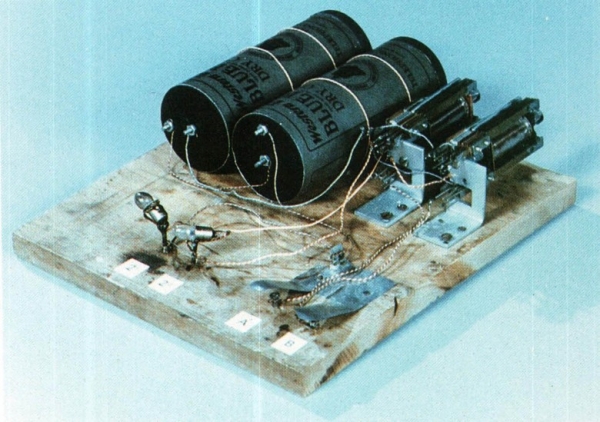
Stibitz's binary adder
Stibitz, a trained physicist, was asked to evaluate the physical properties of relay magnets. He had no prior experience working with relays and thus started by studying their use in Bell telephone circuits. Soon George noticed similarities between some circuits and arithmetic operations with binary numbers. Intrigued, he assembled his side project on the kitchen table.
Initially, Stibitz's tinkering with relays attracted little interest from Bell Labs management. However, in 1938, the head of the research group asked George whether his calculators could be used for arithmetic operations with complex numbers (for instance, a + bi, where i — the square root of a negative number). It turned out that several computational departments at Bell Labs were already lamenting the fact that they constantly had to multiply and divide such numbers. Multiplying one complex number required four arithmetic operations on a desktop calculator, while dividing involved 16 operations. Shitbits claimed he could solve the problem and devised a machine scheme for such calculations.
The final design, which was brought to life by telephone engineer Samuel Williams, was named the Complex Number Computer—or simply Complex Computer for brevity—and began operation in 1940. It used 450 relays for calculations, and intermediate results were stored in ten coordinate switches. Data was input and output using a roll teletypewriter. Three of these teletypewriters were installed in the Bell Labs departments, indicating a significant demand for computational power. Relays, matrix, teletypewriters—this was, in every respect, a product of the Bell system.
The shining moment of the Complex Computer arrived on September 11, 1940. Shitbits presented a report on the computer at a meeting of the American Mathematical Society at Dartmouth College. He arranged for a teletype to be installed there with a telegraphic connection to the Complex Computer in Manhattan, 400 kilometers away. Interested individuals could approach the teletype, enter the problem conditions on the keyboard, and see how, in less than a minute, the teletype magically printed the result. Among those who experienced the novelty were John Mauchly and John von Neumann, each of whom would play a crucial role in the continuation of our story.
The meeting participants caught a brief glimpse of the future world. Later, computers became so expensive that administrators could no longer afford to leave them idle while a user scratched his chin in front of the control console, pondering what to type next. For the next 20 years, scientists would think about how to create general-purpose computers that would always be ready for data input, even while working on something else. And then another 20 years would pass before this interactive mode of computation became the norm.
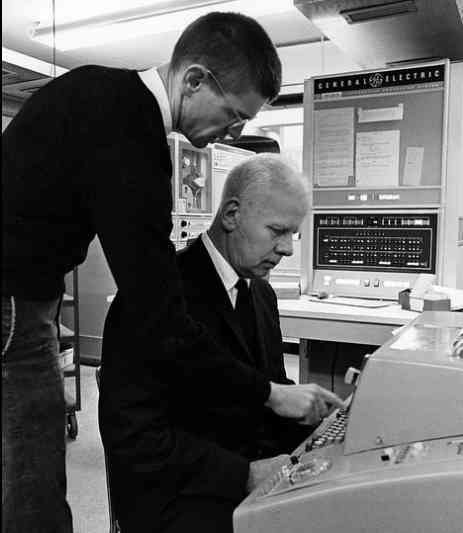
The Shibitz at the Dartmouth interactive terminal in the 1960s. Dartmouth College was a pioneer in interactive computing. Shibitz became a professor at the college in 1964.
Interestingly, despite the tasks it handled, the Complex Computer was not a computer by modern standards. It could perform arithmetic operations with complex numbers and likely solve similar tasks, but it was not a general-purpose computer. It was not programmable. It could not execute operations in arbitrary order or repeat them. It was a calculator capable of performing certain computations much better than its predecessors.
With the onset of World War II, under Shibitz's leadership, Bell created a series of computers named Model II, Model III, and Model IV (the Complex Computer was named Model I). Most of them were built at the request of the National Defense Research Committee, led by none other than Vannevar Bush. Shibitz improved the machine design in terms of greater versatility and programmability.
For instance, the Ballistic Calculator (later known as Model III) was developed for anti-aircraft fire control systems. It was put into operation in 1944 at Fort Bliss, Texas. The device contained 1,400 relays and could execute a program of mathematical operations defined by a sequence of instructions on a continuous loop of paper tape. Input data was fed separately from tabular data. This allowed for quick lookup of values, such as trigonometric functions, without actual calculations. Bell engineers developed special hunting circuits that scanned the tape back and forth, searching for the address of the required tabular value independently of calculations. Shibitz determined that his Model III computer, clicking relays day and night, replaced 25 to 40 female calculators.
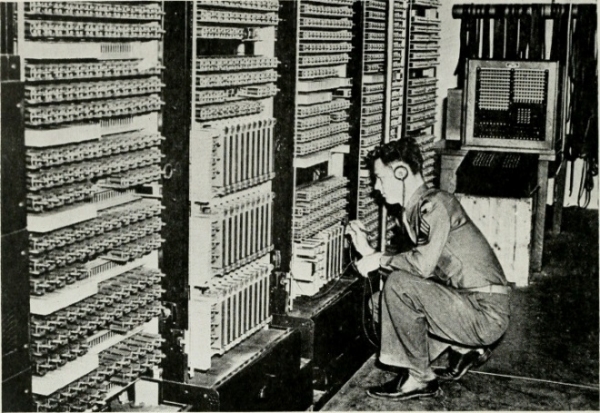
The racks with relays of the Bell Model III
The Model V machine never served in the military. It became even more versatile and powerful. When evaluating the number of processors it replaced, it was approximately ten times superior to the Model III. Several computing modules with 9,000 relays could receive input data from multiple stations, where users entered the conditions of various tasks. Each station had one tape reader for data input and five for instructions. This allowed different subprograms to be called when calculating a task from the main tape. The main control module (essentially like an operating system) distributed instructions to computing modules based on their availability, and programs could execute conditional jumps. It was no longer just a calculator.
A Year of Wonders: 1937
The year 1937 can be considered a turning point in the history of computing machines. In that year, Shannon and Stibitz noticed similarities between relay circuits and mathematical functions. These findings led Bell Labs to create a whole series of important digital machines. It was a kind of — or even substitution — when a humble telephone relay, without changing its physical form, became the embodiment of abstract mathematics and logic.
That same year, in the January issue of Proceedings of the London Mathematical Society , an article by British mathematician Alan Turing titled "On Computable Numbers, With an Application to the " was published. It described a universal computing machine: the author claimed that it could perform actions logically equivalent to those of human calculators. Turing, who had enrolled in Princeton University’s graduate program the previous year, was also intrigued by relay circuits and, like Bush, concerned about the growing threat of war with Germany. Therefore, he took on a side cryptographic project — a binary multiplier that could be used to encrypt military messages. Turing built it from relays gathered in the university's mechanical shop.
In 1937, Howard Aiken contemplated the potential automatic computing machine. A Harvard graduate student in electrical engineering, Aiken relied heavily on a mechanical calculator and printed mathematical tables for his calculations. He proposed a design that would eliminate this routine. Unlike existing computing devices, it was meant to automatically and cyclically process tasks, using the results of previous calculations as input for the next ones.
Meanwhile, at Nippon Electric Company, telecommunications engineer Akira Nakashima had been investigating the links between relay circuits and mathematics since 1935. Finally, in 1938, he independently proved the equivalence of relay circuits to Boolean algebra, which Shannon had discovered the year before.
In Berlin, Konrad Zuse, a former aeronautical engineer tired of the endless calculations required in his work, sought funding to create a second computing machine. He had struggled to get his first mechanical device—V1—to work reliably, so he aimed to develop a relay computer, which he co-created with his friend, telecommunications engineer Helmut Schreyer.
The versatility of telephone relays, insights into mathematical logic, and the desire of brilliant minds to escape mundane tasks all intertwined, leading to the emergence of the concept of a new type of logical machine.
A Forgotten Generation
The fruits of the discoveries and developments of 1937 needed several years to mature. The war proved to be the most powerful fertilizer, and with its arrival, relay computers began to appear everywhere that the necessary technical expertise existed. Mathematical logic became the framework for the vines of electrical engineering. New forms of programmable computing machines emerged—the first sketch of modern computers.
In addition to the Schtybitsa machines, by 1944, the USA could boast of the Harvard Mark I / IBM Automatic Sequence Controlled Calculator (ASCC), a result of Aiken's proposal. The dual name arose from the deteriorating relationship between academia and industry: everyone claimed rights to the device. The Mark I / ASCC used controlling relay circuits, but the main arithmetic module was built on the architecture of IBM’s mechanical calculators. The machine was created for the needs of the US Navy’s Bureau of Ships. Its successor, the Mark II, began operating in 1948 at the Navy's test site, and all its operations were built solely on relays — with 13,000 relays.
During the war, Zuse built several relay computers, each increasingly complex. The culmination was the V4, which, like the Bell Model V, included provisions for calling subroutines and performed conditional jumps. Due to a lack of materials in Japan, none of Nakashima's developments and those of his compatriots were realized in metal until the country recovered from the war. In the 1950s, the newly reformed Ministry of International Trade and Industry financed the creation of two relay machines, the second of which was a monster with 20,000 relays. Fujitsu, involved in the development, created its own commercial products.
Today, these machines are almost entirely forgotten. Only one name remains in memory — ENIAC. The reason for their obscurity is not related to their complexity, capabilities, or speed. The computational and logical properties of relays, discovered by scientists and researchers, apply to any type of devices that can act as a switch. And so it happened that another similar device became available — an electronic switch that could operate hundreds of times faster than a relay.
The importance of World War II in the history of computing machines should be clear by now. The most devastating war served as a catalyst for the development of electronic machines. Its onset released resources necessary to overcome the apparent shortcomings of electronic switches. The dominance of electromechanical computers was short-lived. Like titans, they were overthrown by their offspring. Just as with relays, electronic switching emerged out of the needs of the telecommunications industry. To understand its origins, we must rewind our history to the dawn of the radio era.
Source: habr.com
