

I have loved history my entire conscious life. My interest in other subjects has come and gone, but my passion for history has always remained. I enjoy both documentaries and historical films, light books about those times, essays on famous people and events, scholarly works, the history of the Indian wars, memoirs of great individuals, books about notable figures written in our time, and so on, indefinitely. My love for history even led me to participate in a history olympiad, which I won by writing an essay reflecting on the First State Duma.
But I have never understood why I love history. It’s not that this lack of understanding troubled me greatly, but still, this question occasionally arose in my mind. Each time, I concluded that it was simply some innate inclination, akin to the love some people have for chocolate, communication, adventures, or the color red.
However, the other day, while reading 'The Prince' by Niccolò Machiavelli, everything became clear to me. In particular, I realized that I had understood everything for a long time and had neatly arranged my thoughts; I just needed the final piece of the puzzle. Suddenly, all the arguments I had formulated throughout my life regarding history and the materials about it came rushing back to my mind.
I won’t talk about all types of materials, just one – books. I will attempt to explain to you why reading old works is better and more beneficial. I do not claim to reveal the highest truth or fully cover the topic; I am simply sharing my personal thoughts.
Products
I will start from the opposite side – the drawbacks of contemporary books. Currently, very few 'books' are being published because they have been supplanted by 'products', with all the ensuing consequences.
You know well what a product is. It is some kind of thing for which characteristics are defined: market, segments, audience, lifespan, age restrictions, functional requirements, packaging, etc. Sausages, online services, underwear, and books are all created as products under the same principles, differing only in methods of production and marketing.
A product has a single goal – sales. This goal determines how the product is conceived, born, lives, and dies. This same goal also defines the criteria for evaluating the quality of the product. It sold – good; it didn’t sell – bad.
Once you’ve sold out, you can talk about other values as well. A good example (although from a different field) is the films of Christopher Nolan. On one hand, they sell very well. On the other, they receive awards and high ratings from critics and viewers alike.
Selling a product is like a trigger; after it’s pulled, you can discuss everything else. It’s the entry ticket to the world. Accordingly, when reading a contemporary book, you have to keep its 'productness' in mind. The author wrote it to sell. It really comes through on every page.
Stream
It’s no secret that all information, or rather – content, has become organized into streams. With the development of the internet, this was the only way it could have happened. There’s so much content being created that managing its elements is impossible – only streams can be managed, as a kind of higher-order entity.
Just look at any popular website or service providing text or video content, and you will see these streams, no matter what they are called. Hubs, channels, sections, categories, trends, playlists, groups, feeds, series, etc.
Managing streams using artificial intelligence or machine learning is becoming more frequent to simplify the search for suitable content for consumers and to keep their attention on the resource for as long as possible, because attention converts into time, and time can be monetized.
Streams have long since become endless. As Maxim Dorofeev asked in one of his presentations, has anyone ever managed to finish reading a Facebook feed to the end?
I don’t want to say that streams are some kind of evil to be fought against. Not at all. They are a reasonable response to the dramatically increased amount of content. And then the feedback loop kicked in – people got used to streams; it became more convenient and familiar, and content producers adapted as well. Those who made films began to create series.
I talked about streams because, in my opinion, they have a detrimental effect on content.
For example, articles. In the stream, the lifespan of an article is just a few days, usually one. It might appear in a category — first as 'New', then 'In Focus' or 'Currently Read', and if lucky, it might show up in 'Best of the Week' or something similar, before eventually appearing in a newsletter to attract some more attention. Sometimes, an old article might resurface on certain platforms, but that happens rarely.
Now imagine an author of an article who knows that their creation will only last a few days. How much effort will they be willing to invest in this creation? And how many articles will they write before they start calling it a product?
At first, of course, they'll try hard. I often come across comments from novice authors about how they spent a week, or even a month, writing their article, proofreading and editing it, gathering practical material, searching for suitable media components, etc. But then they face the harsh reality — their creation gets only a minute in the spotlight, after which it’s pushed aside. A few people follow up, asking for more, but after a bit of time listening, they return to the audience — back to where the stream is shown.
Most novice authors give up, thinking that something is wrong with them or their articles. They get upset with unfriendly platforms, blame themselves for their lack of talent, and swear they will never write anything again.
However, they just need to understand that their article made it into the stream, where there are no other rules. One cannot be the center of attention for even a week, even for the sake of honesty — there's only one stage, but countless eager participants to occupy it.
Those who understand the essence of stream operations and the mechanics governing them on a specific platform can become regular authors. Then articles will become products, or at least content. The quality requirements will have to be lowered, purely for economic reasons. There is truly no objective sense in spending a week on an article and earning the same as that guy who spent 2 hours (earning — it doesn’t matter what, whether likes, followers, reads, or rubles).
Dreams of an article becoming iconic, or highly cited, or someone printing it out and hanging it on a wall, or even being ceremoniously inducted into the hall of fame of some library, quickly fade away. All articles that go through the flow end up in almost nowhere. They will be remembered by search engines and a few people who added them to bookmarks for later re-reading (though it’s not guaranteed they will actually reread them).
Streams of Books
Returning to books. They have also lined up in streams, living by their own laws. Especially now, when e-books and self-publishing services have become widely spread. The barrier to entry has disappeared – anyone can now create a book, receive an ISBN, and all respectable platforms will begin selling it.
Books have already merged closely with other content and are adapting to new rules. Unfortunately, quality invariably suffers for the same reasons as with articles.
In the flow, a book does not live long, that’s the reality. Even if it is published on paper, it will only be in the amount necessary to satisfy the demand created by the author and marketers. Then the flow will carry the book into oblivion.
All of this means that there’s no point for the author to exert effort in writing a book. Neither artistic value, nor sharp humor, nor an astonishing plot will save it. Now these are not characteristics of a literary work, but functional requirements for the product, influencing market share, lifespan, NPV, and SSGR.
For us, the readers, organizing books into streams brings nothing good, unfortunately. Firstly, the decline in quality will make us waste time on futile reading. Secondly, the massive increase in book streams significantly complicates the search for anything useful – especially given that texts of books are not available online, and search engines cannot adequately determine if a book is suitable for us. Perhaps soon there will be systems for intelligently recommending books based on readers' interests.
With the quality of books, the story is already amusing. Take, for example, any book from the MIF publishing house and open it to the last pages – you'll find blank sheets titled 'New Ideas.' There is a method from one of the creators of this publishing house that led to these sheets appearing in books. In short, the quality of a book is assessed by the number of new ideas that arise during its reading.
I won't discuss the method itself, but the fact of its emergence is interesting – it’s yet another adequate response to the way books are grouped into streams. Here, quality is evaluated, and some sort of ranking is performed. Although personally, I wouldn't assess books by the number of new ideas, despite my love for numbers and measurements. Simply because ideas are the product of human thought, and their emergence or absence while reading may not correlate with the book at all. Some might scribble two pages after reading 'Neznamyka,' while others might not be deterred from eating boogers by the Great Soviet Encyclopedia.
So it seems to me that books by modern authors have ceased to be books. They have become content and products. Similarly, songs have stopped being just songs and have subtly turned into tracks. Even seasoned rockers, like Andrey Knyazev, now refer to the results of their creativity as tracks.
I presume that soon publishing houses will disappear as a business – there will be no need for them. There will be authors, proofreaders, editors, services for selling e-books with print-on-demand functionality, and printers. You find a book, buy the electronic version for 100 rubles, read it, like it, order the printed version, and 100 rubles are deducted from the final cost. Maybe even the option to compile a book by your choice will emerge – you add articles on a selected topic to your cart, and the service formats them into a book, creates a table of contents, places your photo on the cover, and goes to print.
My attitude towards streams
As I wrote above, I don’t condemn streams as a phenomenon. They are part of reality that emerged in response to changes in another part of reality. A new format for delivering information has appeared, which in turn has generated rules and practices for managing streams, monetizing, and attracting consumers and authors. But personally, I try to avoid streams.
It's essentially about all streams of information. I objectively understand that there's a lot of useful and interesting information hidden within them, but I don't want to waste a bunch of time searching for it, analyzing it, applying it practically, and formulating conclusions – it's impractical and inefficient.
But the main problem is not efficiency; it's the unpleasant feeling that you're like a cow on a farm or a hamster in a wheel.
I spent the first 16 years of my life in a small village. There weren’t many books at home, but there was a library in the village. I still fondly remember going there and choosing what to read. The process of selection could last for hours. Luckily, there weren't many readers in the village – most people preferred to drink, so the choice of books happened in complete silence.
The librarian was a great help. First of all, she was a very smart and well-read girl – she graduated high school with honors and then a cultural institute with distinction, but somehow fate brought her to our collective farm. Secondly, she had once attended school with my older brother, and her good attitude toward him extended to me – she helped, offered advice, and didn't scold me when I kept books for a long time.
So, I enjoyed the process of choosing a book, i.e., information for study, as much as the subsequent reading. Neither the books, the shelves, the entire library, nor its owner needed anything from me. The library's work was not monetized in any way – everything was free. No marketing tricks dragged anyone in.
You come to choose – and feel like the master. Not of the books or the library, but of the situation, the state, the freedom of choice. You came on your own because you decided to come. You leave when you want. No one is pushing anything on you. Most of the authors of the books have long since passed away. The librarian is frankly indifferent whether you take ten books or none at all. Pure pleasure.
And what about the stream? The resource owner essentially needs just one thing from you – activity. Any kind.
Write articles, read articles, comment on articles, comment on comments, evaluate articles, comments, authors, commentators, share posts, read to the end, and definitely subscribe to come back and show activity again.
It feels like money is being mined off you. As soon as you walk in the door—bam, they've stealthily installed some equipment on you, and the owner starts making money off you. You sit in the corner—money hardly comes in, and they pester you, calling you over—let's dance, or sing karaoke, or let's beat someone up! The main thing is to show some activity!
Formally, it seems I came on my own. It feels like I'm reading something and finding it useful. Sometimes I end up talking to interesting people. Rarely, but new pleasant acquaintances or even business contacts do appear. But an unpleasant feeling remains—they're mining, those scoundrels.
They brought me in like an animal, sat me in a wheel, showed me the bait—something like "read-read, there's definitely valuable and useful information here somewhere!"—and then walked away to connect the next lucky one. And I'm running until some physical barrier stops me, like the end of the working day, a deadline, or an unstoppable desire to sleep.
The streams suck you in, regardless of your level of awareness. That is, of course, different resources have different strengths, but from my experience, I've determined this: there's always a stream that will overwhelm you. They are too powerful—this isn't some metaphysics, but a result of the work of a huge number of very smart people. You know, the ones who create algorithms for interesting content curation, write articles, shoot videos and series, etc.
That's actually why I avoid the streams. I know for sure that if I relax and dive in, I'll get stuck for several hours, despite all my conclusions and reasoning. That’s why my Facebook feed is empty with one and a half thousand friends:
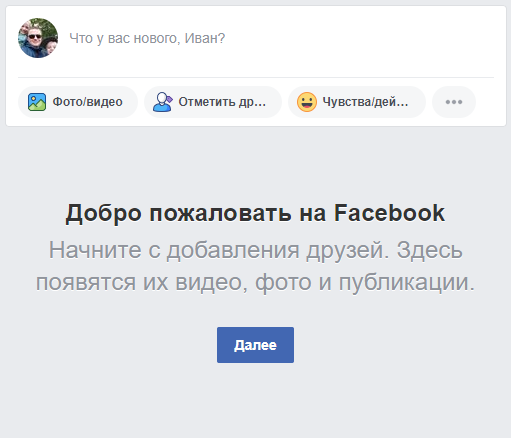
I don’t impose anything on anyone, of course.
So, I got a bit carried away and still haven't moved on to the old books. Next time then—I’ll write the second part, otherwise it will get too long.
Source: habr.com
