

Google is continuously improving security methods for its browser. Today, there are many ways to spy on users by utilizing websites that access certain APIs. One method that emerged a few years ago involves analyzing data from smartphones' accelerometers. This was done using a JavaScript API. This method enables, in particular, the detection of whether a user is in a car or train, how long they remain stationary, or conversely, how much they are walking. Additionally, gait recognition can uniquely identify the user.
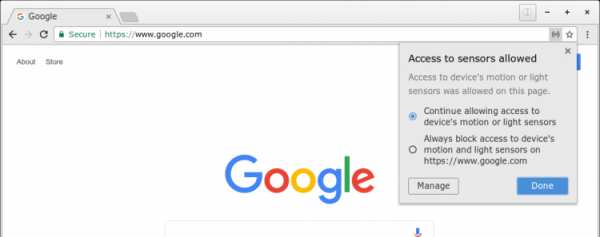
Therefore, Google is working to counteract this technology. Reports indicate that they are developing a method to block websites from accessing gyroscope, accelerometer, and light sensor data. This feature has appeared in the latest Chrome Canary build.
By default, access to sensors is enabled, but now Chrome will alert users when a site attempts to access sensors. This will allow users to permit or deny access to such data. It is worth noting that on Android, users can block access to their motion data across all websites for now. Hence, features like 'whitelists' and 'blacklists' are currently unavailable, although they may be introduced in the future.
It is important to note that a study conducted by the University of Illinois confirmed that websites can indeed spy on users via smartphones. It has been noted that reading data from accelerometers and gyroscopes is necessary for website owners or advertisers. This allows for user recognition and targeted advertising.
The new feature is expected to roll out in Chrome 75.
Source: 3dnews.ru
