


Almost every one of us has heard or read news about the spreading coronavirus. As with any other disease, early diagnosis is crucial in the fight against the new virus. However, not all infected individuals show the same set of symptoms, and even the scanners at airports designed to detect signs of infection do not always successfully identify the sick among the crowd of passengers. This raises the question—why does the same virus manifest differently in different people? Naturally, the first answer is immunity. However, this is not the only important parameter influencing the variability of symptoms and the severity of the disease. Researchers from the University of California and the University of Arizona (USA) have found that the strength of resistance to viruses depends not only on the subtypes of the flu that a person has encountered throughout life but also on their sequence. What exactly did the researchers find out, what methods were used in the study, and how can this work help in the fight against epidemics? We will find answers to these questions in the report from the research group. Let's go.
The foundation of the research
As we know, flu manifests differently in different people. In addition to the human factor (immune system, antiviral medications, preventive measures, etc.), a crucial aspect is the virus itself, or rather its subtype, with which a particular patient is infected. Each subtype has its characteristics, including the degree of impact on various demographic groups. Researchers note that the H1N1 virus ('swine flu') and H3N2 (Hong Kong flu), which have become the most widespread at present, affect people of different ages differently: H3N2 is responsible for the majority of severe cases among the elderly, and it is also attributed to most fatal cases; H1N1 is less deadly but primarily affects middle-aged and younger individuals.
Such differences may be due to the difference in the evolution speed of the viruses themselves, as well as the difference in immune imprinting* in children.
Immune imprinting* is a kind of long-term memory of the immune system formed based on viral attacks experienced by the body and its responses to them.
In this study, researchers analyzed epidemiological data to determine if imprinting during childhood affects the epidemiology of seasonal influenza, and if so, whether it primarily operates through homosubtypic* immune memory or through a broader heterosubtypic* memory.
Homosubtypic immunity* — infection with seasonal influenza A viruses promotes the development of immune protection against a specific subtype of the virus.
Heterosubtypic immunity* — infection with seasonal influenza A viruses promotes the development of immune protection against unrelated sub-strains of the virus.
In other words, childhood immunity and all it has experienced leaves a lasting mark on immunity for life. Previous studies have shown that adults have stronger immunity against the types of viruses they were infected with in childhood. It has also recently been established that imprinting protects against new subtypes of avian influenza virus from the same phylogenetic group of hemagglutinin (hemagglutinin, HA) as during the first infection in childhood.
Until recently, narrow cross-protective immunity specific to variants of a single subtype of HA was considered the primary means of protection against seasonal influenza. However, new data suggests that immunity formation may also be influenced by memory of other influenza antigens (for example, neuraminidase, NA). Since 1918, three subtypes of HA have been recorded among humans: H1, H2, and H3. H1 and H2 belong to phylogenetic group 1, while H3 belongs to group 2.
Considering that imprinting likely causes multiple changes in immune memory, it can be suggested that these changes have a certain hierarchy.
Scientists note that since 1977, two subtypes of influenza A—H1N1 and H3N2—have been circulating seasonally among the population. The differences in the demographics of infections and symptoms were quite evident but poorly understood. These differences may be linked to imprinting during childhood: older individuals almost certainly encountered H1N1 in their youth (from 1918 to 1975, it was the only subtype circulating among humans). Thus, these individuals are currently better protected against modern seasonal variants of this subtype. Similarly, for younger people, the highest likelihood of imprinting during childhood pertains to the more contemporary H3N2 (Image #1), which coincides with the relatively low number of clinically documented cases of H3N2 in this demographic group.
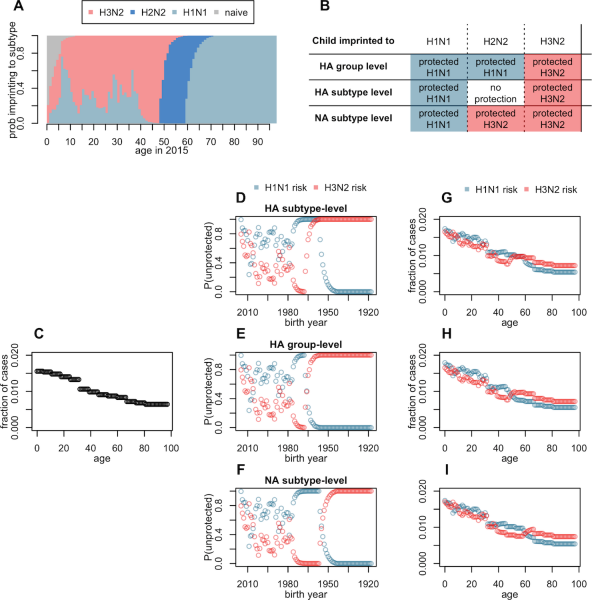
Image #1: models of the dependence of immunity on childhood imprinting and the factor of viral evolution.
On the other hand, these differences may be linked to the evolution of the virus subtypes themselves. For instance, H3N2 shows faster drift* of its antigenic phenotype than H1N1.
Antigen drift* refers to changes in the immune-modulating surface factors of viruses.
For this reason, H3N2 may better evade previously formed immunity in immunologically experienced (previously infected) adults, whereas H1N1 may be relatively constrained in its effect primarily on immunologically naive (previously uninfected) children.
To test all plausible hypotheses, researchers conducted an analysis of epidemiological data, creating likelihood functions for each variant of statistical models, the comparison of which was executed using the Akaike information criterion (AIC).
An additional analysis was also conducted on the hypothesis that the differences are due not to imprinting but to viral evolution.
Preparation for the study
The hypothesis modeling used data from the Arizona Department of Health Services (ADHS), specifically 9,510 cases of seasonal H1N1 and H3N2 across the state. Approximately 76% of reported cases were documented in hospitals and laboratories, while the remaining cases were not specified in laboratories. It is also known that about half of the laboratory-confirmed cases were serious enough to result in hospitalization.
The data used in the study spans a period of 22 years: from the flu season of 1993–1994 to the 2014–2015 season. Notably, the sample size increased significantly after the 2009 pandemic, hence this period was excluded from the sample (Table No. 1).
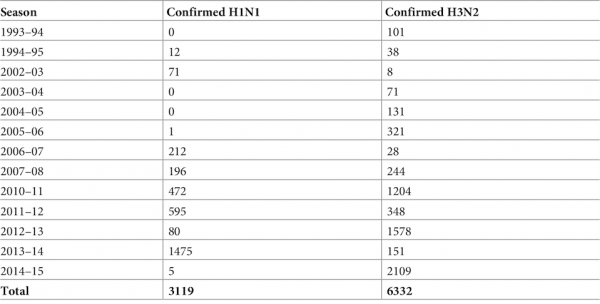
Table No. 1: Epidemiological data from 1993 to 2015 regarding reported cases of H1N1 and H3N2 viruses.
It is also important to note that since 2004, commercial laboratories in the U.S. have been required to report all patient viral infection data to state health authorities. However, most of the cases analyzed (9,150/9,451) were observed starting from the 2004–2005 season, after this rule came into effect.
Of the 9,510 cases, 58 were excluded as they involved individuals born before 1918 (their imprinting status cannot be definitively determined), and another case was excluded due to an incorrectly reported year of birth. Thus, 9,541 cases were included in the analysis model.
In the initial stage of modeling, the probabilities of imprinting to H1N1, H2N2, or H3N2 viruses specific to the year of birth were determined. These probabilities reflect the nature of the impact of influenza A on children and its prevalence over the years.
The majority of individuals born between the pandemics of 1918 and 1957 were first infected with the H1N1 subtype. Those born between the pandemics of 1957 and 1968 were almost entirely infected with the H2N2 subtype (1A). Starting from 1968, the dominant virus subtype was H3N2, which became the cause of infection for most individuals in the younger demographic group.
Despite the prevalence of H3N2, H1N1 has continued to circulate seasonally among the population since 1977, causing imprinting in some people born in the mid-1970s (1A).
If imprinting at the subtype level of HA creates a likelihood of infection during seasonal influenza, then exposure to HA subtypes H1 or H3 in early childhood should provide lifelong immunity to more modern variants of the same HA subtype. However, if imprinting immunity works primarily against specific types of NA (neuraminidase), then lifelong protection will be characteristic for N1 or N2 (1B).
If imprinting is based on a broader HA, i.e. providing protection against a wider range of subtypes, then individuals with imprinting from H1 and H2 should be protected against modern seasonal H1N1. Meanwhile, individuals with imprinting to H3 will only be protected against modern seasonal H3N2 (1B).
Scientists note that the collinearity (roughly speaking, the parallelism) of predictions from various imprinting models (1D—1I) was inevitable, given the limited diversity of influenza antigenic subtypes circulating among the population over the past century.
A crucial role in differentiating between imprinting at the HA subtype level, NA subtype level, or HA group level is played by middle-aged individuals who were first infected specifically with H2N2 (1B).
Each of the tested models used a linear combination of age-related infection (1C), and infection related to year of birth (1D—1F), to obtain the distribution of H1N1 or H3N2 cases (1G – 1I).
A total of 4 models were created: the simplest one contained only the age factor, while more complex models included imprinting factors at the HA subtype level, NA subtype level, or HA group level.
The age factor curve takes the form of a step function, where the relative risk of infection was set to 1 in the age group 0–4. In addition to the primary age group, the following groups were also included: 5–10, 11–17, 18–24, 25–31, 32–38, 39–45, 46–52, 53–59, 60–66, 67–73, 74–80, 81+.
In models that contained imprinting effects, it was assumed that the proportion of individuals in each year of birth with protective imprinting in childhood was proportional to the decrease in infection risk.
The modeling also took into account the factor of viral evolution. For this, data was used that described the annual antigenic progress, defined as the average antigenic distance between strains of a specific viral lineage (H1N1 before 2009, H1N1 after 2009, and H3N2). The 'antigenic distance' between two influenza strains is used as an indicator of the similarity of the antigenic phenotype and potential immune cross-protection.
To assess the impact of antigenic evolution on the age distribution of epidemics, an analysis was conducted on changes in the proportion of cases among children during seasons when significant antigenic changes occurred.
If the level of antigenic drift is a decisive factor in the age-related risk of infection, then the proportion of cases observed in children should be negatively associated with annual antigenic progress. In other words, strains that have not undergone significant antigenic changes compared to the previous season should be unable to evade pre-existing immunity in adults with immunological experience. Such strains would be more active among the population lacking immunological experience, specifically among children.
Research Results
The yearly data analysis showed that seasonal H3N2 was the primary cause of infections among the elderly population, while H1N1 affected middle-aged individuals and youth (Figure 2).
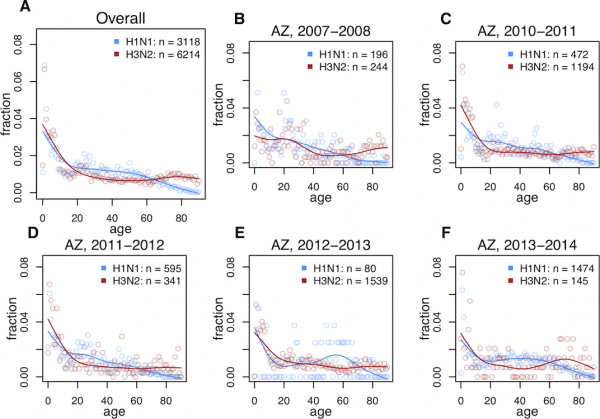
Figure 2: Age distribution of H1N1 and H3N2 influenza over different time periods.
This pattern was present in both pre-pandemic 2009 data and post-pandemic data.
The data showed that imprinting at the NA subtype level predominates over imprinting at the HA subtype level (ΔAIC = 34.54). At the same time, imprinting at the HA group level was virtually absent (ΔAIC = 249.06), as was complete absence of imprinting (ΔAIC = 385.42).
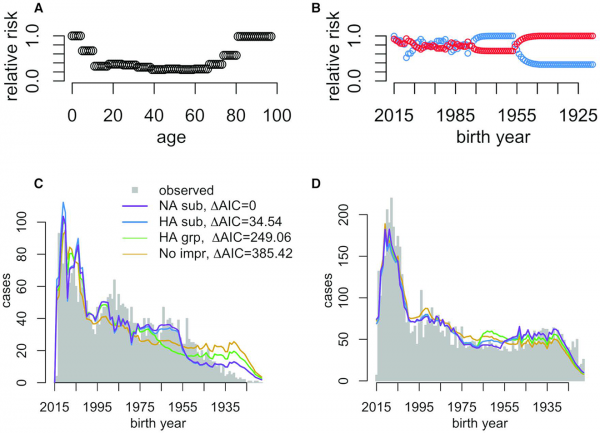
Figure 3: Assessment of model fit to the study data.
Visual assessment of model fit (3C and 3D) confirmed that models containing imprinting effects at narrow subtypes of NA or HA provide the best match to the data used in the study. The fact that a model without imprinting cannot be supported by the data indicates that imprinting is a crucial aspect of immunity formation in the adult population regarding seasonal subtypes of influenza. Nevertheless, imprinting operates within a very narrow specialization, meaning it acts exclusively on a certain subtype rather than on a whole spectrum of influenza subtypes.
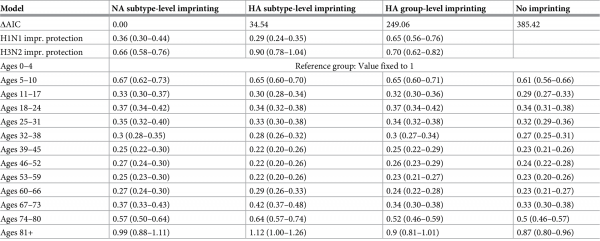
Table No. 2: assessment of the models' conformity to the study data.
After accounting for the demographic distribution by age, the assumed age risk was highest among children and the elderly, which corresponded to the accumulation of immune memory in childhood and the weakening of immune function in older adults ( 3A the approximate curve from the best model is shown). The estimates of the imprinting parameters were less than one, indicating a slight reduction in relative risk (Table No. 2). Within the best model, the presumed reduction in relative risk from imprinting in childhood was stronger for H1N1 (0.34, 95% CI 0.29–0.42) than for H3N2 (0.71, 95% CI 0.62–0.82).
To check the influence of viral evolution on the age distribution of infection risk, researchers sought a decrease in the proportion of infection cases among children during periods associated with antigenic changes, when strains with high antigenic drift more effectively infected immunologically experienced adults.
Data analysis showed a slight negative but insignificant correlation between the annual increase in antigenic activity and the proportion of H3N2 cases observed in children (4A).
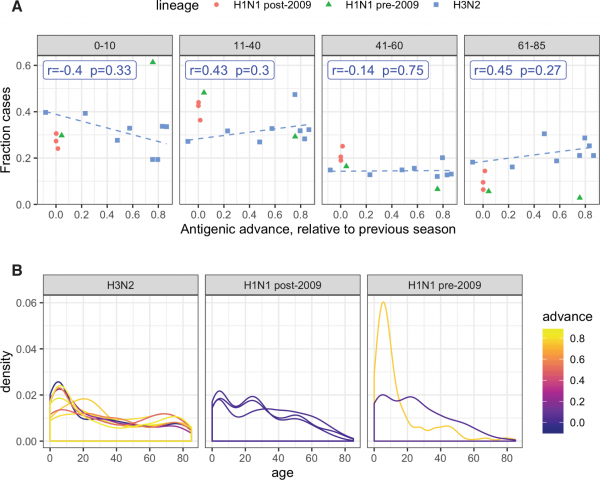
Figure No. 4: the impact of viral evolution on age-related infection risk factors.
However, no clear correlation was found between antigenic changes and the proportion of cases observed in children over 10 years old and adults. If viral evolution played a significant role in this distribution, we would have seen clearer evidence of evolutionary influence among adults, not just in comparisons between adults and children under 10.
Moreover, if the degree of evolutionary changes in viruses is dominant for subtype-specific differences in the distribution of epidemic age, then when subtypes H1N1 and H3N2 show the same annual antigen spread, their age distribution of infection cases should appear more similar.
For a more detailed understanding of the nuances of the research, I recommend checking out the .
Epilogue
In this study, researchers analyzed epidemiological data on H1N1, H3N2, and H2N2 infections. The data analysis revealed a clear dependence on childhood imprinting and the risk of infection in adulthood. In other words, if a child was infected in the 1950s when H1N1 was circulating and H3N2 was absent, the likelihood of being infected with H3N2 in adulthood will be much higher than the chance of contracting H1N1.
The main conclusion of this study is that it is not only important what a person was infected with in childhood but also in what sequence. The immune memory formed throughout life actively 'records' data from the first viral infections, which contributes to a more effective response to them in adulthood.
Researchers hope that their work will help better predict which age groups are more susceptible to the effects of specific flu subtypes. This knowledge can assist in preventing the spread of epidemics, especially when it is necessary to allocate a limited number of vaccines among the population.
This study is not aimed at finding super medicines for any type of flu, although that would be wonderful. It focuses on what is much more realistic and important at the moment — preventing the spread of infection. If we cannot instantly eliminate the virus, we must have all possible tools to contain it. One of the most reliable allies of any epidemic is the careless attitude towards it both from the state as a whole and from each individual in particular. Panic, of course, is not needed, as it can only make things worse, but precautionary measures will always be beneficial.
Thank you for your attention, stay curious, take care of yourself and your loved ones, and have a great weekend, everyone! 🙂
A little advertisement 🙂
Thank you for staying with us. Do you enjoy our articles? Want to see more interesting content? Support us by placing an order or recommending us to your friends, , a unique entry-level server alternative that we have created for you: (options available with RAID1 and RAID10, up to 24 cores and up to 40GB DDR4).
Dell R730xd at half the price in the Equinix Tier IV data center in Amsterdam? Only with us in the Netherlands! Dell R420 — 2x E5-2430 2.2GHz 6C 128GB DDR3 2x960GB SSD 1Gbps 100TB — from $99! Read about how
Source: habr.com
