

Abstract
The whole world is talking about Artificial Intelligence, yet — here’s the paradox! — there still isn't a universally accepted, clear, logically structured, and profound definition of ‘intelligence’ (not even artificial intelligence, but intelligence in general)! Why not take the daring step to try and find and propose such a definition? After all, a definition is the foundation upon which everything else is built, isn’t it? How can we build AI if everyone has a different view of what should underlie it? Let's get started…
Keywords: intelligence, ability, property, object, adaptation, behavior, environment, preservation, survival.
To describe existing definitions of intelligence, we used the article "A Collection of Definitions of Intelligence" (S. Legg, M. Hutter. A Collection of Definitions of Intelligence (2007), ), quotes from which are presented along with comments (italic).
Introduction
This article (A Collection of…) is a review of a large number (over 70!) of unofficial definitions of the term ‘intelligence’ that the authors have gathered over many years. Naturally, compiling a complete list would be impossible, as many definitions of intelligence are deeply buried within articles and books. Nevertheless, the definitions presented here are the largest collection, complete with detailed references…
Despite the long history of research and discussions, there is still no benchmark definition of intelligence. Some have come to think that intelligence can only be defined approximately, rather than completely. We believe that such a degree of pessimism is excessive. While there is no single benchmark definition, if one reviews the numerous proposals, it quickly becomes clear that there are strong similarities between many definitions.
Definition of Intelligence
Definitions from general sources (dictionaries, encyclopedias, etc.)
(the 3 best definitions of intelligence from the 18 provided in this section of the original article are included. The selection was based on the criteria of breadth and depth of coverage of the properties — abilities, characteristics, parameters, etc., highlighted in the definition).
- The ability to effectively adapt to the environment, either by making changes to oneself, modifying the environment, or seeking a new one...
- Intelligence is not a single mental process, but rather a combination of many mental processes aimed at effectively adapting to the environment.
Adaptation is the result of the manifestation of various unspecified properties that form intelligence. It is important that the environment is specified—existing or even new.
- The ability to learn and understand, or to deal with new or complex situations;
- The skillful use of reasoning;
- The ability to apply knowledge to influence the environment, or the ability to think abstractly, as this ability is measured by objective criteria (during testing).
It is important that the environment is specified! Drawbacks:
- Through the conjunction 'or', heterogeneous categories are connected: 'the ability to learn' and 'to deal with new situations'.
- And 'the skillful use of reasoning' is not suitable for definition at all.
- People differ from one another in their abilities to understand complex ideas, their effectiveness in adapting to the environment, learning from their experiences, engaging in various forms of reasoning, and overcoming obstacles through contemplation.
Well, at least people are mentioned, i.e., a person who possesses abilities! The effectiveness of adaptability is indicated—which is important—but adaptation itself is not on the list! Overcoming obstacles is essentially problem-solving.
Descriptions provided by psychologists (the top 3 out of 35 definitions are presented)
- I prefer to call intelligence 'successful intelligence'. The reason is that the emphasis is on using intelligence to achieve success in life. Therefore, I define intelligence as the skill of achieving what one wants in life within a sociocultural context, which means that people have different goals: for some, it is getting very good grades in school and successfully passing tests, while for others, it may be becoming a very good basketball player, or actress, or musician.
The goal is explicitly achieving success in life, but that's all...
From a very general perspective, intelligence exists where an individual animal or person is aware, even if vaguely, of the relevance of their behavior in relation to a goal. Among the many definitions attempted by psychologists to define what is inherently undefined, the more or less acceptable ones are:
- the ability to respond to new situations or to learn to do so through new adaptive responses, and
- the ability to perform tests or solve problems, including grasping relationships, with the level of intelligence being proportional to the complexity or abstractness, or both together.
Thus, a hierarchy has emerged: "From a very general perspective...", which is already good. But that's where all the good ends...
- Tautology: react… through new adaptive responses. There’s no difference—whether through old or new responses, the main thing is to react!
- Now about tests… Grasping relationships is not bad, but far from sufficient!
- Intelligence is not a single ability, but a composite consisting of several functions. It represents a combination of abilities necessary for survival and development within a given culture.
Oh, finally, survival through intelligence has been mentioned! But everything else is lost...
Descriptions provided by AI researchers (the top 3 out of 18)
- An intelligent agent does what corresponds to its circumstances and its goals; it is flexible regarding changing conditions and evolving goals, it learns from its own experiences and makes appropriate choices conditioned by perception limits and processing capabilities.
Perhaps the best definition of intelligence among all those presented here.
The goal is marked, true, but not specified.
Adaptability—both in terms of conditions and goals. The latter means that there is no concept of the main goal!
Learning means identifying (though not explicitly stated) the properties of the environment, memorizing, and utilizing.
Choice means that criteria are implied.
Limitations—on perception and influence.
- "The ability to learn something is a necessary, context-independent skill required to acquire a wide range of subject-specific knowledge. Achieving this 'General AI' requires a highly adaptive, universal system that can independently acquire an extremely wide range of specific knowledge and skills, and can enhance its cognitive abilities through self-education."
"It seems that the ability to learn is the ultimate goal... From it arise the properties of General AI — high adaptability, universality..."
- "Intelligent systems must operate, and operate well, in many different environments. Their intelligence allows them to maximize the likelihood of success, even in the absence of complete knowledge of the situation. The functioning of intelligent systems cannot be viewed separately from their environment, from the specific situation, including the goal."
"What does 'functioning well' mean? What constitutes success?"
"The potential for a composite description"
"If we extract the frequently encountered functions (traits, characteristics, etc.) from the examined definitions, we find that intelligence:"
- "It is a property that an individual agent possesses when interacting with the environment/environments."
- "This property relates to the agent’s ability to achieve success or benefit in relation to a certain goal or task."
- "This property depends on how the agent can and must adapt to various goals and environments."
"The joint use of these key attributes gives us an informal definition of intelligence: Intelligence is measured by an agent's ability to achieve goals across a wide range of conditions."
"But wait, we need an answer to the question: what is intelligence, not how (or what) it is measured (assessed)""! One could justify the authors of the article by saying that these definitions are nearly thirteen years old, and one would expect that something should have changed in the intervening years — after all, the IT field is developing at a rapid pace... But below follows an example from a 2012 article, (M.Hutter, One Decade of Universal Artificial Intelligence," ") where the definition of intelligence has changed little over the years:
Reasoning, creativity, association, abstraction, pattern recognition, problem-solving, memory, planning, goal achievement, learning, optimization, self-preservation, vision, language processing, classification, induction and deduction, acquisition and processing of knowledge… It seems difficult to provide a precise definition of intelligence that encompasses every aspect of it.
The same problems (even more so) with the definition as 8 years ago: manifestations of intelligence are presented as an unstructured list of characteristics!
The definition of intelligence on Wikipedia (accessed May 22, 2016):
“Intelligence (from Latin intellectus — sensation, perception, understanding, comprehension, reason) is a quality of the psyche that consists of the ability to adapt to new situations, the ability to learn from experience, the understanding and application of abstract concepts, and the use of knowledge to manage the environment. A general capacity for cognition and problem-solving that unites all of a person's cognitive abilities: sensation, perception, memory, imagination, thinking.”
The same Wikipedia, but in the latest version as of January 24, 2020:
“Intellect (from Latin intellectus "perception", "understanding", "comprehension", "concept", "reason") or mind is a quality of the psyche that consists of the ability to adapt to new situations, the ability to learn and memorize based on experience, understanding and applying abstract concepts, and using knowledge to manage the environment surrounding a person. A general capacity for cognition and problem-solving that unites cognitive abilities: sensation, perception, memory, imagination, thinking, as well as attention, will, and reflection.”
So many years have passed, yet we see the same thing — a set of characteristics without any structure… And mentioning a person — the bearer of intelligence, only at the very end of the text. That is, making the replacement: ‘abstract Object with intelligence -> Human with intelligence’ followed by identifying in this definition: ‘What does a Human need to become intelligent?’, does not seem feasible. Or this replacement leads to trivial wishes: For a Human to become intelligent, they need to acquire the ability to adapt to new situations, to learn from experience, to understand and apply abstract concepts, and to use their knowledge to manage their environment, etc. In short, that’s how one can become smart, rather than remain foolish…
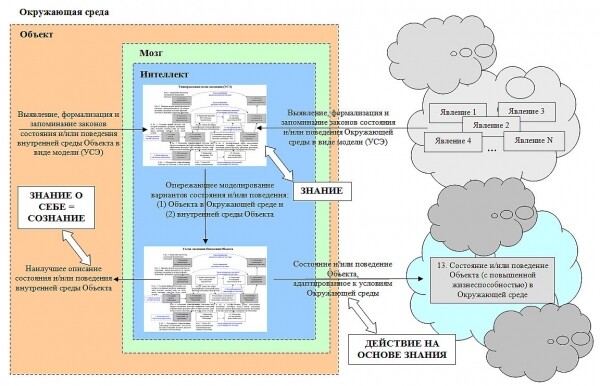
Thus, based on the above, the following definition is proposed, linked to the Object, since intelligence cannot ‘hang in the air’, it must belong to someone’s abilities. The same applies to behavior, which can only belong to someone or something:
The intelligence of the Object is a set of abilities used in:
(1) Identifying, formalizing, and memorizing (in the form of a model) the laws of states and/or behavior:
(1.1) of the Environment, and
(1.2) of the Internal Environment of the Object.
(2) Proactive modeling of states and/or variants of behavior:
(2.1) in the Environment, and
(2.2) of the Internal Environment of the Object.
(3) Creating a description of the state and/or implementation of the behavior of the Object, adapted to:
(3.1) the Environment, and
(3.2) the Internal Environment of the Object
provided that the ratio of the Behavior of the Object / Costs of behavior is maximized
of the Object in order to preserve (existence, persistence, being) of the Object in the Environmental
environment.
This is how it looks in the diagram:
 »
»
Now about the application of the definition… Truth, as they say, is always specific. Therefore, to test the logic of the definition, we should replace Object with some widely known and understandable specific system, for example, with… a Car. So…
A car with intelligence — is a Car with a set of abilities used in:
(1) Identifying, formalizing, and memorizing (in the form of a model) the laws of states and/or behavior:
(1.1) Road conditions, and
(1.2) Internal environment of the Car.
(2) Proactive modeling of states and/or variants of behavior:
(2.1) in Road conditions, and
(2.2) Internal environment of the Car.
(3) Creation of a description of the condition and/or behavior implementation of the Vehicle, tailored to:
(3.1) the Traffic environment, and
(3.2) the Internal environment of the Vehicle
to maximize the ratio (Vehicle Behavior / Costs of behavior of the Vehicle) in order to maintain (existence, duration, being) of the Vehicle — both in the Traffic environment and the Internal environment of the Vehicle.
Is it just me who can see that we call a Vehicle with such capabilities an intelligent one? Then another question: would you notice a difference between a ride in a car driven by a professional driver and a ride in such an Intelligent Vehicle?
The answer 'NO' means:
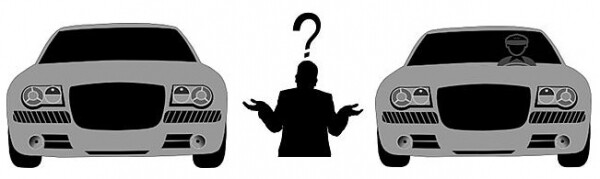
A correct definition of intelligence is given: by replacing 'Object -> Vehicle', there are no logical failures or inconsistencies in the description.
- A Vehicle with such capabilities during a ride effectively passed the 'automotive' Turing test: the passenger on the trip saw no difference between a car with a professional driver and this Vehicle. Or in precise terms of the Turing test: 'If during several rides the passenger in the driverless car and the car with a professional driver cannot guess which car was driving him, then in terms of 'thinking in traffic conditions', the driverless vehicle can be considered equivalent to the car with a professional driver.'
- Those interested are invited to 'play' with this definition — substitute the impersonal word 'Object' with the name of any familiar system (natural, social, production, technical) of your choice and independently check the compatibility. Be sure to share your results and thoughts based on the experiment!
Defining intelligence through its objectives
(A. Zhdanov. 'Autonomous Artificial Intelligence' (2012), 3rd ed., e-book, pp. 49-50):
The main goals that the nervous system of any organism strives for are:
survival of the organism;
- accumulation of knowledge by its nervous system.
- These 2 points: survival and accumulation of knowledge — are a generalized description of points 3 and 2 respectively!
In conclusion…
‘Vicarious teaches the computer to use imagination’
‘Vicarious teaches the computer to use imagination’
("The Computer Has Learned Aggressive Driving") )
"Life Would Be Quite Boring Without Imagination. Therefore, Probably the Biggest Problem with Computers Is That They Actually Lack Imagination. The Startup Vicarious Is Creating a New Way of Processing Data Inspired by How Information Likely 'Flows' Through the Brain. The Company's Leaders Say This Will Give Computers Something Like Imagination, Which They Hope Will Help Make Machines Much Smarter. The Company Has Introduced a New Type of Neural Network Algorithm with Properties Borrowed from Biology. One of These Is the Ability to Envision How Information Learned Should Look in Different Scenarios — Something Like Digital Imagination."
Well, what a coincidence! Exactly point (2) of the definition: anticipatory reflection — this is digital imagination!
This Doesn’t Happen Often, But Look What We Discover Online:
("The Computer Has Learned Aggressive Driving") )
"Georgia Tech Specialists Have Built a Model of an Autonomous Vehicle (Scale 1:5 Based on a Series RC Model Chassis) Capable of Navigating Turns Using Controlled Drifting. The Onboard Computer Is Equipped with an Intel Skylake Quad-core i7 Processor and Nvidia GTX 750ti GPU and Processes Information from a Gyroscope, Wheel Rotation Sensors, GPS, and a Pair of Front Cameras. Based on the Data from the Sensors, the Control Algorithm Generates 2560 Forward Motion Trajectories for the Next Two and a Half Seconds."
The Control Algorithm Contains a "World View" of the Vehicle in the Form of a Set of Possible Motion Trajectories on a Given Track.
"Out of 2560 Trajectories, the Algorithm Chooses the Most Optimal One and Adjusts the Position of the Wheels and Speed Accordingly. In This Process, All 2560 Trajectories Are Constructed and Updated 60 Times Per Second."
This Is Anticipatory Reflection, Artificial Creativity, or Digital Imagination! The Choice of the Optimal Trajectory from 2560 Pre-generated Ones and the Adjustment of Wheel Position and Speed (Adaptation!) to Remain on Track. All of This Is Described by the Presented Scheme of Intelligence!
"The Entire Training Process of the Control Algorithm Took Several Minutes of Track Driving by an Operator with Minimal Driving Experience."
The learning process is the creation of a worldview!
"At the same time, researchers note that controlled skidding was not used during training; the car 'invented' it on its own. During the tests, the vehicle autonomously navigated the track, trying to maintain a speed as close to eight meters per second as possible."
Controlled skidding is an element of optimal strategy (that very maximization of the 'Object Behavior / Cost of Behavior') developed independently by the car.
"According to the authors, training algorithms for aggressive driving may also be useful for everyday autonomous vehicle management in the same way that knowing how to control skidding can benefit a human driver. In case of an unexpected situation—for example, icy conditions—the autonomous vehicle will be able to regain control and prevent a possible accident."
And this is the dissemination of the car's experience... Well, like a guardian bird (remember the well-known story), which, having acquired a useful skill, immediately passes it on to everyone else.
Once again, I will provide a definition that is proposed for use:
The intelligence of the Object is a set of abilities used in:
(1) Identifying, formalizing, and memorizing (in the form of a model) the laws of states and/or behavior:
(1.1) of the Environment, and
(1.2) of the Internal Environment of the Object.
(2) Proactive modeling of states and/or variants of behavior:
(2.1) in the Environment, and
(2.2) of the Internal Environment of the Object.
(3) Creating a description of the state and/or implementation of the behavior of the Object, adapted to:
(3.1) the Environment, and
(3.2) the Internal Environment of the Object
provided that the ratio of the Behavior of the Object / Costs of behavior is maximized
An object aimed at preserving (existing, enduring, being) the object in the environment.
Thank you for your attention. Comments and remarks are always welcome.
P. S. Regarding "… a highly adaptive, universal system capable of independently acquiring an extremely wide range of specific knowledge and skills" required for creating AGI, we can discuss that separately—it's a very interesting topic. If, of course, there is interest from the readers. 🙂
Source: habr.com
