

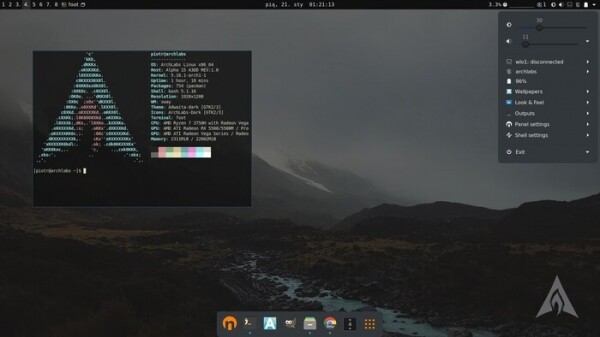
The release of the Sway 1.7 compositor has been published, built using the Wayland protocol and fully compatible with the i3 tiling window manager and the i3bar panel. The project's code is written in C and is distributed under the MIT license. The project is designed for use on Linux and FreeBSD.
Compatibility with i3 is provided at the level of commands, configuration files, and IPC, allowing Sway to be used as a transparent replacement for i3, utilizing Wayland instead of X11. Sway allows windows to be organized on the screen logically rather than spatially. Windows are arranged in a grid that makes optimal use of screen space and allows for quick manipulation of windows using only the keyboard.
To create a complete user environment, the following components are offered: swayidle (background process implementing the KDE idle protocol), swaylock (screen locker), mako (notification manager), grim (screenshot creation), slurp (screen area selection), wf-recorder (video capture), waybar (application bar), virtboard (on-screen keyboard), wl-clipboard (clipboard management), wallutils (desktop wallpaper management).
Sway evolves as a modular project built on top of the wlroots library, which abstracts all basic primitives for organizing the operation of the compositing manager. Wlroots includes backends for abstracting access to the screen, input devices, rendering without direct access to OpenGL, interaction with KMS/DRM, libinput, Wayland, and X11 (providing a layer to run X11 applications on Xwayland). In addition to Sway, the wlroots library is actively used in other projects, including Librem5 and Cage. In addition to C/C++, bindings have been developed for Scheme, Common Lisp, Go, Haskell, OCaml, Python, and Rust.
In the new release:
- The ability to move tabs with the mouse has been added.
- Support for output to virtual reality headsets has been added.
- The command 'output render_bit_depth' has been added to enable high color depth compositing output mode.
- The reliability and performance of fullscreen window output has been enhanced (direct output without additional buffering is provided using dmabuf).
- The xdg-activation-v1 protocol has been utilized, allowing focus to be transferred between different first-level surfaces (for example, with xdg-activation, one application can switch the focus to another).
- The option client.focused_tab_title has been added for customizing the color of the active tab.
- The command 'output modeline' has been added to set a custom DRM (Direct Rendering Manager) mode.
- The command 'output dpms toggle' has been added to simplify turning off the screen from scripts. Commands 'gaps toggle ', 'smart_gaps inverse_outer', and 'split none' have also been added.
- The option '--my-next-gpu-wont-be-nvidia' has been removed, and instead, the '--unsupported-gpu' mode should be used. Proprietary NVIDIA drivers are still not supported.
- The default terminal emulator defined in the settings has been replaced with foot.
- The ability to disable the swaybar panel and swaynag dialogs during the build process has been provided.
- Dynamic adjustment of the window title height based on the characters in the title text has been prohibited; the title now always has a fixed height.
Source: opennet.ru
