

Google has removed the ability to delete default search engines from the Chromium codebase. In the configurator under the ‘Manage Search Engines’ section (chrome://settings/searchEngines), it is now impossible to remove items from the list of default search engines (Google, Bing, Yahoo). This change took effect starting with the release of Chromium 97 and also impacted all browsers based on it, including new releases of Microsoft Edge, Opera, and Brave (Vivaldi remains on Chromium 96).
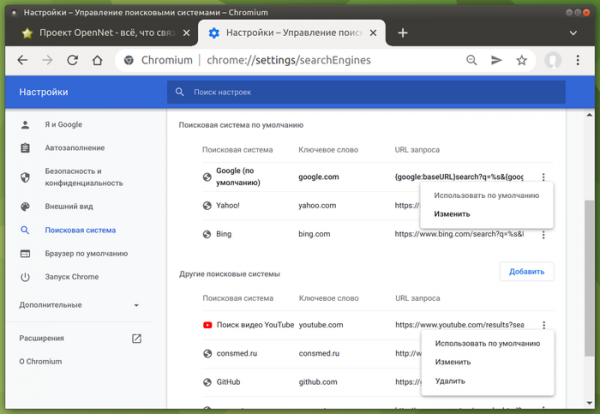
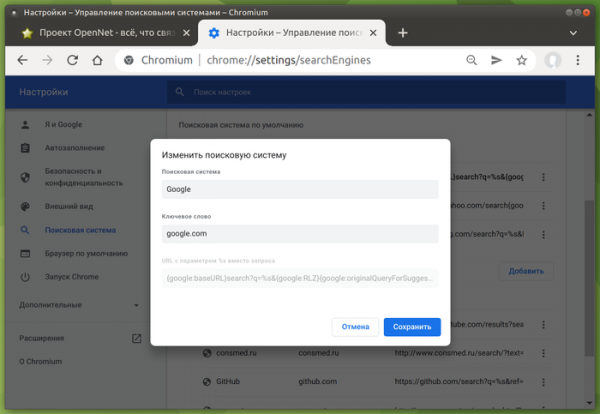
In addition to hiding the delete button in the browser, the options for editing search engine parameters are also limited, now allowing only the modification of the name and keywords while blocking changes to the URL with query parameters. However, the functionality to delete and edit additional search engines added by the user has been retained.
The reason for prohibiting the deletion and modification of default search engine parameters cited is the difficulty of restoring settings after careless deletion — a default search engine can be deleted with one click, after which the functionality of contextual suggestions, the new tab page, and other features linked to searches becomes disrupted. Furthermore, restoring deleted entries cannot be accomplished by simply using the button to add a custom search engine; it requires a labor-intensive operation to transfer original parameters from the installation archive, necessitating file profile editing, which is cumbersome for an average user.
Developers considered adding a warning about the potential consequences of deletion or could have implemented a dialog for adding the default search engine to simplify the restoration of settings, but ultimately, it was decided to simply disable the delete button for entries. The ability to delete default search engines could have been useful for completely disabling requests to external sites when typing in the address bar or for blocking changes made to search engine settings by malicious extensions, for example, those attempting to redirect input key queries in the address bar to their own site.
Source: opennet.ru
