

Nomination: For the development of contract theory in neoclassical economics. The neoclassical approach implies the rationality of economic agents, broadly utilizes equilibrium theory and game theory.
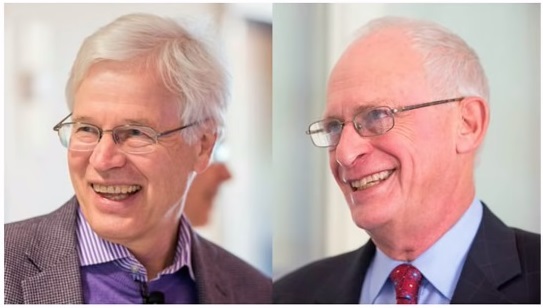
Oliver Hart and Bengt Holmström.
A contract. What is it? I am an employer, I have several employees, and I tell them how their salaries will be arranged. In what cases and what they will receive. These cases may include the behavior of their colleagues.
Let me give five examples. Three of them illustrate how attempts at intervention led to a deterioration of the situation.
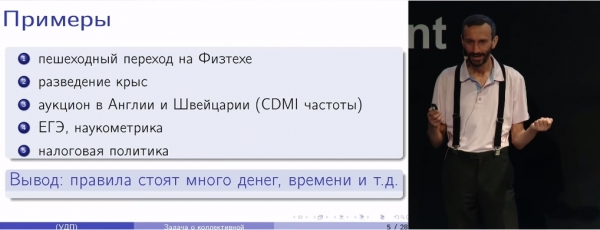
1. Students were crossing the street at different places. Cars slowed down, students ran across, and the traffic was somehow 'organized'. Chaotic, but everything seemed fine, life went on.
A couple of years ago, an order was issued to organize a single pedestrian crossing. It was a stretch of road of 200-300 meters. Fences were put up around, and all the students went to this one crossing. As a result, students completely blocked traffic for 25 minutes from 8:45 to 9:10. Not a single car could pass. A typical example of a 'negative contract'.
2. I did not find exact confirmation. A factoid, something that everyone knows as a fact, but in reality may have no verification.
In an Eastern country, they began to fight against rats. They started paying for each rat killed ('10 coins'). After that, everything is clear, everyone abandoned their jobs and started breeding rats.From the hall, it was shouted that this case occurred in India with cobras.).)
3. There were two auctions for the sale of mobile frequency ranges, in England and Switzerland. In England, the process was led by Roger Myerson, a Nobel laureate. He managed it in such a way that the contract cost was about 600 pounds for each Englishman. In Switzerland, they completely failed the auction. They colluded, and it ended up being 20 francs per person.
4. I cannot speak without tears, but the tears have already run out. The Unified State Exam (USE) has destroyed school education. It was intended to fight corruption, to ensure everything was honest and fair. How this all ended, I can say that in most schools, apart from the very best, students are just trained for the USE, education has stopped, and training sessions are taking place instead. Teachers are told outright: 'Your salary and your presence in school depend on how your students do on the USE.'
The same goes for articles and scientometrics.
5. Tax policy. There are many successful examples and many unsuccessful ones. A significant part of the report will be focused on this issue.
Mechanism design
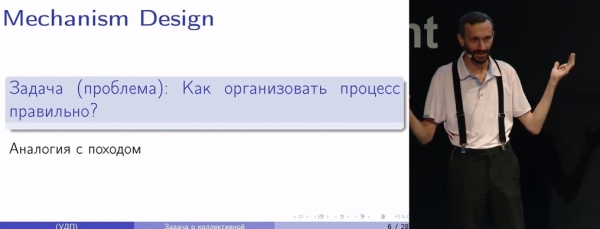
I have seen many different hiking groups, including those of large sizes — 30-40-50 people. When properly organized, this is a combat unit that lives as one organism. Everyone has their own role, their own task. In other places, it's just a relaxed mess.
How to solve the control problem when there are very few controllers?
Such problems often arise in different forms. They are not always successfully resolved.
Example.
There is a metro station with a transfer to commuter trains. 20 turnstiles and one inspecting guard. And in the corner, about 10 fare evaders are gathering. A train arrives and they all rush out as if by command. The guard grabs someone, but the others get away. If we look at this situation from the perspective of game theory, it presents two completely different equilibrium scenarios.
In one, no one goes in and everyone knows that no one is going in, and no one tries. This is a self-sustaining scenario. It's an equilibrium where everyone behaves 'correctly'. One person holds back the entire crowd.
But there is another equilibrium. Everyone runs. If you believe that everyone is running, then the probability of getting caught is 1/15, so you might take the risk. The existence of these two options poses a significant challenge to scientists in the field of game theory. Perhaps half of game theory is dedicated to processing such situations. How can we instill the fear of 'getting caught' in the minds of the fare evaders?
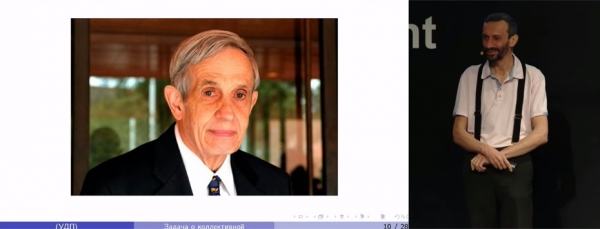
This is John Nash. He proved a very general theorem about the existence of equilibria in games with interdependent decisions. When the outcome depends not only on your decisions but also on the decisions of all other participants.
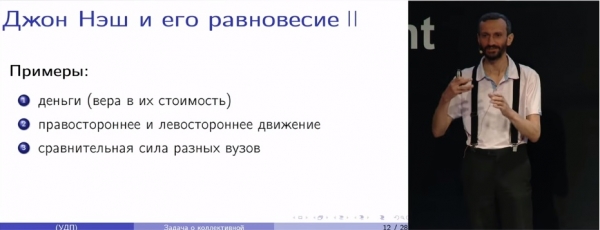
Several examples of equilibria.
What is money? У вас в кармане лежит какая-то непонятная бумажка. Вы поработали и этих бумажек (цифр на счету) стало больше. Сами по себе они не значат ничего. Можно разжечь костер и погреться. Но вы верите, что они что-то значат. Вы знаете, что вы пойдете в магазин и их примут. Тот кто примет, тоже верит, что дальше у него её тоже примут. Всеобщая вера в то, что у этих бумажек есть ценность — это социальное равновесие, которое, время от времени, разрушается, когда происходит гиперинфляция. Тогда из ситуации, когда все верят в деньги, превращается в ситуацию, когда все не верят в деньги.
Right- and left-hand traffic. In some countries, it's different, but you follow these rules.
Why do people go to the Physics and Technology Institute? Because there is confidence that the teaching there is good. There is confidence that other strong students will go there as well. Imagine for a second that a group of very strong school students suddenly agreed to go to a weak university. It would instantly become strong.
How can a guard eliminate a bad equilibrium?
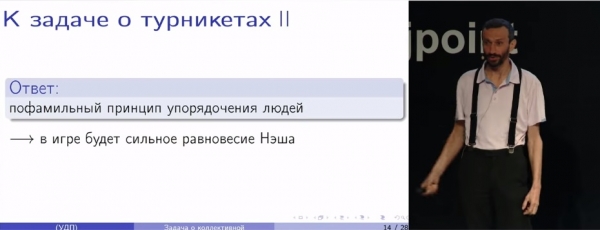
We need to number all the rabbits out loud and inform them that anyone who jumps will be caught based on having the lowest number.
Suppose some company decides to jump. Then the one with the lowest number knows for certain that they will be caught and will not jump. Equilibrium is when we correctly predict others' actions and those actions that others predict about us. In the situation of "counting out loud," equilibrium has an additional property of stability. It is stable against "coordination/cooperation." This means that even in this equilibrium, it is impossible to agree that a certain number of people will change their behavior simultaneously so that everyone will benefit.
If you create complex rules, and the company cannot understand them, you cannot expect them to behave in accordance with Nash equilibrium. They will make random choices.
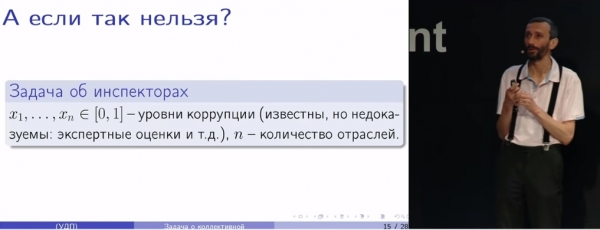
Suppose we are prohibited (institutional constraint) from "counting out loud." Our strategies must be symmetric (anonymous). But we can resort to "the coin." Heads means I do one thing, tails means I do another.
It’s a serious problem. It was formulated and studied 20 years ago. No one paid taxes. They tried every which way to organize the process. Zero profits, bribes… The tax officials turned to the institute where I work a bit, to my supervisor. Together we formulated the problem this way. There are n industries, each has its inspector, but in some % of cases, he colludes. % is chosen by each one. x1, x2… xn.
x=0 means that the inspector decided to be honest. x=1 means he takes bribes in all cases.
The x values could be inferred from indirect indicators, but they cannot be used in court. Based on this information, a verification strategy needs to be developed.
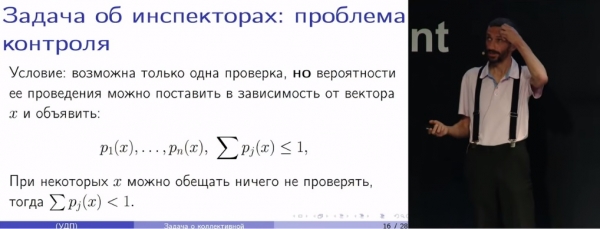
It can be simplified to having just one verification, but with a very large fine. We assign a probability to this verification. The probability that I come to you is this, and to you is that. And these are functions of the x values. The total does not exceed one. Strategically, in some cases, it is correct not to check at all and to promise this to them.
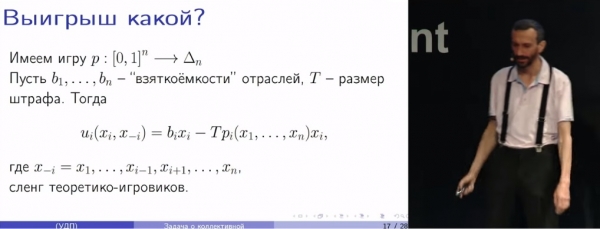
r is the representation of an n-dimensional cube in the set of all probability distributions. We need to define their winnings and understand how much each will receive when they decide in what % of cases to take bribes.
bi is the "bribe capacity" of the industry (if everywhere you take a bribe instead of paying tax).
The fine is deducted with the probability of it occurring. What is that probability? Firstly, it needs to be checked specifically. But that's not all; the check may encounter a case where everything was clean. A simple formula, but the complexity lies in "p."
We have slang that doesn't exist in other fields of mathematics: x-i. This is a set of all variables except my own. These are the choices made by everyone else. This is collective responsibility.
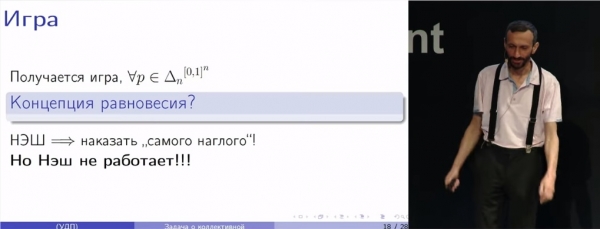
Now the question is: In which equilibrium concept do we suppose they will be?
In the 90s, there was a major slip here. The organizers of the checks announced to everyone that the most brazen would be punished. An inspection would come to them.
How will the forecast for this situation look?
The people who set the rules thought there would be independent interactions. The only equilibrium is all zeros. But in reality, it was 100%. Why?
The answer is that the equilibrium is unstable to collusion.
We started scratching our heads.
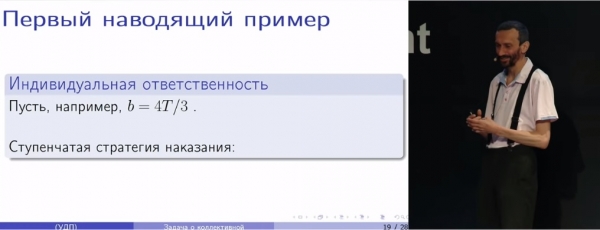
A leading example is individual responsibility. Imagine a dreadful situation where the fine is legislatively lower than the bribe. If an inspector works in such a "greasy" industry that their bribe exceeds the fine, can anything be done? The fine can't be collected multiple times.
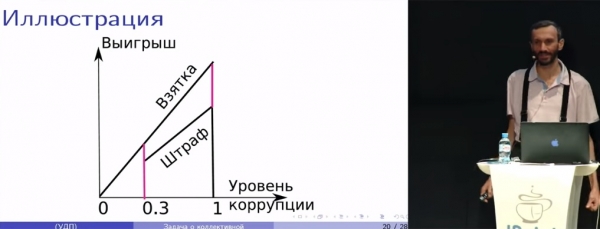
I know that the inspector will bribe their way out and be in profit. But I can promise not to check you at all if your corruption level is no higher than 30%. What's more advantageous?
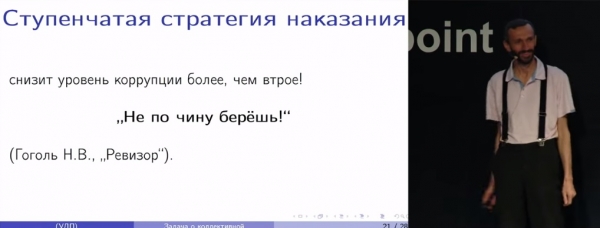
The classics had this already.
In triplicate the level of corruption decreases.
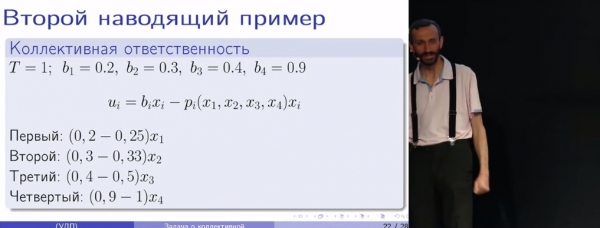
An abstract situation. Four people. Bribe capacity is lower than the fine.
If you rely on individual contracts, you won’t "zero out" everyone. But I can zero out everyone through a strategy of collective responsibility.
I equally send checks with equal probabilities not to the maximums, but to the non-zeros. All thieves with a non-zero percentage will each receive a check with a probability of 1/4. I don't even change the probability depending on x's.
Then there are no equilibriums except for the zero one. And collusion cannot exist either.
If there exists not only a silent collusion but also the exchange of money, then game theory completely collapses. There is a strict proof.
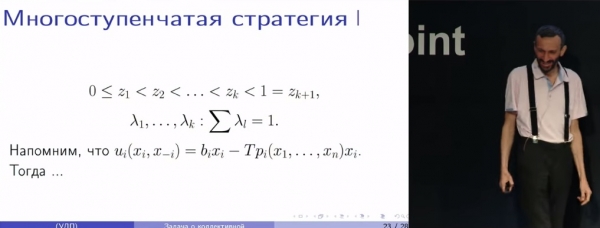
A whole class of strategies has been developed, which is implemented through Nash equilibrium, resistant to collusion.
We assign several levels of tolerance to corruption. z1 is the fully tolerant level, the others represent increasing levels of intolerance. For each level, we designate a probability of inspection. The formula looks like this:
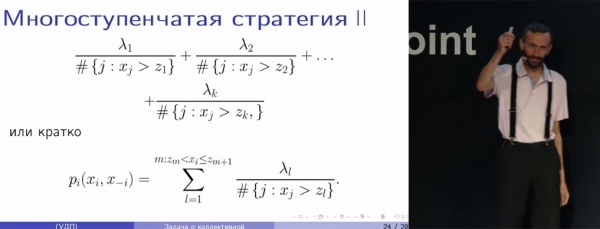
λ1 — the probability of inspection at the first level of tolerance — is divided equally among all who have surpassed it; additionally, λ2 is divided among all who have surpassed the second threshold, and so on.
I proved the following theorem 15 years ago.
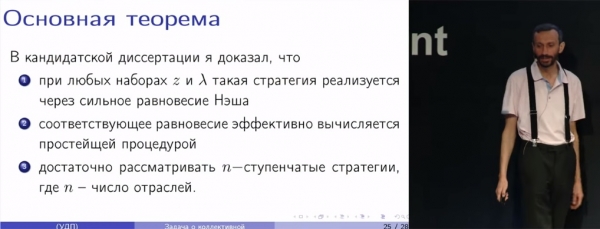
This strategy was used even before me, as a cost-sharing strategy.
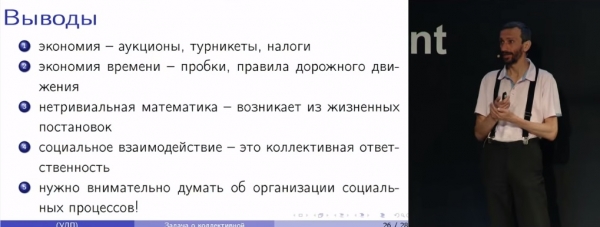
Contracts cost money. Well-designed interaction schemes can lead to significant cost savings at times. Time saving as well.
Collective responsibility is effective. Binding a person to a group is effective.
How I presented a report at the Ministry of Internal Affairs.
I arrived, there were about 40 policemen of different ranks, they listened, glanced at each other, whispered, and then the chief came up to me and said: "Alexey, thank you, it's interesting to listen to someone passionate about their science... but this has nothing to do with reality."
Experimentally observed Russian corrupt officials behave differently from experimentally observed Americans. Do you know the difference? A Russian, when he starts taking bribes, is no longer an economic agent who rationally maximizes his benefit. [Applause]
A person starts taking bribes to the limit, never discussing anything. He needs to be caught and imprisoned; that is all the science.
Thank you.
Source: habr.com
