

AMD has announced the creation of its own composite server, ACS (AMDGPU Composition Stack), based on the codebase of the reference composite server Weston, developed by the Wayland project. ACS is presented as a synchronized fork of Weston, incorporating enhanced capabilities. The fork is planned to be synchronized with the current codebase of Weston twice a year. The project's code is distributed under the MIT license.
The project is created as a testbed for developing new Wayland features, which will later be incorporated back into the main Weston framework. ACS will also be used to maintain code developed for AMD hardware that cannot be integrated into the main Weston code due to the project's policy regarding the addition of support for specific hardware features.
ACS is viewed as a benchmark composite server, providing the most comprehensive support for AMD hardware and used during the development of AMD's advanced graphics and display features. ACS will also serve as an open platform, forming a base for AMD's commercial products and specific applications such as performance optimizers, multimedia players, 3D games, and profiling tools.
Additional features of ACS that are absent in Weston:
- Support for the FreeSync mechanism, allowing for adaptive refresh rate changes (VRR - Variable Refresh Rate) to ensure smoothness and eliminate tearing during gaming and video playback.
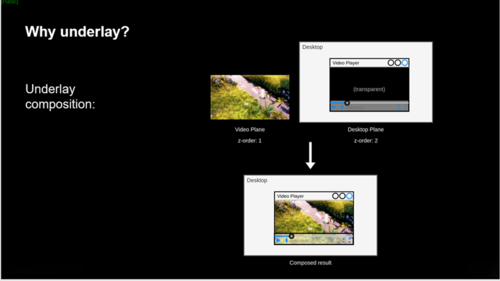
- Implementation of multi-plane overlay (MPO), which consolidates multiple framebuffers into one, utilizing underlay compositing, where the desktop forms the top layer over other layers (in typical overlay compositing, content is rendered over the lower layer with the desktop). The proposed method reduces GPU resource consumption, simplifies compositing, and eases blending rules.

- Support for direct decoding of multimedia content and provision of the ACS Media Player, showcasing the available enhanced video playback capabilities. The player supports HDR, FreeSync, hardware acceleration through VDPAU/VAAPI, and direct access to the FFmpeg API.
- Support for the Wayland protocol extension for color management and wide color gamut.
- The ability for fullscreen video playback with High Dynamic Range (HDR) on monitors that support HDR. Tone mapping support (HDR Tone Mapping).
- Support for Multiseat configurations, where separate input devices are attached to existing GPUs (e.g., integrated GPU and discrete graphics card), allowing independent sessions on one system with output to different screens.
- Minor upgrade to the user interface.
Among the still unimplemented features noted in the plans are: HDR and per-window color management; TMZ (Trusted Memory Zone) and a mode to protect against data interception displayed on the screen (Secure Display); optimization profiles for AMDGPU; debugging and GPU reset capabilities; support for virtualization and modifications for QEMU; a graphical interface for the UMR (User Mode Register) debugger; MM Audio support for video and games.
Source: opennet.ru
