

Introduction
An excavator can be seen on any construction site in the city. A regular excavator is operated by a single operator. It does not require a complex automation system for control.
But what if the excavator is several times larger than usual, reaching the height of a five-story building, capable of holding a Land Cruiser in its bucket, and its 'filling' consists of electric motors, cables, and gears the size of a car? And it operates in coal and mining quarries, 24 hours a day / 7 days a week for 30-40 years straight?
Such an excavator is an industrial system, the maintenance of which is very expensive.
Automation of technological processes reduces the cost of operating an industrial system. An automated process control system is called – APCS. An excavator like the one described is no exception.
So what kind of excavator is this? What APCS is used in it?
Which excavators are we talking about?
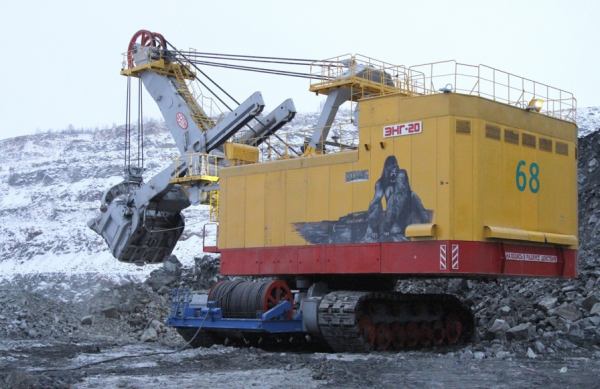
We are talking about bucket-wheel excavators. These machines are used for developing mining and coal quarries.
Dimensions: Bucket-wheel excavators reach the height of a five-story building.
Movement: the excavator moves using a crawler chassis. The chassis consists of:
- crawler frames;
- tracks;
- drive units;
- a lubrication circuit for the chassis.
Digging: for digging, bucket-wheel excavators use a 'Straight Shovel' mechanism. This mechanism consists of a bucket, arm, and boom. The bucket is attached to the arm. The arm is designed to provide translational movement to the bucket. It is positioned transversely to the boom. A pressure mechanism is installed on the boom, which performs the pressure and return movement of the arm with the bucket. A complex system of cables drives this mechanism.
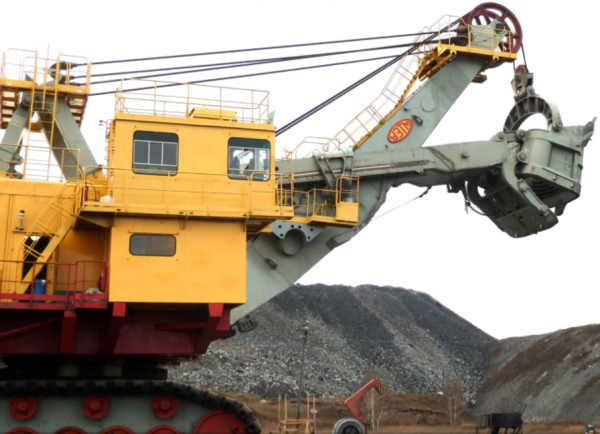
Device (Composition): the excavator consists of three major components:
- working equipment;
- rotating platform with mechanisms;
- chassis.
The working equipment was described above – this is the 'Straight Shovel' mechanism.
Bucket-wheel excavators perform many operations: digging, turning the machine body, moving, etc. Each operation is designed for a separate engine. A huge number of systems are required to perform all these operations. All systems and mechanisms, as required, are located in the 'machine hall'.
The "machine hall" of the excavator is the rotating platform. It houses the bucket lifting mechanism, the rotary mechanism, the excavator's electrical equipment with control and monitoring system, auxiliary mechanisms, pneumatic system, and centralized automatic lubrication system.
Operating conditions and lifespan: excavators operate in a 24/7 mode, and their lifespan truly amounts to 30-40 years.
Power / fuel: excavators operate on electricity. Each mining site receives power from a substation with a voltage of 35/6 kV.
What automation do excavators have on board?
A quarry excavator is an industrial system. The tasks of operating the excavator are similar to those of operating an industrial facility:
- monitoring movement system parameters;
- equipment wear monitoring;
- protecting equipment from external and internal threats: overloads, short circuits, etc.;
- energy accounting;
- monitoring the excavator's position;
- inspecting equipment during operation;
- blind spot monitoring;
- monitoring the excavator's performance indicators;
- keeping an event log;
- data transmission for centralized accounting.
One operator handles all these tasks. This is made possible through automation.
The automated control system "on board" the excavator includes the following systems:
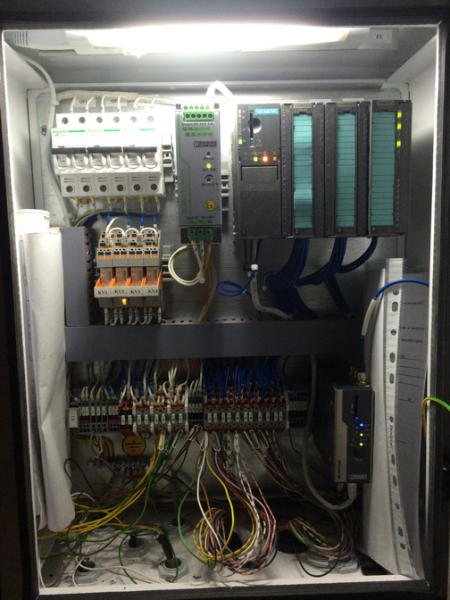
Controllers are installed for monitoring movement parameters. The operator monitors the following parameters: the operation of the drive control systems, the temperature of the system components, and pressure in the pneumatic system, along with high-density lubrication. An electricity meter is installed to account for active and reactive electric energy consumed and delivered.
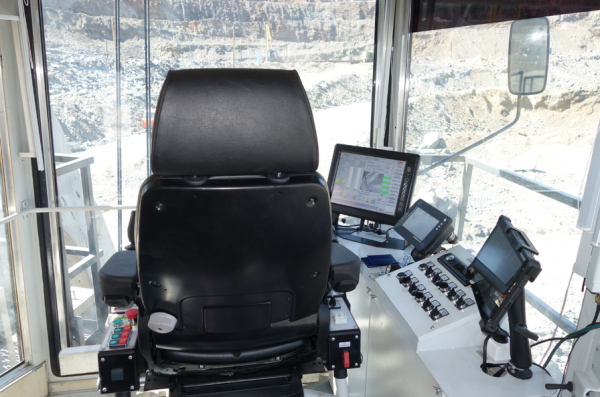
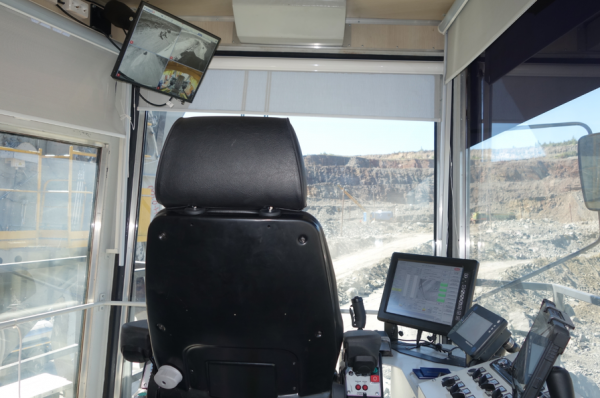
Blind spots, the operation of mechanical equipment, and the working face are displayed on the operator's screen. For this purpose, cameras are installed. Data from controllers are used to calculate and account for the excavator's performance indicators. Indicators are calculated over a specific time interval: per shift, per month, by teams.
All events are stored in the event log and kept for the required time period. How is data transmission organized?
As mentioned above, the excavator consists of a travel car and a rotating platform. показателей работы экскаватора используются данные из контроллеров. Показатели вычисляют за определенной временной интервал: за смену, за месяц, по бригадам.
Все события сохраняются в журнал событий и хранятся необходимый интервал времени.
Как организована передача данных?
Как уже упоминалось выше, экскаватор состоит из ходовой тележки и поворотной платформы.
The rotating platform can freely rotate 360 degrees around the chassis. It is very challenging to use wires for data transmission between these two parts, as they tend to wear out quickly.
Data between the parts of the excavator is transmitted via Wi-Fi. Functional Wi-Fi WLAN 5100 modules are installed in the base and the rotating platform from in conjunction with special cables and omnidirectional antennas . In total, 3 antennas are installed on the excavator for stable communication.
Additionally, a with a wide-range antenna and a surge protection device .
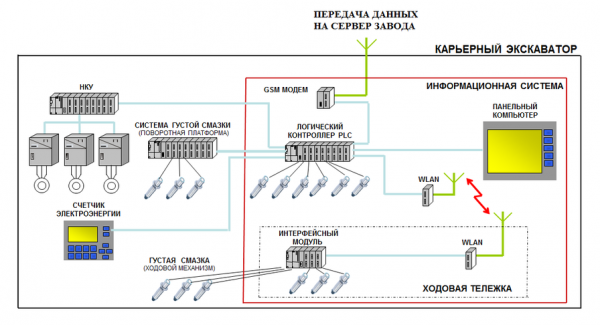
The structural diagram of the information system of the bucket excavator
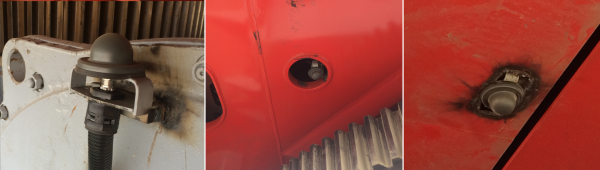
Antenna installation on the EKD-20 excavator
What does the operator's cabin look like?
The final result of automation for the operator looks as follows:
Source: habr.com
