

The infamous 'tin foil hats' will no longer be needed for those concerned about health in RF-saturated environments. Wireless optical networks promise to relieve Wi-Fi congestion in enclosed spaces, including homes. This new technology will not displace cellular communication and traditional Wi-Fi hotspots but can address speed shortages for various tasks and reduce energy consumption.
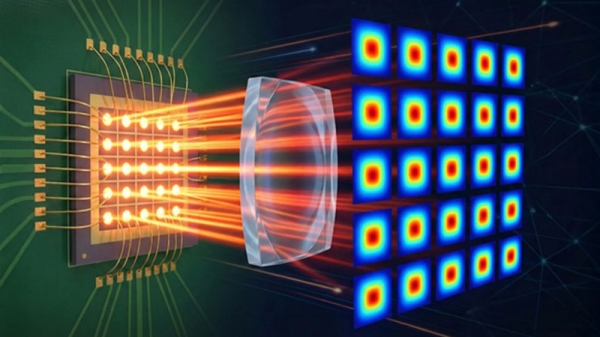
Breakthrough in the development of wireless optical data transmission systems informed engineers of the International Society for Optics and Photonics (SPIE). They have developed a compact chip with an array of miniature vertical-cavity surface-emitting lasers (VCSELs) that use light instead of radio waves for data transmission. In laboratory tests, the system achieved a record speed of 362.7 Gbps, significantly surpassing the capabilities of traditional Wi-Fi and cellular networks.
Importantly, the energy efficiency of the proposed solution was found to be twice that of radio communication, consuming about 1.4 nJ per bit of information, which will significantly reduce energy consumption amid increasing network loads.
At the core of the technology is a chip less than a millimeter in size with a matrix of lasers arranged in a 5x5 format, where each element operates independently and transmits a separate data stream. A special optical system with microlenses directs each beam, creating an even grid of illuminated zones at distances of up to two meters without interference (the experiment was conducted in a regular room with the transmitter and receiver spaced two meters apart).
The matrix of emitting LEDs allows multiple users to be served simultaneously in one room. Signal modulation using multiple frequency channels ensured high bandwidth—up to 362.7 Gbps with 21 out of 25 LEDs operating. The transfer speed could have been even higher but was limited by an off-the-shelf photoreceiver used in the experiment.
The compact size of the transmitting chip allows it to be embedded in access points, light fixtures, and virtually anywhere, providing high-speed connectivity in close proximity to the user. When multiple users are present, the multi-channel mode ensures each user receives their share of high-speed traffic, as confirmed by experiments that established four separate communication channels with impressive bandwidth. Each of the matrix's laser speeds reached 19 Gbit/s.
Developers emphasize that optical communication is not susceptible to the interference issues characteristic of radio frequencies, which is especially important in crowded environments such as offices, hospitals, data centers, and residential spaces. This new technology will not replace Wi-Fi or mobile communication but will complement them, alleviating the main load on the radio components of networks in enclosed spaces. It will pave the way for faster, safer, and more environmentally friendly wireless networks of the future, where high-speed internet for video, virtual reality, and IoT devices becomes the norm with minimal energy consumption.
Source:
Source: 3dnews.ru
