

Starting from the Ubuntu 22.04 LTS release, the deb packages firefox and firefox-locale will be replaced with placeholders that install the Firefox Snap package. The option to install the classic deb package will be discontinued, and users will be required to use either the offered snap package or download builds directly from the Mozilla website. For users of the deb package, a seamless transition process to snap will be offered through the release of an update that installs the snap package and transfers current settings from the user's home directory.
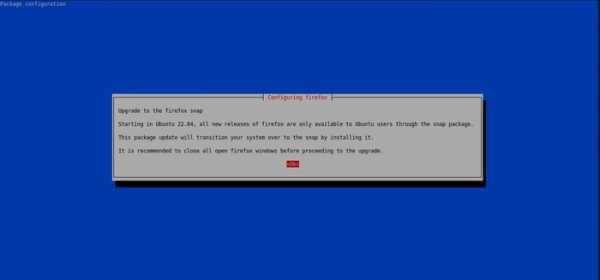
Recall that in the fall release of Ubuntu 21.10, Firefox was switched to being delivered by default as a snap package, but the option to install the deb package was retained and remained available. Since 2019, Chromium has also been delivered only in snap format. Mozilla employees are involved in the development of the snap package with Firefox.
The reasons for promoting the snap format for browsers include the desire to simplify maintenance and unify development across different versions of Ubuntu — the deb package requires separate maintenance for all supported Ubuntu branches and, consequently, builds and testing considering different versions of system components, whereas the snap package can be built for all Ubuntu branches at once. One of the important requirements for delivering browsers in distributions is the need for timely updates to address vulnerabilities. Delivering in snap format will expedite the process of getting new browser versions to Ubuntu users. Moreover, delivering the browser in snap format allows Firefox to run in an additionally isolated environment created using the AppArmor mechanism, which enhances the protection of the rest of the system from exploiting vulnerabilities in the browser.
The drawbacks of using snap include difficulties in community control over package development and dependency on additional tooling and third-party infrastructure. The snapd process runs with root privileges, which poses additional risks in case of infrastructure compromise or vulnerability discovery. Another downside is the need to resolve issues specific to the snap format (some updates may not work, there are bugs when using Wayland, guest session issues, and difficulties launching external handlers).
Notable changes in Ubuntu 22.04 include the switch to a default GNOME session with Wayland on systems with proprietary NVIDIA drivers (if the driver version is 510.x or newer). On systems with AMD and Intel GPUs, the default transition to Wayland occurred in the Ubuntu 21.04 release.
Source: opennet.ru
