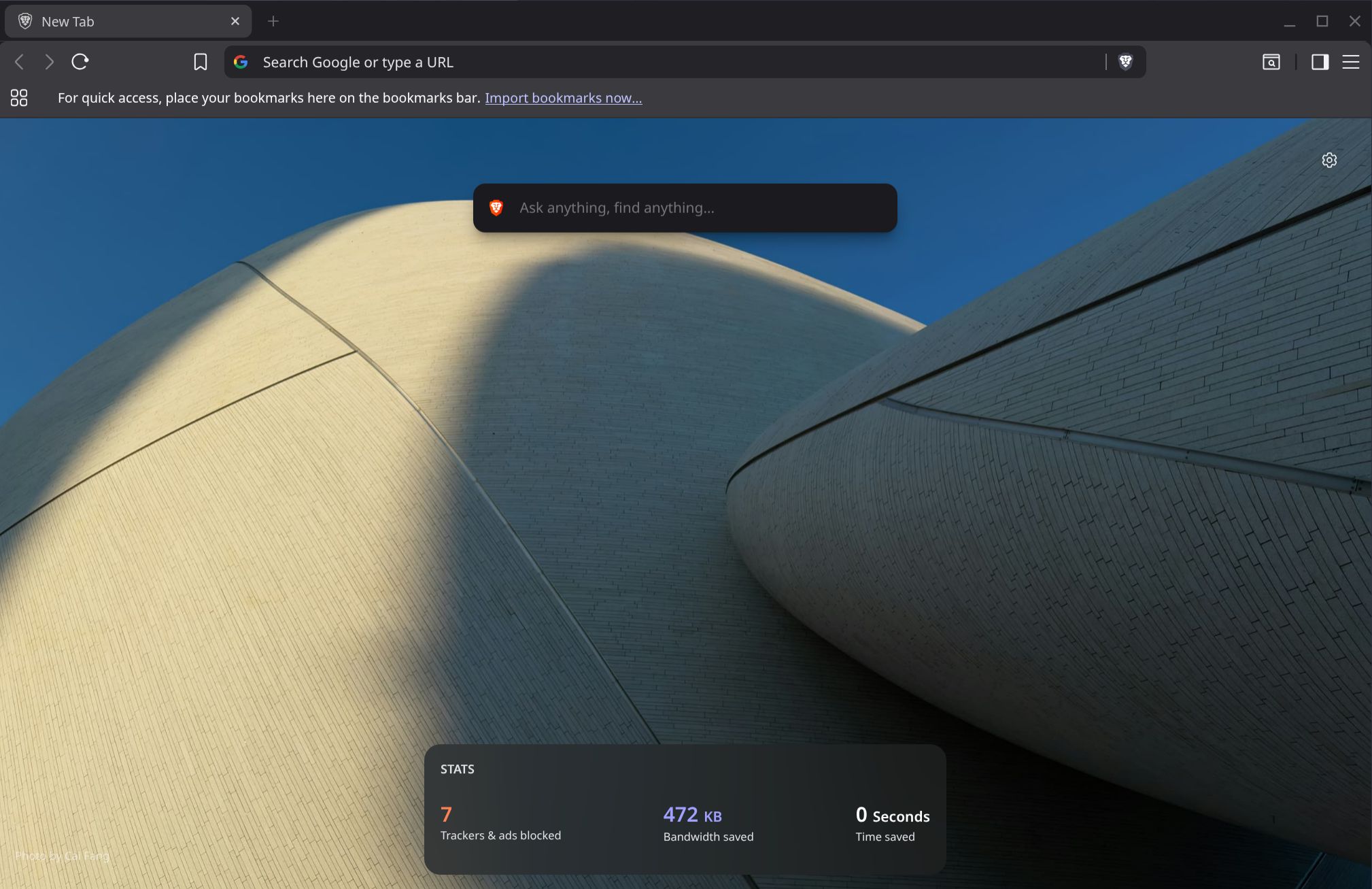
The release of Brave Origin, a minimalist version of Brave, has taken place.
Brave is an internet browser, a fork of Chromium, supported by Brave Software. This company was founded by Brendan Eich, the creator of the JavaScript programming language and former CTO of Mozilla Corporation.
Brave is developed based on an 'open core' model: the source code of patches to Chromium is available at github, but binary packages are built in a closed manner and contain the following proprietary features:
- Leo. An AI assistant that can use both the supported Brave language models (list), as well as any others that provide access via an OpenAI-compatible API. This includes the possibility of using local models that can run using Ollama, for instance.
- News. A personalized news feed. Pre-set sources can be removed and custom ones added. RSS is supported, and personalization algorithms work locally.
- Playlist. Extracts media from the current page and adds it to the playlist.
- Wallet. A built-in crypto wallet and support for web3 domains (meaning domains whose IP addresses are stored not on DNS servers but on a blockchain).
- Rewards. Earns crypto tokens if you agree to view ads.
- Speedreader. Leaves only the text of the article on the web page. Unlike similar modes in other browsers, it is invoked before navigating to the page and prevents not only the display of extraneous content but also its loading.
- Talk. A paid video conferencing service. According to the official documentation, it is a Jitsi deployed on the infrastructure of Brave Software.
- Tor. A special mode for operating through this network.
- VPN. A paid service that does not work in Russia.
- Wayback Machine. Integration with https://archive.org/, allows you to view a saved copy of this URL by clicking.
- Web Discovery Project. If you agree to its use, it sends anonymous statistics about visited web pages to Brave Software servers. There, this statistics is used to build the index Brave Search (the search engine developed by this company).
- Email Aliases. Allows you to create disposable emails for site registrations with a single click. Requires the creation of a brave account with a real email.
The Origin version differs from the regular Brave in that all the features listed above are disabled. There are two types of builds available: in the first type, these features are disabled in the settings and can be re-enabled, while in the second type, they are disabled at compilation and are completely unavailable.
Also, the Brave Origin removes the functionality for collecting anonymous analytics and crash information. However, the following features remain:
- Shields. A built-in ad blocker.
- Sync. A data synchronization tool between browsers. It does not require account registration. It operates in a p2p mode similar to Syncthing: devices connect in chains using QR codes and exchange data over the local network. But unlike Syncthing, in addition to p2p, data is also copied to Brave Software servers in an encrypted form. Here’s a brief technical description of the synchronization mechanism: link. (presumed) source code for the synchronization server is also are, but the author of the news did not investigate whether it can be self-hosted and used instead of the official servers.
Users of supported platforms (macOS, Windows, Android, iOS) are offered to pay a one-time fee of $60 for this build.
Linux users of Brave Origin are offered it for free via this link. However, they can also donate to the developers. The provided script will set up repositories for supported distributions (Debian-based, Fedora, openSUSE, Arch). All others can download the portable zip archive from GitHub.
Source: linux.org.ru