

All users of the stable branch of the Chrome browser have been informed of a change that, by default, activates new code for output organization on systems with the X server, based on the use of the Ozone layer, abstracting interaction with the graphical subsystem. The use of Ozone allows support for both X11 and Wayland in a single build of Chrome, without being tied to a specific graphical subsystem. The old backend, which only supports operation via X11, is planned to be deprecated and eventually removed from the codebase.
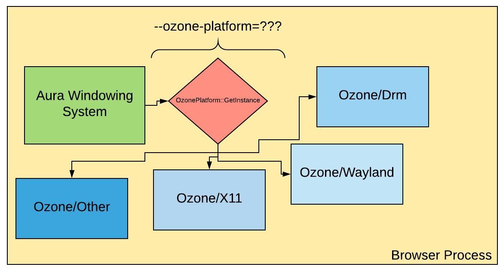
Independence from the characteristics of graphical interface construction in various operating systems in Chrome is achieved through its own cross-platform graphics stack, Aura. Aura serves as a window manager (Aura shell), operating through its own compositor server and utilizing available GPU resources to accelerate graphical operations. The Aura UI graphics toolkit is used to create interface elements, providing its own set of widgets, dialog windows, controls, and event handlers. Only the output over the root window is utilized from the underlying graphics stack (X11, Wayland, Cocoa, or Windows).
All specific operations with the Linux graphics stack are reduced to an easily replaceable abstract layer, Ozone. Until now, Ozone support has been provided as an option, while the old backend, strictly tied to X11, was used by default. Work on transitioning assemblies for X11 to the use of the Ozone layer began in 2020, and gradual inclusion of the Ozone/X11 backend as the default for users began with the release of Chrome 92. Just a few days ago, the new backend was activated for all Linux Chrome users. In addition to X11 and Wayland (‘—ozone-platform=wayland’ and ‘—ozone-platform=x11’), Ozone is also developing platforms for output over KMS/DRM graphics drivers, ASCII graphics output using the libcaca library, rendering to PNG images (Headless), and transmission through Chromecast devices.
Source: opennet.ru
