

This year, the ITIL 4 update was released. We explain how the certification of IT service management specialists will be conducted under the new standard.
/ Unsplash /
How the certification process is changing
The last update for the ITIL 3 library was introduced eight years ago. During this time, the IT industry has undergone significant changes and has 'accumulated' new technologies. Many companies have started to implement IT management practices (such as ITSM based on ITIL).
To adapt them to the changed context, specialists from Axelos, responsible for the development of the ITIL methodology, released an update — ITIL 4 — at the beginning of this year. It includes new knowledge areas related to increasing user satisfaction, value creation streams, and agile methodologies like Agile, Lean, and DevOps.
Along with the new practices, the approaches to the certification of IT service management specialists have also changed. In ITIL 3, the highest title in the ITIL system was the ITIL Expert.
In the fourth version, this level has been divided into two directions — ITIL Management Professional and ITIL Strategic Leader. The first is for IT department managers, while the second is for leaders of departments not related to information technology (experts who complete both courses earn the title of ITIL Master).
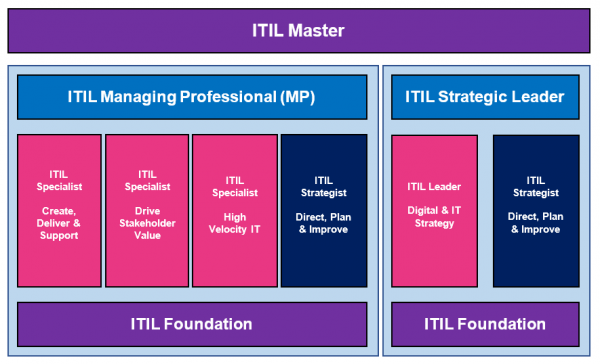
Each of these directions includes its own set of exams (the requirements for them and training programs are published by Axelos What is included in the foundational level
In February, Axelos
published the book 'ITIL Foundation. ITIL 4 Edition'. Its purpose is to explain key concepts and lay the groundwork for further study of advanced programs. ITIL 4 Foundation covers the following topics:
Key concepts of service management;
- The purpose and components of ITIL;
- The purpose and key definitions of the fifteen ITIL practices;
- Approaches to implementing ITIL;
- The four aspects of service management;
- Approaches to creating service value and their interconnections.
- What the questions will be like
The exam consists of 40 questions. To pass successfully, one needs to answer at least 26 of them correctly (65%).
The difficulty level corresponds to
Bloom's taxonomy. , meaning that learners need not only to answer questions but also to demonstrate their ability to apply knowledge in practice.
Some tasks consist of test questions with one or multiple answer options. There are assignments that require the examinee to explain key concepts of IT management in writing.
For example, there are questions that require defining terms such as service, user, or client. In another task, you will have to outline the key components of the ITIL value system. You can find more examples from Axelos.

/ Unsplash /
Upon successfully passing the tests, the exam participant receives the ITIL Foundation Certificate in IT Service Management. ITIL 4 Edition. This certification allows progression to ITIL Management Professional and ITIL Strategic Leader.
What else should be known
Individuals certified in ITIL 3 can complete the entire exam chain from Foundation to Management Professional and Strategic Leader once Axelos publishes all the requirements.
An alternative option for renewing certifications is to pass a 'transition' exam. It is called ITIL Managing Professional Transition. However, in order to take it 17 points in ITIL 3. This number of points corresponds to the level required to sit for the ITIL Expert exam.
We will continue to monitor Axelos releases and publish information about the most significant changes and innovations in ITIL on our blog on Habr.
Themed materials from our corporate blog:
Source: habr.com
