


Everything in a person should be wonderful, and a modern data center should operate with the precision of Swiss watches. No component of the complex architecture of the data center's engineering systems should be left unattended by the operations team. These considerations guided us at the Linxdatacenter site in Saint Petersburg as we prepared for Uptime Management & Operations certification in 2018, aligning all data center systems with the best global standards.
Today, I will explain how and why we implemented a remote pressure monitoring system and air 'support' in server rooms. Let me remind you that during the preparation for the Uptime Institute audit, one of the tasks was cleanliness. Our team worked in two directions: cleaning (previously my colleague spoke about how we fought dust in server rooms) and pressure monitoring in server halls. I, as the chief engineer of the company, was assigned the latter task. In any server room, there is a general ventilation system. It's quite simple in design: one ventilation unit brings air in, while the other exhausts it out. Both motors are controlled by frequency regulators, meaning we can adjust their speeds to regulate the volume of air supplied or removed.
What it's about
This system has two tasks:
To ensure the required air exchange for the comfort of people in the server room (the number of people is based on the room's specifications),
- To maintain positive air pressure in the server room to prevent dust particles from being drawn in through open doors and to uphold necessary cleanliness.
- The supply ventilation unit must deliver more air into the server room than is removed by the exhaust. This creates a positive pressure in the server room relative to adjacent areas—known as 'air support.' With this setup, air enters the server room only through the filters of the supply ventilation, and the ingress of unfiltered air is eliminated.
The supply ventilation machine must provide more air to the server room than is removed by the exhaust. This ensures positive pressure in the server room relative to neighboring spaces—this is what is referred to as 'air support.' With such a system, air only enters the server room through the filters of the supply ventilation, thus preventing the influx of unfiltered air.
If everything is happening the other way around – exhaust ventilation removes more air than supply ventilation provides – then unfiltered air starts to enter the server room from adjacent spaces, which is often the cause of dust accumulation on surfaces and equipment.
No control
It seems straightforward. However, at the beginning of the efforts to improve the cleaning quality in the data center, we did not have an effective tool to monitor the presence of positive pressure. We set the supply frequency higher than the exhaust frequency, and then adjusted it by eye. The doors to the server room are difficult to open (as if being pulled inward) – the pressure is negative. Conversely, if the door closer struggles to close, it means the pressure is very strong. We would stop somewhere in the middle, trying to find a balance between these two states.
However, this approach is unreliable, and we considered it impossible to rely on it further.
Why? Working by eye, it is impossible to take into account the impact of the air filter condition on the supply ventilation performance. If the filter is clean, we will see certain resistance and air volume readings; if the filter is dirty, these readings will differ significantly. The dynamics of door opening and closing will not reveal these nuances.
Typically, the filter replacement occurs based on a standard mechanical differential manometer that disables ventilation at a certain stage of filter contamination (the pressure difference before and after the filter should not exceed a specific value corresponding to the filter cleanliness standard).
It turns out that there is a long period during which the filter becomes progressively contaminated, while the standard differential manometer considers it operable. However, the ventilation power and, therefore, the pressure force change depending on the filter condition.
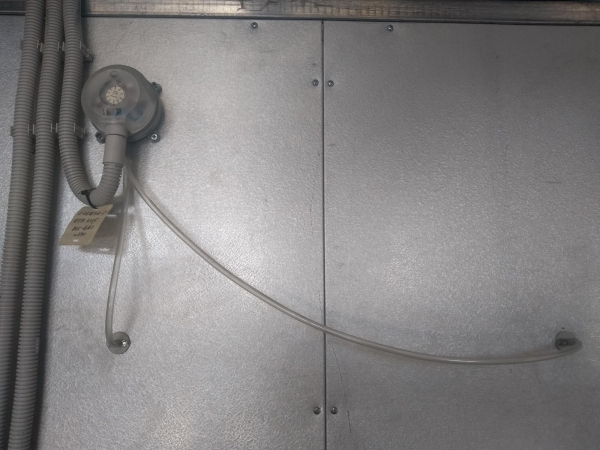
Standard differential manometer for ventilation.
In the end, we concluded that the process of setting and monitoring pressure under such a scenario is too complex and ineffective for the data center.
Solution
To answer the question, 'What should we do?' we turned to best global practices, aided by a trip to Stockholm to tour local data centers.
In one of the data centers We found the solution we needed – a mechanical differential manometer was installed at the entrance of the server room and showed the pressure difference between the 'server room/corridor'.
Interestingly, our Swedish colleagues use manometers at the entrance of server rooms and to monitor the contamination of ventilation filters: they replace filters when the static pressure drops without waiting for a signal from the built-in manometer of the ventilation system. The readings of the manometer are visually monitored by the staff during their rounds.
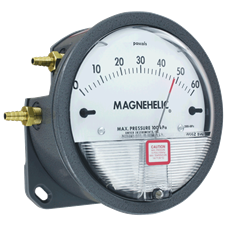
Upon returning, we started searching for similar equipment in Russia. It turned out that similar manometers are used in so-called 'clean rooms', such as operating rooms, laboratories, etc. Due to the special status of these rooms, the prices for this equipment were astronomical.
Moreover, we needed a digital device, preferably with a 4-20mA output, so that it could be connected to the data center monitoring system. This was important for setting threshold values to trigger alerts, as well as for collecting and analyzing statistics.
Those who seek will always find.
We were lucky – soon after starting our search, we managed to find the required device: a digital differential manometer with a display and an output for connection to the BMS at a budget of around 10,000 rubles per unit.
We installed it, configured it, and we are only surprised by one thing – why we didn’t come up with this ourselves earlier, and why this solution is not standard in data center projects.
It looks like this:
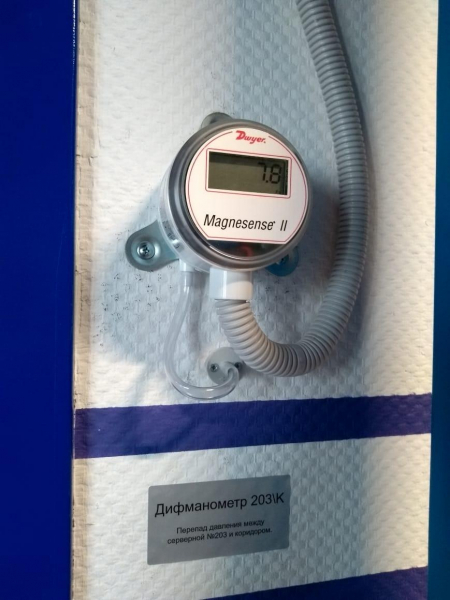
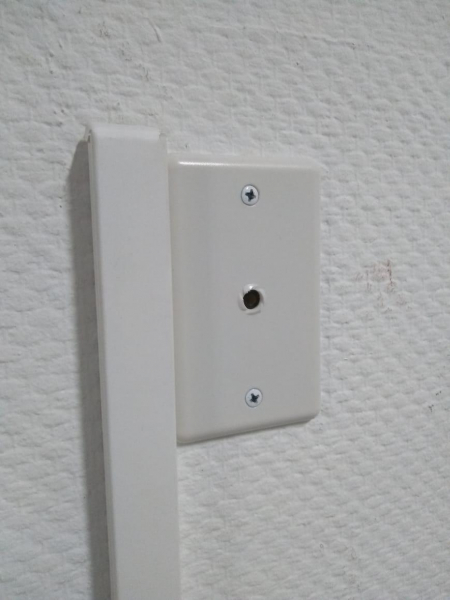
The electronic manometer in the corridor outside the server room, with one measurement channel tube routed into the server room, and the second channel measuring the pressure in the corridor.
This is how the device is displayed in the data center monitoring system:
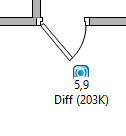
This is what the monitoring system statistics of the manometer readings look like:
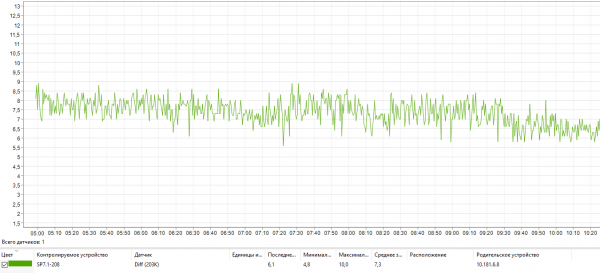
According to GOST R ISO 14644-4-2002 'Clean Rooms and Associated Controlled Environments', which we took as a reference, 'to ensure the unobstructed opening of doors and to exclude unintended counterflows of air due to turbulence, the pressure difference between clean rooms or clean zones of different cleanliness classes should typically range from 5 to 20 Pa.'
We have taken this range as the norm in the data center. As soon as any deviation occurs, it is immediately registered in the system, as shown in the graph below.
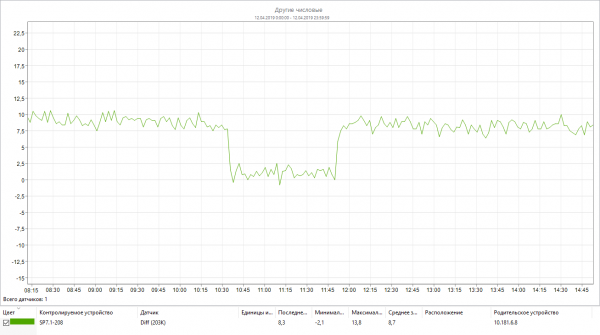
The sharp drop in pressure on the graph represents an open door to the server room.
If the sensor readings are below the set point for more than 5 minutes, it indicates an issue with the filter, an incident has occurred, or something is abnormal. Specifically, in this graph, the cause is the prolonged opening of the door to bring equipment into the room.
What we achieved
Firstly, a new level of control and transparency in the operation of the data center's engineering systems.
Secondly, cleanliness monitoring has become even more effective: the system allows for early warnings of pressure drops and timely changes of air filters or addressing other causes of pressure reduction.
Thirdly, all these processes are monitored with mathematically precise tools. We collect observational history over time and have statistics on the actual lifespan of air filters and all unexpected situations.
The completed Management & Operations audit and our recent visit to European data centers showed that we are pioneers in this area not only in Russia but also in the EU — such solutions are far from common among market leaders in European data centers.
Of course, this system is not critical for the operation of the site's engineering systems. At the same time, it is an extremely useful addition for the operations team and an excellent illustration of our data center's compliance with high standards. In our industry, there are no small details.
Source: habr.com
