

The testing of the beta version of the Fedora Linux 36 distribution has begun. This beta release marks the transition to the final testing stage, during which only critical bug fixes are allowed. The release is scheduled for April 26. The release covers Fedora Workstation, Fedora Server, Fedora Silverblue, Fedora IoT, and Live builds provided as spins with desktop environments KDE Plasma 5, Xfce, MATE, Cinnamon, LXDE, and LXQt. Builds are created for x86_64, Power64, ARM64 (AArch64), and various devices with 32-bit ARM processors.
The most significant changes in Fedora Linux 36 are:
- The Fedora Workstation desktop has been updated to the GNOME 42 release, which includes environment-wide settings for a dark interface theme and has transitioned many applications to use GTK 4 and the libadwaita library, which offers ready-made widgets and objects for building applications that comply with the new GNOME HIG (Human Interface Guidelines).
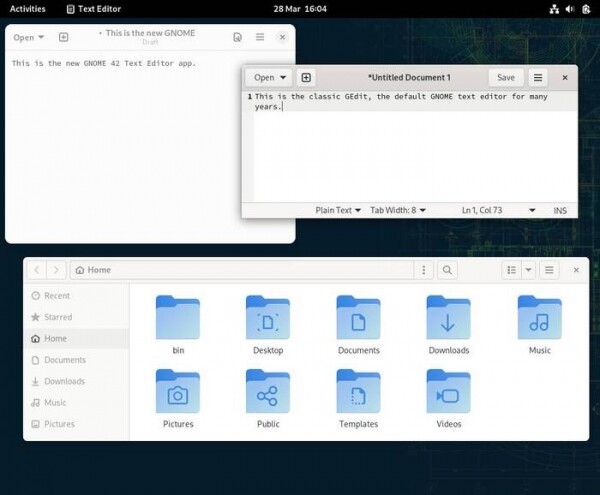
GNOME 42 has been criticized for its inconsistency in styles—some programs adhere to the new GNOME HIG guidelines, while others continue to use the old style or mix elements of both new and old styles. For instance, in the new text editor, buttons are not texturally distinguished, and the window has rounded corners, while the file manager has buttons outlined and less rounded window corners. In gedit, buttons are clearly distinguished, more contrasting, and placed against a darker background, with sharp lower corners of the window.

- For systems with proprietary NVIDIA drivers, a GNOME session based on the Wayland protocol is enabled by default, which was previously only used with open drivers. The option to select a GNOME session running on the traditional X server is retained. Earlier, enabling Wayland on systems with NVIDIA drivers was hindered by a lack of support for hardware acceleration of OpenGL and Vulkan in X11 applications using the DDX (Device-Dependent X) component of XWayland. In the new driver branch, these issues have been resolved, and the performance of OpenGL and Vulkan in X applications launched via XWayland now closely matches that under the standard X server.
- Atomically updatable editions, Fedora Silverblue and Fedora Kinoite, which offer monolithic images with GNOME and KDE, without separation into individual packages and built using rpm-ostree tools, have been reworked to host the hierarchy /var on a separate Btrfs subvolume, allowing manipulation of snapshots in /var independently from other system partitions.
- The packages and edition of the distribution with the LXQt desktop environment have been updated to version LXQt 1.0.
- During operation, systemd provides output of unit file names, making it easier to determine which services are starting and stopping. For instance, instead of "Starting Frobnicating Daemon...", it will now display "Starting frobnicator.service — Frobnicating Daemon...".
- By default, Noto fonts are employed for most languages instead of DejaVu.
- A whitelist of allowed encryption algorithms available in GnuTLS has been implemented for selecting usable algorithms, clearly specifying the acceptable algorithms rather than excluding the disallowed ones. This approach allows for the reinstatement of support for disabled algorithms for specific applications and processes if desired.
- Executable files and libraries in ELF format have been enhanced with information about which rpm package the file belongs to. In systemd-coredump, this information is used to reflect the package version when sending failure notifications.
- The fbdev drivers used for output via Framebuffer have been replaced with the simpledrm driver, which utilizes the EFI-GOP or VESA framebuffer provided by UEFI firmware or BIOS for output. A layer has been employed for backward compatibility to emulate the fbdev device.
- Preliminary support for containers in OCI/Docker formats has been added to the stack for atomically updated images based on rpm-ostree, enabling easy creation of container images and transferring system environments into containers.
- The RPM package manager database has been moved from the directory /var/lib/rpm to /usr/lib/sysimage/rpm, with /var/lib/rpm replaced by a symbolic link. This layout is already used in rpm-ostree-based builds and in SUSE/openSUSE distributions. The reason for this relocation is the inseparability of the RPM database from the content of the /usr partition, where RPM packages are actually located (for example, placing them in different partitions complicates the management of filesystem snapshots and rolling back changes, and relocating /usr loses information about the relationship with installed packages).
- In NetworkManager, support for the ifcfg configuration format (/etc/sysconfig/network-scripts/ifcfg-*) has been discontinued by default in new installations. Starting with Fedora 33, the keyfile format is used by default in NetworkManager.
- Hunspell dictionaries have been moved from the directory /usr/share/myspell/ to /usr/share/hunspell/.
- Support for the simultaneous installation of different versions of the Haskell language compiler (GHC) has been provided.
- A cockpit module with a web interface for configuring file sharing via NFS and Samba has been included.
- The default implementation of Java has switched to the java-17-openjdk package instead of java-11-openjdk.
- The locale management program mlocate has been replaced with plocate, a faster and more space-efficient alternative.
- Support for the old wireless stack used in the ipw2100 and ipw2200 (Intel Pro Wireless 2100/2200) drivers has been discontinued, replaced by the mac80211/cfg80211 stack introduced back in 2007.
- In the Anaconda installer, the checkbox to grant administrative rights to the new user has been enabled by default in the user creation interface.
- The supply of the nscd package, used for caching the host database, has been discontinued. Systemd-resolved has replaced nscd, and for caching named services, sssd can be used.
- The toolkit for managing Stratis local storage has been updated to version 3.0.0.
- Package versions have been updated, including GCC 12, LLVM 14, glibc 2.35, OpenSSL 3.0, Golang 1.18, Ruby 3.1, PHP 8.1, PostgreSQL 14, Autoconf 2.71, OpenLDAP 2.6.1, Ansible 5, Django 4.0, MLT 7, Podman 4.0, Ruby on Rails 7.0.
Source: opennet.ru
