

Developers of the openSUSE project have invited users to participate in testing the new D-Installer. Installation images have been prepared for x86_64 (598MB) and Aarch64/ARM64 (614MB) architectures. The downloaded image allows the installation of three platforms: the stable release openSUSE Leap 15.4, the continuously updated openSUSE Tumbleweed, and the Leap Micro 5.2 edition built on isolated containers (x86_64 only). In the future, the new installer is planned to be used in products based on the ALP (Adaptable Linux Platform), which is replacing the SUSE Linux Enterprise distribution.
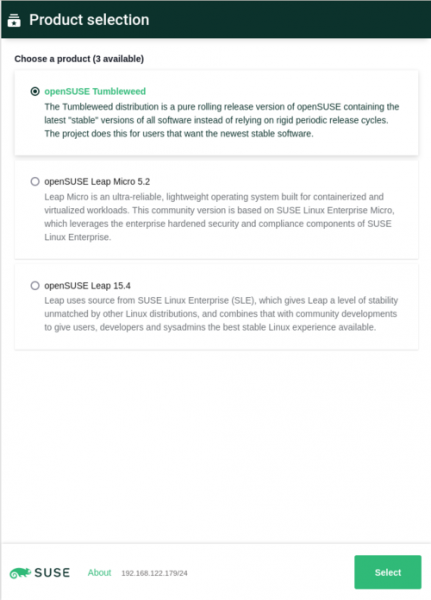
The new installer is notable for separating the user interface from the internal components of YaST and providing the possibility of using various front-ends, including a front-end for managing installations via a web interface. Libraries from YaST continue to be used for package installation, hardware checks, disk partitioning, and other necessary installation functions, with a layer implemented on top to abstract access to the libraries through a unified D-Bus interface.
The basic interface for managing installations is built using web technologies and includes a handler that provides access to D-Bus calls via HTTP, along with the web interface itself. The web interface is written in JavaScript using the React framework and PatternFly components. The service for binding the interface to D-Bus, as well as the built-in HTTP server, are written in Ruby and built using ready-made modules developed by the Cockpit project, which are also used in Red Hat web configurators. The installer uses a multiprocess architecture, ensuring that the user interface remains responsive while other tasks are being executed.
Among the goals of developing D-Installer is to eliminate existing limitations of the graphical interface, expand the use of YaST functionality in other applications, move away from reliance on a single programming language (the D-Bus API will allow extensions to be created in various languages), and encourage the creation of alternative configurations by community representatives.
Source: opennet.ru
