

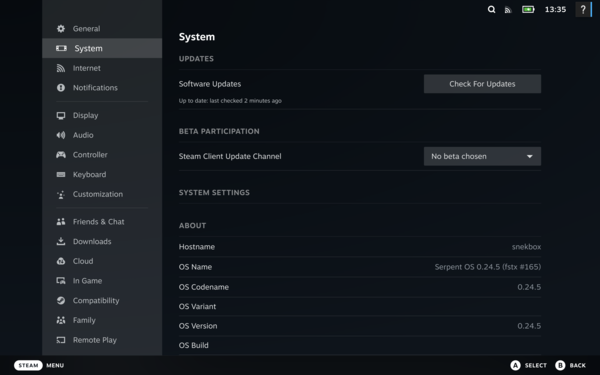
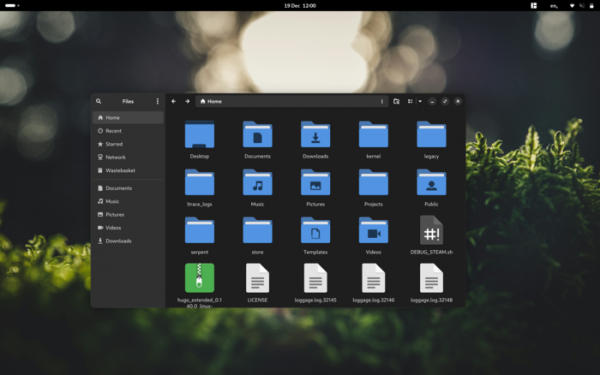
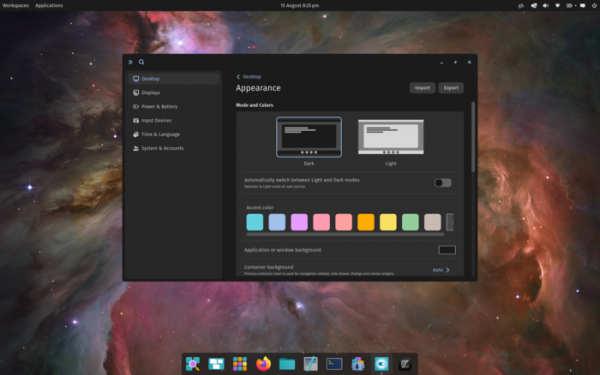
The first alpha release of the SerpentOS distribution has been announced, utilizing its own package manager, moss, and an atomic system update model. The developers present Serpent OS as the next step in the evolution of Linux distributions. The project is developed by the original team behind the Solus distribution, which includes Ikey Doherty, the creator of Solus, and Joshua Strobl, a key developer of the Budgie desktop environment. The builds are created for the x86_64-v2 architecture and come with GNOME and COSMIC desktops.
The moss package manager uses its own Stone package format and provides tools for managing the system's state. Updates occur in an atomic manner by replacing the contents of the /usr partition. The distribution guarantees system integrity — in case of a failure during the update installation, the system reverts to its previous working state. Changes, except for the kernel and some system components, are applied on the fly without needing to reboot. To save disk space when storing multiple versions of packages, deduplication based on hard links is used.
The project also develops the Lichen installer, the boulder build system, control panel summit, the blsforme boot manager, and the moss-container system. The package manager and low-level utilities are written in Rust. The majority of packages, including the Linux kernel, are built using the Clang compiler. The standard library for C++ applications uses libc++ from the LLVM project.
Features of the Serpent OS alpha version:
- Additional patches for ASUS and Microsoft Surface devices have been added. A driver for the NVIDIA GPU (recompiled open-gpu-kernel-modules) has been added to the repository.
- A package for installing the Steam game delivery client has been added, along with mesa-32bit and nvidia-graphics-driver-32bit drivers for running 32-bit applications in a 64-bit environment.

- System components written in Rust have been utilized where possible: GNU coreutils utilities have been replaced with uutils, the sudo program has been replaced with sudo-rs, ntpd-rs is used instead of a process for synchronizing precise time, and the curl utility has been built with the rustls library and hyper HTTP backend (support for hyper was recently dropped by the Curl project due to lack of interest from developers).
- The default GNOME desktop environment includes the starship command line prompt. It features the zed code editor, loupe profiler, and an interface for monitoring system resources.
- The moss toolkit allows bypassing the ext4 file system limit of 65 thousand hard links per inode by creating new inodes for empty files. To prevent free space exhaustion on the boot partition (ENOSPC), it implements automatic cleanup of old files with kernels and initrd.
- The blsforme boot manager has been automated to handle the EFI System Partition and boot entries without manual intervention. Configuring kernel command line parameters has been simplified. The ability to generate multiple initrd images has been added.
- The lichen installer has a revamped user interface. There is now an option to choose the file system for the root partition — xfs, ext4, or f2fs.
- Package versions have been updated, including Linux kernel 6.12.6, Firefox 133.0.3, LLVM 18.1.8, GNOME 47.2, COSMIC 1.0.0_alpha4.
Source: opennet.ru
