

After almost two years since the formation of the last major branch, a stable release of the OpenMediaVault 7.0 distribution has been published, allowing for the quick deployment of network-attached storage (NAS). The OpenMediaVault project was founded in 2009 after a split among the developers of the FreeNAS distribution, resulting in the creation of a fork alongside the classic FreeNAS based on FreeBSD. The developers aimed to transition the distribution to the Linux kernel and Debian package base. Installation images for OpenMediaVault are prepared for the x86_64 architecture (981 MB).
The OpenMediaVault distribution prioritizes the expansion of support for embedded devices and the creation of a flexible system for installing plugins. Compared to FreeNAS, the mechanism for installing plugins has been significantly redesigned; instead of switching the entire firmware for updates, OpenMediaVault uses standard tools for updating individual packages along with a full installer, allowing users to select necessary components during installation.
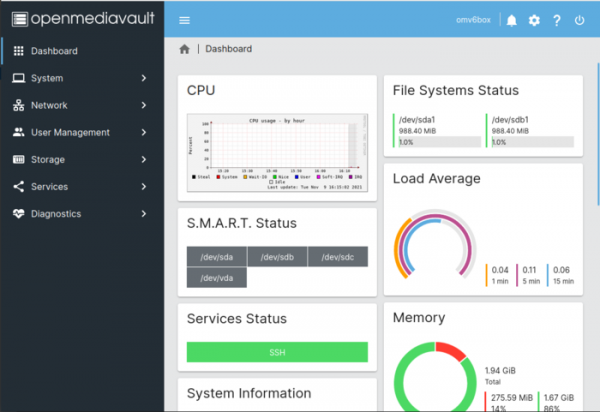
The OpenMediaVault web-based management interface is written in PHP and features data loading on demand using Ajax technology without page reloads (the FreeNAS web interface is written in Python using the Django framework). The interface includes features for data sharing and privilege separation (including ACL support). Monitoring can utilize SNMP (v1/2c/3), and there is also a built-in notification system for issues via email (including disk status tracking through S.M.A.R.T and UPS system monitoring).
Among the basic services related to storage organization are: SSH/SFTP, FTP, SMB/CIFS, DAAP client, RSync, BitTorrent client, NFS, and TFTP. The file systems that can be used include EXT3, EXT4, XFS, and JFS. Since OpenMediaVault is primarily focused on extending functionality through plugins, separate plugins are developed for AFP (Apple Filing Protocol) support, server BitTorrent, iTunes/DAAP server, LDAP, iSCSI target, UPS, LVM, and antivirus (ClamAV) support is provided. Software RAID (JBOD/0/1/5/6) can be created using mdadm.
Key innovations:
- The package base has been updated to Debian 12.
- For automatic updates and notifications of new version availability, the unattended-upgrades package is used. The cron-apt package has been replaced with unattended-upgrades and apticron. The apt-listchanges package is used to send statistics about automatically installed updates to email.
- Management of software RAID (mdadm) has been moved to a separate plugin.
- Added the ability to use persistent Ethernet interface names ('enbX') defined through Device Tree.
- Support for authenticating RPC calls using the X-OPENMEDIAVAULT-SESSIONID header instead of a Cookie has been added.
- A widget for displaying the temperature of all drives has been added to the summary page of the web interface.
- In the web interface, when creating SSH keys, the option to choose between RSA and Ed25519 algorithms is provided. Support for importing DSA keys into SSH has been discontinued. Support for SSH keys based on the ed25519-sk algorithm has been added.
- The content of the Storage, Shared Folders, and ACL pages has been reorganized in the web interface.
- Improvements have been made to the application of quotas for file systems.
- The hdparm utility call has been replaced with a smartctl call (hdparm is no longer used).
Source: opennet.ru
