

The developers of the openSUSE project have released the atomically updatable distribution openSUSE Leap Micro 5.5, designed for creating microservices and as a base system for virtualization platforms and container isolation. Builds for x86_64 and ARM64 (Aarch64) architectures are available for download, provided both with an installer (Offline builds, size 2.1 GB) and as ready-to-boot images: 782 MB (pre-configured), 959 MB (with Real-Time kernel), and 1.1 GB. The images can run on Xen and KVM hypervisors or directly on hardware, including Raspberry Pi boards.
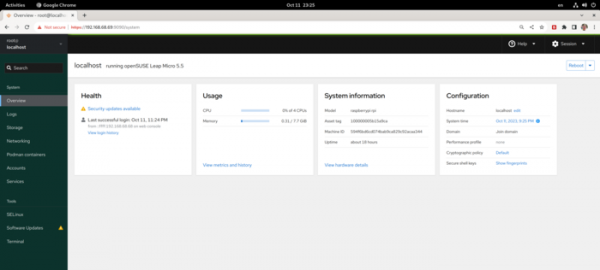
The openSUSE Leap Micro distribution is based on the MicroOS project and is positioned as a community version of the commercial SUSE Linux Enterprise Micro product, differing in the lack of a graphical interface. For configuration, the Cockpit web interface can be used, allowing system management through a browser, the cloud-init toolkit for passing settings at each boot, or Combustion for setting configurations during the first boot. Users are provided with tools for quickly switching from Leap Micro to SUSE SLE Micro, implying that a solution based on Leap Micro can initially be implemented for free, and if extended support or certification is required, the existing configuration can be transitioned to the SUSE SLE Micro product.
A key feature of Leap Micro is the atomic update mechanism, which automatically downloads and applies updates. Unlike atomic updates based on ostree and snap, used in Fedora and Ubuntu, openSUSE Leap Micro utilizes standard package management tools (the transactional-update utility) combined with Btrfs snapshot mechanisms (snapshots are used for atomic switching between the system state before and after installation of updates). In case of issues following the updates, the system can be rolled back to a previous state. Live patches are supported for updating the Linux kernel without rebooting and interrupting operations.
The root partition is mounted in read-only mode and does not change during operation. To launch isolated containers, an integrated toolkit with support for runtime Podman/CRI-O and Docker is included. A micro-edition of the distribution is used in the ALP (Adaptable Linux Platform) project to ensure the operation of the 'host OS' environment. In ALP, a trimmed 'host OS' is suggested for operation on the hardware, and all user space applications and components are executed not in a mixed environment but in separate containers or in virtual machines, executed over the 'host OS' and isolated from each other.
In the new release:
- System components have been updated to the package base of SUSE Linux Enterprise (SLE) Micro 5.5, based on SUSE SLE 15 Service Pack 5.
- Support for SELinux has been significantly expanded.
- Support for the podman-docker toolkit (which replicates Docker CLI through podman) and the hypervisor hyper-v has been added for systems based on the AArch64 architecture.
- The podman toolkit has been updated to version 4.4, which includes the quadlet utility for simplifying the deployment of system containers under systemd.
- Packages fwupdate and fwupdate-efi have been added for simplifying firmware updates.
- Images in QCOW (QEMU Copy On Write) format have been created for x86_64 and aarch64 architectures.
- The Cockpit web interface has been updated to version 298, with the cockpit-selinux module integrated for managing SELinux.

Source: opennet.ru
