

Proxmox, a company known for its Proxmox Virtual Environment and Proxmox Mail Gateway products, has released version 4.1 of the Proxmox Backup Server distribution, which is presented as a ready-made solution for backing up and restoring virtual environments, containers, and server content. The installation ISO image is available for free download. Distribution-specific components are open-sourced under the AGPLv3 license. For updates, both a paid Enterprise repository and two free repositories with different stabilization levels are available.
The system part of the distribution is based on the Debian package base and OpenZFS. The software stack for managing backups is written in Rust and supports incremental backups (only changed data is transferred to the server), deduplication (only one copy is kept if duplicates exist), compression (ZSTD is used), and encryption of backups. The system is designed based on a client-server architecture – Proxmox Backup Server can be used both for working with local backups and as a centralized server for backing up data from different hosts. It provides modes for fast selective recovery and data synchronization between servers.
Proxmox Backup Server supports integration with Proxmox VE for backup of of virtual machines and containers. Backup management and data recovery are conducted through a web interface. There is an option to restrict user access to their data. All traffic transmitted from clients to server is encrypted using AES-256 in GCM mode, and the backups themselves are transferred already encrypted using asymmetric encryption with public keys (encryption occurs on the client side, and compromising the server with backups will not lead to data leakage). The integrity of the backups is monitored using SHA-256 hashes.
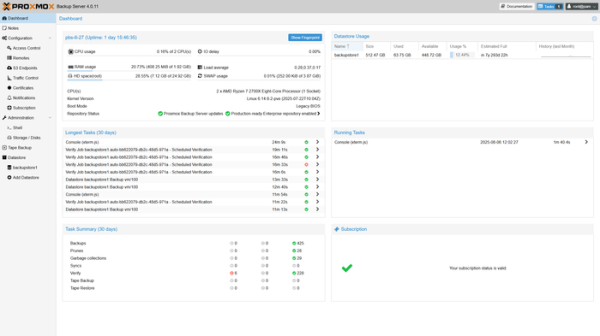
In the new release:
- Synchronization with the Debian distribution package base 13.2 has been carried out. Updated to Linux kernel 6.17.2 and OpenZFS 2.3.4.
- Bandwidth management has been provided to limit traffic when transferring backups over the network, linked to the user who initiated the backup (previously, limits could be set based on subnets).
- The ability to configure the number of simultaneous integrity check tasks for backups has been added for optimal utilization of available system resources.
- Preliminary support for limiting data exchange intensity with AWS S3-based storage has been added to reduce the negative impact of backup transfers on other tasks.
- The web interface has been optimized for optimal operation on high-resolution screens.
- Support for automatic unmounting of externally connected storage after data synchronization has been implemented (the system can now be configured so that when a drive is connected, the data synchronization process starts automatically, and after synchronization is completed, the drive is automatically unmounted).
Source: opennet.ru
