

The release of the ELKS 0.8 project (Embeddable Linux Kernel Subset) has been published, which develops a Linux-like operating system for 16-bit Intel 8086, 8088, 80188, 80186, 80286 processors and NEC V20/V30. The OS can be used on old IBM-PC XT/AT computers, the domestic MK-88 computer, the vintage Monotech NuXT 2.0 board, and on SBC/SoC/FPGA devices that replicate the IA16 architecture. The project has been in development since 1995 and started as a fork of the Linux kernel for devices without a memory management unit (MMU). The source code is distributed under the GPLv2 license. The system is provided in the form of images for writing to floppy disks or running in the QEMU emulator.
In addition to the Linux kernel tailored for 16-bit systems, the project is developing a set of standard utilities (ps, bc, tar, du, diff, netstat, mount, sed, xargs, grep, find, telnet, meminfo, etc.), including a bash-compatible command interpreter, the screen console window manager, text editors Kilo and vi, and a graphical environment based on the X server Nano-X.
Two options for the network stack are offered—the default TCP/IP stack of the Linux kernel and the ktcp stack, which operates in user space. Supported network cards include Ethernet adapters compatible with NE2K and SMC. Channels can also be created via a serial port using SLIP and CSLIP. Supported file systems include Minix v1, FAT12, FAT16, and FAT32. Boot process configuration is handled via the script /etc/rc.d/rc.sys. The executable file format is borrowed from the Minix OS.
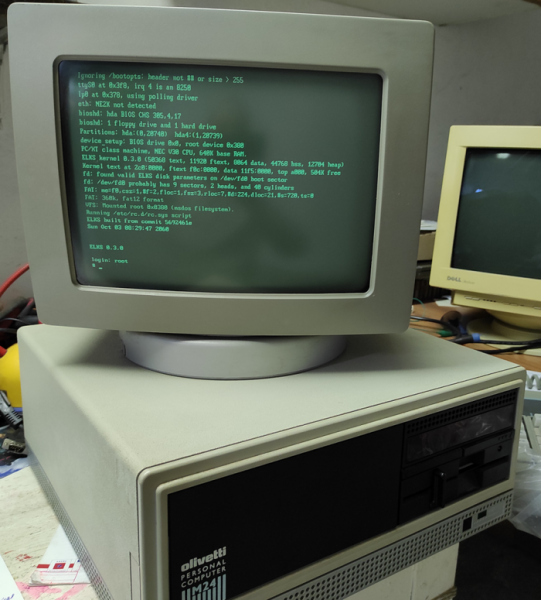
In the new release:
- Added the ability to load and run files in OS/2 executable format.
- Provided the capability to build programs with the Open Watcom C compiler.
- The game Doom has been ported.
- Network adapters NE2K, WD, and 3COM are included in the default build.
- Executable file compression has been added, allowing more applications to fit into the floppy disk image.
- Support for asynchronous input/output has been implemented in the kernel.
- A new driver for disk drives has been added, utilizing asynchronous input/output and allowing other applications to run during I/O operations.
- During boot, kernel parameters such as heap size, number of tasks, inodes, and files are configured to allocate resources depending on memory size.
- Debugging capabilities have been enhanced, such as disassembler and tracing mechanisms for system calls and functions.
- Optimization of L1/L2 cache usage has been performed.
- Functions for precise time measurement have been added.
- Commands ttyclock, ttypong, ttytetris, and md5/md5sum have been ported from other systems.
- The sysctl system call and related command have been added.
Source: opennet.ru
