

A new version of Delta Chat 1.22 has been released — a messenger that uses email as a transport instead of its own servers (chat-over-email, a specialized email client that functions as a messenger). The application code is distributed under the GPLv3 license, and the core library is available under the MPL 2.0 (Mozilla Public License). The release is available on Google Play and F-Droid. A similar version for desktop is delayed.
In the new version:
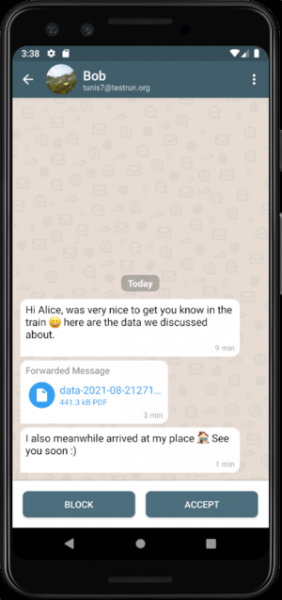
- The process of interacting with people not in the address book has been significantly improved. If a person not in the address book sends a message or adds a user to a group, the specified user now receives a chat request that requires them to accept or decline further communication. The request may include elements of ordinary messages (attachments, images) and is displayed directly in the chat list but is marked with a special label. If accepted, the request transforms into a separate chat. The request can be pinned prominently or moved to the archive for easy return to the conversation.

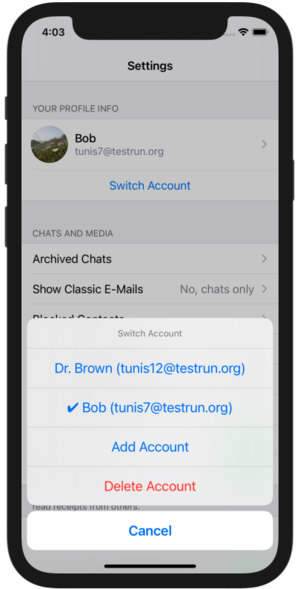
- The implementation of support for multiple Delta Chat accounts (Multi-Account) within a single application has been transitioned to a new unified handler for all platforms, enabling parallel work with accounts (switching between accounts is now instantaneous). The handler also allows for background operations connecting to groups. In addition to builds for Android and desktop systems, the ability to use multiple accounts has also been implemented in the version for the iOS platform.

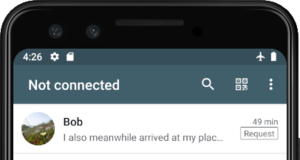
- The top panel now displays the connection status, allowing for a quick assessment of connection issues due to network problems. Clicking on the header brings up a dialog with more detailed information about the reasons for the lack of connection, such as the data transmitted by the provider regarding traffic quotas.

Note that Delta Chat does not use its own servers and can work with virtually any mail server that supports SMTP and IMAP (the Push-IMAP technique is used for quickly detecting new messages). It supports encryption using OpenPGP and the Autocrypt standard for simple automatic configuration and key exchange without the need for keys (the key is automatically transmitted in the first sent message). servers The implementation of end-to-end encryption is based on the rPGP code, which underwent an independent security audit this year. The traffic is encrypted using TLS in the implementation of standard system libraries.
Delta Chat is fully controlled by the user and is not tied to centralized services. No registration with new services is required — an existing email can be used as an identifier. If a correspondent does not use Delta Chat, they can read the message as a regular letter. Spam is mitigated by filtering out messages from unknown users (by default, only messages from users in the address book and those to whom messages have previously been sent are displayed, as well as responses to one's own messages). Attachments and attached images and videos can be displayed.
Group chats are supported, allowing multiple participants to communicate. There is the possibility of linking a verifiable list of participants to the group, preventing outsiders from reading messages (participants are verified via a cryptographic signature, and messages are encrypted using end-to-end encryption). Connection to verified groups is done through an invitation sent with a QR code.
The core of the messenger is developed separately in the form of a library and can be used to write new clients and bots. The current version of the base library is written in Rust (the old version was written in C). There are bindings for Python, Node.js, and Java. Unofficial bindings for Go are in development. There exists DeltaChat for libpurple, which can use both the new Rust core and the old C core.
Source: opennet.ru
