

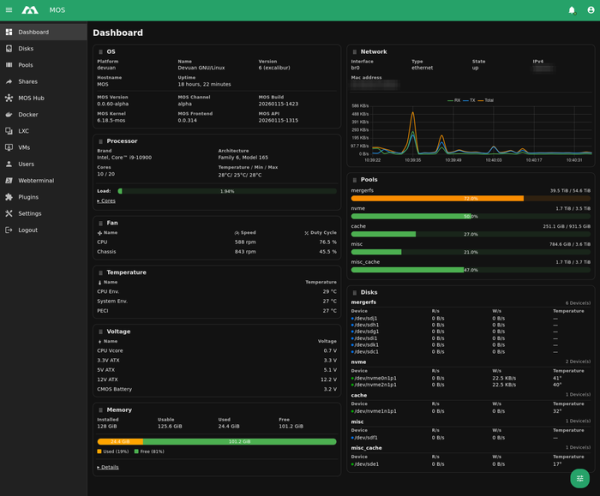
The MOS project develops a lightweight modular Linux distribution based on Devuan Linux, aimed at managing home servers. The project was initially developed "for itself" but later expanded beyond a personal use system and was released as open source. The current version 0.1.9-beta supports booting in UEFI mode only. Images are prepared for installation on USB drives (354 MB) and for running in virtualization systems (348 MB).
MOS is positioned as a general-purpose server OS with a web interface. The architecture is built on an API-first principle: the web interface acts merely as a client to the backend's REST API, with all operations performed by server services. WebSockets are used for real-time notifications. Developments are distributed under the AGPLv3 license. The project does not collect telemetry or send data externally. Minimum requirements for operation in a VM: 2 CPU cores and 6 GB of RAM.
Out of the box, MOS includes support for mergerfs to combine multiple disks into a single pool and SnapRAID for data protection through parity checks based on snapshots (a popular combination for home media servers that does not require traditional RAID). Additional storage drivers and hardware drivers (GPU, DVB) are connected through a plugin system. A catalog of plugins and templates is available through the MOS Hub component.
Containerization is implemented through Docker and LXC, while virtualization is managed via QEMU (the frontend for VMs is under development, though the API is nearly fully functional). Services can be activated and deactivated separately, allowing for a minimalist base installation. A dedicated notification service written in Go (MOS Notify) has been developed. Authentication is token-based, and TLS and reverse proxy are recommended for use outside isolated networks.
Source: opennet.ru
