

The Eclipse community has presented the Jakarta EE 11 platform. Jakarta EE has replaced Java EE (Java Platform, Enterprise Edition) following the transfer of the specification development processes, TCK, and reference implementation to the Eclipse Foundation, a non-profit organization. The platform has continued its evolution under a new name as Oracle only transferred the technologies and project management, but did not grant Eclipse community rights to the Java trademark.
Among the changes in the new version:
- The tests for compatibility assessment — TCK (Test Compatibility Kits) — have been modernized and restructured. The transition from Apache Ant and Java Test Harness to JUnit 5 and Apache Maven has been completed.
- A new component, Jakarta Data 1.0, has been included, providing an API to simplify database access. Interfaces such as BasicRepository and CrudRepository for accessing Jakarta Data repositories, a Pagination interface for accessing distinct data batches, and a simplified query language are offered.
- Support for Java SE 21 has been added, along with new features from this branch, such as virtual threads.
- In Jakarta Persistence 3.2, the ability to mark Java SE record templates as @Embeddable or @IdClass has been added. Automatic mapping of java.time.Instant and java.time.Year to built-in types has been provided.
- Jakarta Validation 3.1 has introduced support for applying validation rules to record templates.
- In Persistence 3.2, java.util/java.sql, Date/Time/Timestamp/Calendar and @Temporal have been deprecated, with the recommendation to use the java.time API instead.
- Specifications for 16 Jakarta EE components have been updated: Authorization 3.0, Authentication 3.1, Concurrency 3.1, CDI 4.1, Expression Language 6.0, Faces 4.1, Security 4.0, Servlet 6.1, Persistence 3.2, Pages 4.0, WebSocket 2.2, Validation 3.1, RESTful Web Services 4.0, Annotations 3.0, Interceptors 2.2, and CDI Lite 4.1.
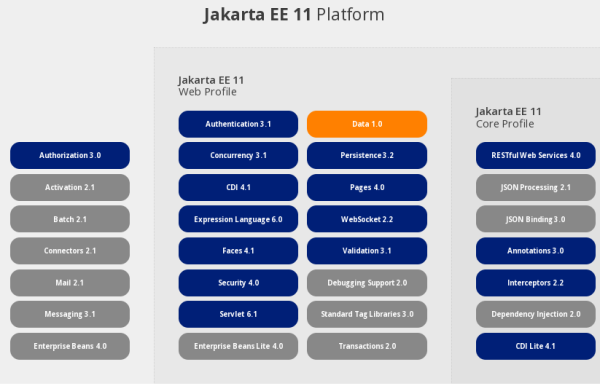
Source: opennet.ru
