

The release of OpenSilver 2.1 has been published, continuing the development of the Silverlight platform and enabling the creation of interactive web applications using C#, F#, XAML, and .NET technologies. Applications compiled with OpenSilver can run in any desktop and mobile browsers that support WebAssembly, but compilation is currently only possible on Windows using Visual Studio. The project code is written in C# and is distributed under the MIT license.
In 2021, Microsoft ceased the development and support of the Silverlight platform in favor of standard web technologies. Initially, the OpenSilver project aimed to provide tools to extend the life of existing Silverlight applications in light of Microsoft's discontinuation of platform support and the end of plugin support in browsers. OpenSilver supports all the main features of the Silverlight engine, including full support for C# and XAML languages, as well as the implementation of much of the platform API, sufficient for using C# libraries such as Telerik UI, WCF RIA Services, PRISM, and MEF.
In its current form, OpenSilver has already moved beyond a mere layer to extend the life of Silverlight and can be seen as a standalone platform for creating new applications. For example, the project is developing a development environment (add-in for Visual Studio), providing support for new versions of the C# language and the .NET platform, and offering compatibility with libraries in JavaScript.
OpenSilver is based on the code of open projects Mono (mono-wasm) and Microsoft Blazor (part of ASP.NET Core), and for execution in the browser, it compiles applications into WebAssembly intermediate code. OpenSilver continues the development of the CSHTML5 project, which allows compiling C#/XAML/.NET applications into a JavaScript representation suitable for running in a browser, and expands its codebase with capabilities to compile C#/XAML/.NET into WebAssembly rather than JavaScript.
Key improvements in OpenSilver 2.1:
- Support has been added for the functional programming language F#, which can be used in conjunction with the XAML markup language within a single project to build complex user interfaces.
- The original set of examples 'Silverlight Toolkit Samples' supplied by Microsoft has been adapted for use with OpenSilver.
- Support for customizable themes has been added. The package includes 12 themes ported from the Silverlight Toolkit.
- More than 100 small applications written in F# have been added to the gallery of application examples.
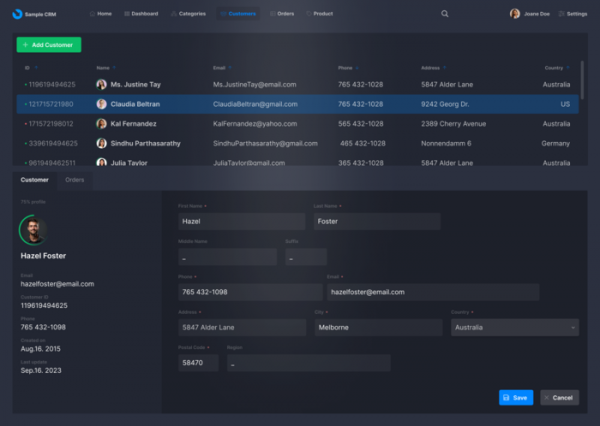
- The development of SampleCRM has continued, demonstrating a CRM system for managing customer interactions within a company and supporting sales operations.

- A preview version of the XR# framework has been proposed for using .NET and XAML in the development of 3D applications and augmented or virtual reality systems.
- The animation system has been redesigned with features for working with animations originally offered in Silverlight.
- The UIElement.Clip element has been enhanced to allow the use of any geometric objects.
- Performance optimization has been conducted.
Future plans include providing a visual design environment to create XAML interfaces in WYSIWYG mode, supporting additional WPF features, supporting 'Hot Reload' in XAML (applying code changes to a running application), LightSwitch support, improving integration with the VS Code editor, and integrating with the .NET MAUI (Multi-platform App UI) framework for creating hybrid applications that utilize native platform APIs.
Source: opennet.ru
