

The release of OpenSilver 3.0 has been presented, continuing the development of the Silverlight platform and allowing the creation of interactive web applications using C#, F#, XAML, and .NET technologies. Applications compiled with OpenSilver can run in any desktop and mobile browser that supports WebAssembly, but compilation is currently only possible on Windows using Visual Studio. The project's code is written in C# and distributed under the MIT license.
In 2021, Microsoft ceased the development and support of the Silverlight platform in favor of standard web technologies. Initially, the OpenSilver project aimed to provide tools to extend the life of existing Silverlight applications in light of Microsoft's discontinuation of platform support and the end of plugin support in browsers. OpenSilver supports all the main features of the Silverlight engine, including full support for C# and XAML languages, as well as the implementation of much of the platform API, sufficient for using C# libraries such as Telerik UI, WCF RIA Services, PRISM, and MEF.
In its current form, OpenSilver has already moved beyond a mere layer to extend the life of Silverlight and can be seen as a standalone platform for creating new applications. For example, the project is developing a development environment (add-in for Visual Studio), providing support for new versions of the C# language and the .NET platform, and offering compatibility with libraries in JavaScript.
OpenSilver is based on the code of open projects Mono (mono-wasm) and Microsoft Blazor (part of ASP.NET Core), and for execution in the browser, it compiles applications into WebAssembly intermediate code. OpenSilver continues the development of the CSHTML5 project, which allows compiling C#/XAML/.NET applications into a JavaScript representation suitable for running in a browser, and expands its codebase with capabilities to compile C#/XAML/.NET into WebAssembly rather than JavaScript.
In the new version:
- A visual interface builder has been proposed, allowing for the design of .NET application interfaces and websites in a drag-and-drop mode, using over 100 built-in interface blocks.
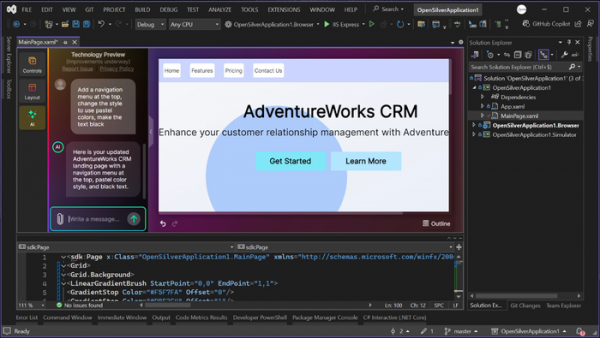
- An AI assistant has been added, allowing for the generation and modification of user interfaces using natural language commands. The user simply needs to describe desired changes in plain language or provide an image with a layout, and the AI assistant will update or generate XAML code on its own.

- Tools for integration with external integrated development environments have been expanded. Support for the Visual Studio Code code editor has been added.
- The XAML.io web application has been launched, allowing users to design user interfaces based on XAML from within the browser.
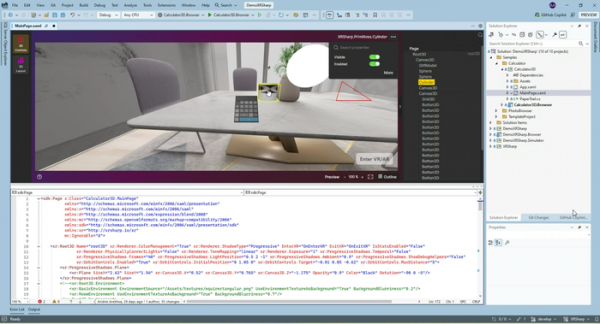
- A preliminary version of the XAML 3D toolkit has been proposed, allowing the creation of 3D websites and mixed reality applications that utilize WebXR and are compatible with various 3D headsets like Meta Quest and Apple Vision Pro.

Source: opennet.ru
